The First Punic War: How Rome and Carthage Went to War
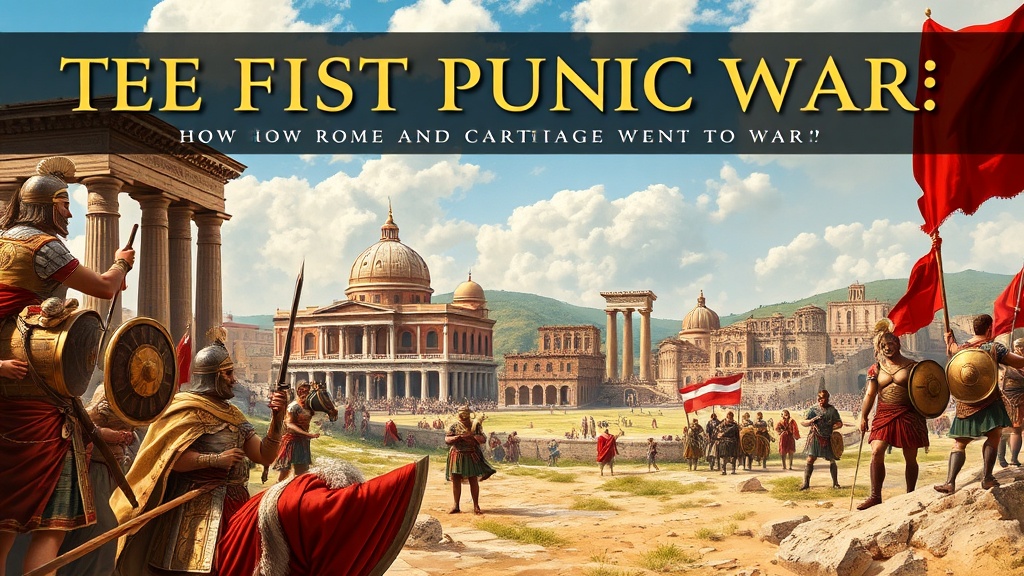
Quick Summary
Discover how a band of rogue mercenaries sparked the First Punic War between Rome and Carthage — and why this ancient rivalry changed the world forever.
In This Article
When Two Superpowers Were Always Going to Collide
There is a particular kind of war that historians call inevitable — the kind where two great powers spend decades circling each other, signing polite treaties, exchanging diplomatic pleasantries, and all the while knowing, deep in their bones, that it will end in blood. The First Punic War, which erupted in 264 BC and raged for more than two decades, was exactly that kind of war. It pitted the Mediterranean's two most ambitious civilisations against one another: Rome, the hungry young republic carving its name into the Italian peninsula with a gladius, and Carthage, the ancient trading empire whose wealth and naval mastery had made it the undisputed lord of the western seas.
What makes this conflict so endlessly fascinating is not just its scale — though 23 years of near-continuous warfare is staggering by any measure — but the sheer improbability of how it began, how it evolved, and what it demanded of both sides. Rome, a nation with virtually no naval tradition, was forced to reinvent itself mid-war. Carthage, wealthy and powerful, repeatedly failed to translate its advantages into decisive victory. And somewhere in between, the ancient world was irrevocably reshaped.
This is the story of how it started.
Carthage: The Empire That Built Its Throne on Water
To understand the First Punic War, you first have to understand what Carthage actually was — because it is one of history's great underappreciated civilisations, largely because Rome eventually won.
Carthage was founded around 814 BC by Phoenician settlers from the city of Tyre, on the coast of what is now Lebanon. The Phoenicians were the ancient world's great maritime traders, establishing colonies across the Mediterranean not for conquest, but for commerce. Carthage — called Qart Hadasht, meaning "New City" in Phoenician — began as one of those trade outposts. But over centuries, it grew into something far more formidable.
By the third century BC, Carthage controlled a vast commercial empire stretching across North Africa, Sardinia, Corsica, and much of Sicily. Its navy was the most powerful in the western Mediterranean. Its merchants traded in gold, ivory, textiles, and slaves across routes that stretched from West Africa to the British Isles. The city itself, located near modern-day Tunis in Tunisia, was one of the largest and wealthiest in the ancient world, with a population estimated at several hundred thousand people.
Like Rome, Carthage was a republic of sorts — it had a senate, magistrates called suffetes, and a general assembly of citizens. But its culture was decisively different. Where Rome glorified the farmer-soldier, the man who worked his land and bled for his republic, Carthage celebrated the merchant-admiral. Military service was often outsourced to mercenaries, reflecting a pragmatic, commercially minded outlook on warfare that would later prove to be both a strength and a fatal weakness.
There were also darker dimensions to Carthaginian culture that ancient sources — admittedly, mostly hostile Roman ones — describe at length. Archaeological evidence at the tophet site in Carthage has fuelled centuries of debate about whether the Carthaginians practised child sacrifice to their god Ba'al Hammon. The evidence remains contested among modern scholars, but it coloured Roman perceptions of their enemy as barbarous and godless, a propaganda advantage Rome would exploit ruthlessly.
Rome in 264 BC: Dangerous, Ambitious, and Not Yet Done Growing
Rome in the mid-third century BC was not yet the empire that would eventually swallow the known world. But it was already extraordinarily dangerous — a republic forged in centuries of brutal internal conflict and relentless external warfare that had, by 264 BC, brought the entire Italian peninsula under its control.
The Romans had defeated the Latin League, the Samnites, the Etruscans, and the Greek colonies of southern Italy. In doing so, they had developed a military system of extraordinary adaptability and resilience — the manipular legion, capable of fighting in broken terrain where the rigid Greek phalanx would collapse. They had also developed something equally important: a political culture that practically demanded expansion.
Rome's republican constitution was designed, above all else, to prevent the rise of a king — a tyrant who might undo the republic as the Tarquin kings had supposedly done before their expulsion in 509 BC. To this end, executive power was divided between two Consuls, elected annually, who shared command and could veto each other. It was a system brilliantly designed to prevent autocracy. It was also a system that, entirely by accident, created an engine of perpetual war.
Because a Consul served for only one year, every ambitious Roman aristocrat who reached that office knew he had twelve months to accomplish something worth carving into stone. Military victory brought gloria, dignitas, and auctoritas — the currency of Roman political life. A successful general could expect a triumph, the ultimate public honour, and the lasting fame that came with it. The result was a political class constitutionally incentivised to find wars, start wars, and win wars. It was not aggression for aggression's sake. It was aggression as a structural feature of republican competition.
This is the Rome that looked across the Strait of Messina at Sicily in 264 BC — hungry, capable, and, crucially, never quite satisfied with the territory it already held.
The Mamertines: How Mercenary Madness Lit the Fuse of the First Punic War
The proximate cause of the First Punic War was, by the grand standards of geopolitical conflict, almost comically small. It began with a group of Italian mercenaries called the Mamertines — "Sons of Mars" — who had been employed by Agathocles, the tyrant of Syracuse in Sicily. When Agathocles died around 289 BC and his successor dismissed them, the Mamertines found themselves unemployed, battle-hardened, and disinclined to simply go home.
Instead, they did what dangerous men without employment have done throughout history: they found something to take. Invited as guests into the Sicilian city of Messana — modern Messina — they turned on their hosts, massacred the male population, seized their property, and installed themselves as the city's new rulers. For decades they raided the surrounding countryside, making themselves a persistent nuisance to everyone in the region, particularly to Syracuse.
When Syracuse finally moved to crush them militarily, the Mamertines did something audacious: they sent simultaneous appeals for help to both Carthage and Rome. Carthage responded first, sending a garrison to Messana. But a faction among the Mamertines, uneasy about their new Carthaginian protectors, continued to press their appeal to Rome.
The Roman Senate debated. Going to war over a city of mercenary brigands, on an island they had never before set foot upon, against the most powerful naval empire in the western Mediterranean — it was, objectively, a reckless proposition. And yet the debate was resolved not by cool strategic calculation, but by the very political logic that had been baked into Rome's constitution. The Consuls of 264 BC saw Sicily, and beyond it, glory. The people voted for war. And Rome crossed the water for the first time.
The Naval Problem: Rome's Greatest Strategic Crisis
The early land engagements in Sicily went broadly in Rome's favour. After the initial confrontation at Messana, which sent the Carthaginian garrison retreating in confusion, Rome found that Sicilian towns were willing to switch allegiance to a winner. By 262 BC, the Romans were besieging the major Carthaginian stronghold of Agrigentum, and though the campaign was horrifically costly — both sides suffering extraordinary losses to starvation and attrition before a final pitched battle — Rome eventually prevailed.
But Sicily was an island. And that simple geographical fact presented Rome with the most acute strategic problem it had ever faced.
Carthage's navy was not merely good — it was the product of centuries of accumulated maritime expertise. The Carthaginian quinquireme, a warship powered by five banks of oars and crewed by highly trained rowers, was among the most formidable weapons systems of the ancient world. Carthage used its naval dominance to resupply its Sicilian garrisons at will, to raid Italian coastlines, and to threaten Roman supply lines. Without a comparable navy, Rome could not win the war. It could win every land battle on the island and still lose, strangled by Carthaginian control of the sea.
What Rome did next is one of the most remarkable episodes in military history. According to ancient sources — primarily Polybius, our most detailed account of the war — the Romans found a wrecked Carthaginian quinquireme that had run aground on Italian shores. They used it as a template, reverse-engineering the design and constructing an entirely new war fleet of 120 vessels in approximately two months. Simultaneously, they trained rowing crews on land, using benches arranged to simulate the feel of oars on water.
Modern historians debate the precise timeline and the extent of Rome's prior naval experience — some argue the Romans must have had at least some seafaring capability to defend their coastline, and that the story of copying from a single captured ship is probably simplified. But the essential truth holds: within an astonishingly short period, Rome built a competitive war fleet from very limited foundations. The organisational capacity this required — the logistics, the timber supply, the coordination of skilled craftsmen, the recruitment and training of tens of thousands of oarsmen — was itself a feat of republican governance that deserves far more attention than it typically receives.
The fleet's first test, however, was humbling. The Consul Gnaeus Cornelius Scipio, sailing ahead of the main fleet to the island of Lipara, blundered into a Carthaginian trap and was captured — earning the ignominious nickname Asina, meaning donkey. Raw ships and inexperienced crews, however numerous, could not instantly match the instinctive seamanship that Carthaginian sailors had developed over generations.
Free Weekly Newsletter
Enjoying this guide?
Get the best articles like this one delivered to your inbox every week. No spam.
Rome would need something more than ships. It would need a way to turn a naval battle into something that looked, from a Roman perspective, reassuringly like a land battle.
Why the First Punic War Still Matters
It would be easy to treat the First Punic War as a distant curiosity — a conflict between civilisations that no longer exist, fought over an island most people only think about in the context of holiday bookings. But the war's consequences were genuinely world-historical in their reach.
The conflict forced Rome to become a naval power — a transformation that opened the entire Mediterranean basin to Roman ambition. Without the First Punic War, there is no Roman conquest of the western Mediterranean, no eventual subjugation of Greece and the Hellenistic east, and arguably no Roman Empire in any recognisable form. The war also inflicted deep psychological wounds on Carthage that shaped the catastrophic Second Punic War — the one that brought Hannibal Barca and his elephants across the Alps into Italy.
More broadly, the First Punic War is a masterclass in how great power conflicts are actually triggered. It was not started by a grand strategic decision in Carthage or Rome. It was started by a group of mercenaries who massacred a city and then called for help when the consequences caught up with them. The superpowers were pulled in by local actors pursuing local interests — and once in, neither side could afford to back down without losing face, territory, and ultimately security.
That dynamic — local crisis escalating into superpower confrontation — is not an ancient phenomenon. It is the grammar of geopolitical conflict across history. Recognising it in 264 BC makes it considerably easier to recognise elsewhere.
The Romans and Carthaginians were not simply enemies. They were two fundamentally different answers to the question of how a civilization should be built — one through the sword and the plough, one through the sail and the ledger. The First Punic War was, in its deepest sense, a clash of civilisational models. And the world we inherited was shaped by which one won.
Frequently Asked Questions
What caused the First Punic War?
The First Punic War (264–241 BC) was triggered when the Mamertines, a group of Italian mercenaries who had seized the Sicilian city of Messana, appealed simultaneously to both Carthage and Rome for protection against Syracuse. Carthage sent troops first, but Rome ultimately intervened, crossing into Sicily for the first time. This intervention collided with Carthage's long-standing strategic interests in the island, escalating quickly into full-scale war.
Why was Sicily so important to both Rome and Carthage?
Sicily was the largest island in the Mediterranean and sat at a critical strategic crossroads between the western and eastern halves of the sea. For Carthage, it represented centuries of investment, trade routes, and the desire to dominate the entire western Mediterranean. For Rome, controlling Sicily meant neutralising a potential threat on its doorstep and opening a new theatre for the expansion that its political culture constantly demanded. Whoever controlled Sicily effectively controlled the central Mediterranean.
How did Rome build a navy so quickly?
Ancient sources, particularly the historian Polybius, claim that Rome reverse-engineered a captured Carthaginian quinquireme that had run aground on Italian shores and used the design to construct a fleet of around 120 warships in roughly two months. Rowers were trained on land using simulated benches. While modern historians debate the precise details and suggest Rome likely had some prior naval capability, the rapid construction of a war fleet on this scale was an extraordinary logistical and organisational achievement.
What were the key differences between the Roman and Carthaginian military systems?
Rome's military was built around the citizen-soldier — men who farmed in peacetime and fought in defence of the republic. Its Consuls were politically rewarded for military aggression and victory, making Roman commanders bold and offensive-minded. Carthage, by contrast, relied heavily on mercenary forces and professional soldiers, and its generals faced brutal punishment — including crucifixion — for failure, which encouraged caution and restraint. This asymmetry in risk and reward shaped the tactical character of both armies throughout the Punic Wars.
What does 'Punic' mean?
The word 'Punic' derives from the Latin Punicus, which was the Roman term for the Phoenicians and their descendants. Since Carthage was founded as a Phoenician colony, the Romans referred to its people as Punic. The three wars fought between Rome and Carthage between 264 and 146 BC are therefore known collectively as the Punic Wars.
Frequently Asked Questions
When Two Superpowers Were Always Going to Collide
There is a particular kind of war that historians call inevitable — the kind where two great powers spend decades circling each other, signing polite treaties, exchanging diplomatic pleasantries, and all the while knowing, deep in their bones, that it will end in blood. The First Punic War, which erupted in 264 BC and raged for more than two decades, was exactly that kind of war. It pitted the Mediterranean's two most ambitious civilisations against one another: Rome, the hungry young republic carving its name into the Italian peninsula with a gladius, and Carthage, the ancient trading empire whose wealth and naval mastery had made it the undisputed lord of the western seas.
What makes this conflict so endlessly fascinating is not just its scale — though 23 years of near-continuous warfare is staggering by any measure — but the sheer improbability of how it began, how it evolved, and what it demanded of both sides. Rome, a nation with virtually no naval tradition, was forced to reinvent itself mid-war. Carthage, wealthy and powerful, repeatedly failed to translate its advantages into decisive victory. And somewhere in between, the ancient world was irrevocably reshaped.
This is the story of how it started.
Carthage: The Empire That Built Its Throne on Water
To understand the First Punic War, you first have to understand what Carthage actually was — because it is one of history's great underappreciated civilisations, largely because Rome eventually won.
Carthage was founded around 814 BC by Phoenician settlers from the city of Tyre, on the coast of what is now Lebanon. The Phoenicians were the ancient world's great maritime traders, establishing colonies across the Mediterranean not for conquest, but for commerce. Carthage — called Qart Hadasht, meaning "New City" in Phoenician — began as one of those trade outposts. But over centuries, it grew into something far more formidable.
By the third century BC, Carthage controlled a vast commercial empire stretching across North Africa, Sardinia, Corsica, and much of Sicily. Its navy was the most powerful in the western Mediterranean. Its merchants traded in gold, ivory, textiles, and slaves across routes that stretched from West Africa to the British Isles. The city itself, located near modern-day Tunis in Tunisia, was one of the largest and wealthiest in the ancient world, with a population estimated at several hundred thousand people.
Like Rome, Carthage was a republic of sorts — it had a senate, magistrates called suffetes, and a general assembly of citizens. But its culture was decisively different. Where Rome glorified the farmer-soldier, the man who worked his land and bled for his republic, Carthage celebrated the merchant-admiral. Military service was often outsourced to mercenaries, reflecting a pragmatic, commercially minded outlook on warfare that would later prove to be both a strength and a fatal weakness.
There were also darker dimensions to Carthaginian culture that ancient sources — admittedly, mostly hostile Roman ones — describe at length. Archaeological evidence at the tophet site in Carthage has fuelled centuries of debate about whether the Carthaginians practised child sacrifice to their god Ba'al Hammon. The evidence remains contested among modern scholars, but it coloured Roman perceptions of their enemy as barbarous and godless, a propaganda advantage Rome would exploit ruthlessly.
Rome in 264 BC: Dangerous, Ambitious, and Not Yet Done Growing
Rome in the mid-third century BC was not yet the empire that would eventually swallow the known world. But it was already extraordinarily dangerous — a republic forged in centuries of brutal internal conflict and relentless external warfare that had, by 264 BC, brought the entire Italian peninsula under its control.
The Romans had defeated the Latin League, the Samnites, the Etruscans, and the Greek colonies of southern Italy. In doing so, they had developed a military system of extraordinary adaptability and resilience — the manipular legion, capable of fighting in broken terrain where the rigid Greek phalanx would collapse. They had also developed something equally important: a political culture that practically demanded expansion.
Rome's republican constitution was designed, above all else, to prevent the rise of a king — a tyrant who might undo the republic as the Tarquin kings had supposedly done before their expulsion in 509 BC. To this end, executive power was divided between two Consuls, elected annually, who shared command and could veto each other. It was a system brilliantly designed to prevent autocracy. It was also a system that, entirely by accident, created an engine of perpetual war.
Because a Consul served for only one year, every ambitious Roman aristocrat who reached that office knew he had twelve months to accomplish something worth carving into stone. Military victory brought gloria, dignitas, and auctoritas — the currency of Roman political life. A successful general could expect a triumph, the ultimate public honour, and the lasting fame that came with it. The result was a political class constitutionally incentivised to find wars, start wars, and win wars. It was not aggression for aggression's sake. It was aggression as a structural feature of republican competition.
This is the Rome that looked across the Strait of Messina at Sicily in 264 BC — hungry, capable, and, crucially, never quite satisfied with the territory it already held.
The Mamertines: How Mercenary Madness Lit the Fuse of the First Punic War
The proximate cause of the First Punic War was, by the grand standards of geopolitical conflict, almost comically small. It began with a group of Italian mercenaries called the Mamertines — "Sons of Mars" — who had been employed by Agathocles, the tyrant of Syracuse in Sicily. When Agathocles died around 289 BC and his successor dismissed them, the Mamertines found themselves unemployed, battle-hardened, and disinclined to simply go home.
Instead, they did what dangerous men without employment have done throughout history: they found something to take. Invited as guests into the Sicilian city of Messana — modern Messina — they turned on their hosts, massacred the male population, seized their property, and installed themselves as the city's new rulers. For decades they raided the surrounding countryside, making themselves a persistent nuisance to everyone in the region, particularly to Syracuse.
When Syracuse finally moved to crush them militarily, the Mamertines did something audacious: they sent simultaneous appeals for help to both Carthage and Rome. Carthage responded first, sending a garrison to Messana. But a faction among the Mamertines, uneasy about their new Carthaginian protectors, continued to press their appeal to Rome.
The Roman Senate debated. Going to war over a city of mercenary brigands, on an island they had never before set foot upon, against the most powerful naval empire in the western Mediterranean — it was, objectively, a reckless proposition. And yet the debate was resolved not by cool strategic calculation, but by the very political logic that had been baked into Rome's constitution. The Consuls of 264 BC saw Sicily, and beyond it, glory. The people voted for war. And Rome crossed the water for the first time.
The Naval Problem: Rome's Greatest Strategic Crisis
The early land engagements in Sicily went broadly in Rome's favour. After the initial confrontation at Messana, which sent the Carthaginian garrison retreating in confusion, Rome found that Sicilian towns were willing to switch allegiance to a winner. By 262 BC, the Romans were besieging the major Carthaginian stronghold of Agrigentum, and though the campaign was horrifically costly — both sides suffering extraordinary losses to starvation and attrition before a final pitched battle — Rome eventually prevailed.
But Sicily was an island. And that simple geographical fact presented Rome with the most acute strategic problem it had ever faced.
Carthage's navy was not merely good — it was the product of centuries of accumulated maritime expertise. The Carthaginian quinquireme, a warship powered by five banks of oars and crewed by highly trained rowers, was among the most formidable weapons systems of the ancient world. Carthage used its naval dominance to resupply its Sicilian garrisons at will, to raid Italian coastlines, and to threaten Roman supply lines. Without a comparable navy, Rome could not win the war. It could win every land battle on the island and still lose, strangled by Carthaginian control of the sea.
What Rome did next is one of the most remarkable episodes in military history. According to ancient sources — primarily Polybius, our most detailed account of the war — the Romans found a wrecked Carthaginian quinquireme that had run aground on Italian shores. They used it as a template, reverse-engineering the design and constructing an entirely new war fleet of 120 vessels in approximately two months. Simultaneously, they trained rowing crews on land, using benches arranged to simulate the feel of oars on water.
Modern historians debate the precise timeline and the extent of Rome's prior naval experience — some argue the Romans must have had at least some seafaring capability to defend their coastline, and that the story of copying from a single captured ship is probably simplified. But the essential truth holds: within an astonishingly short period, Rome built a competitive war fleet from very limited foundations. The organisational capacity this required — the logistics, the timber supply, the coordination of skilled craftsmen, the recruitment and training of tens of thousands of oarsmen — was itself a feat of republican governance that deserves far more attention than it typically receives.
The fleet's first test, however, was humbling. The Consul Gnaeus Cornelius Scipio, sailing ahead of the main fleet to the island of Lipara, blundered into a Carthaginian trap and was captured — earning the ignominious nickname Asina, meaning donkey. Raw ships and inexperienced crews, however numerous, could not instantly match the instinctive seamanship that Carthaginian sailors had developed over generations.
Rome would need something more than ships. It would need a way to turn a naval battle into something that looked, from a Roman perspective, reassuringly like a land battle.
Why the First Punic War Still Matters
It would be easy to treat the First Punic War as a distant curiosity — a conflict between civilisations that no longer exist, fought over an island most people only think about in the context of holiday bookings. But the war's consequences were genuinely world-historical in their reach.
The conflict forced Rome to become a naval power — a transformation that opened the entire Mediterranean basin to Roman ambition. Without the First Punic War, there is no Roman conquest of the western Mediterranean, no eventual subjugation of Greece and the Hellenistic east, and arguably no Roman Empire in any recognisable form. The war also inflicted deep psychological wounds on Carthage that shaped the catastrophic Second Punic War — the one that brought Hannibal Barca and his elephants across the Alps into Italy.
More broadly, the First Punic War is a masterclass in how great power conflicts are actually triggered. It was not started by a grand strategic decision in Carthage or Rome. It was started by a group of mercenaries who massacred a city and then called for help when the consequences caught up with them. The superpowers were pulled in by local actors pursuing local interests — and once in, neither side could afford to back down without losing face, territory, and ultimately security.
That dynamic — local crisis escalating into superpower confrontation — is not an ancient phenomenon. It is the grammar of geopolitical conflict across history. Recognising it in 264 BC makes it considerably easier to recognise elsewhere.
The Romans and Carthaginians were not simply enemies. They were two fundamentally different answers to the question of how a civilization should be built — one through the sword and the plough, one through the sail and the ledger. The First Punic War was, in its deepest sense, a clash of civilisational models. And the world we inherited was shaped by which one won.
Frequently Asked Questions
What caused the First Punic War?
The First Punic War (264–241 BC) was triggered when the Mamertines, a group of Italian mercenaries who had seized the Sicilian city of Messana, appealed simultaneously to both Carthage and Rome for protection against Syracuse. Carthage sent troops first, but Rome ultimately intervened, crossing into Sicily for the first time. This intervention collided with Carthage's long-standing strategic interests in the island, escalating quickly into full-scale war.
Why was Sicily so important to both Rome and Carthage?
Sicily was the largest island in the Mediterranean and sat at a critical strategic crossroads between the western and eastern halves of the sea. For Carthage, it represented centuries of investment, trade routes, and the desire to dominate the entire western Mediterranean. For Rome, controlling Sicily meant neutralising a potential threat on its doorstep and opening a new theatre for the expansion that its political culture constantly demanded. Whoever controlled Sicily effectively controlled the central Mediterranean.
How did Rome build a navy so quickly?
Ancient sources, particularly the historian Polybius, claim that Rome reverse-engineered a captured Carthaginian quinquireme that had run aground on Italian shores and used the design to construct a fleet of around 120 warships in roughly two months. Rowers were trained on land using simulated benches. While modern historians debate the precise details and suggest Rome likely had some prior naval capability, the rapid construction of a war fleet on this scale was an extraordinary logistical and organisational achievement.
What were the key differences between the Roman and Carthaginian military systems?
Rome's military was built around the citizen-soldier — men who farmed in peacetime and fought in defence of the republic. Its Consuls were politically rewarded for military aggression and victory, making Roman commanders bold and offensive-minded. Carthage, by contrast, relied heavily on mercenary forces and professional soldiers, and its generals faced brutal punishment — including crucifixion — for failure, which encouraged caution and restraint. This asymmetry in risk and reward shaped the tactical character of both armies throughout the Punic Wars.
What does 'Punic' mean?
The word 'Punic' derives from the Latin Punicus, which was the Roman term for the Phoenicians and their descendants. Since Carthage was founded as a Phoenician colony, the Romans referred to its people as Punic. The three wars fought between Rome and Carthage between 264 and 146 BC are therefore known collectively as the Punic Wars.
About Zeebrain Editorial
Zeebrain publishes independent analysis of markets, investing, personal finance, and business. We disclose affiliate relationships, never accept payment for coverage, and fact-check all claims against primary sources. Read our editorial policy →
How this article was produced: Zeebrain articles are created with AI assistance from primary sources (including cited videos and market data) and reviewed under our editorial standards before publication. Spot an error? Tell us and we will correct it.
More from History & Mysteries



Related Guides
Keep exploring this topic
The First Punic War: How Rome Refused to Lose
History & Mysteries · First Punic War · Ancient Rome
The Second Punic War: How Rome Turned the Tide on Hannibal
History & Mysteries · Second Punic War · Hannibal Barca
The Second Punic War: How Hannibal Nearly Broke Rome
History & Mysteries · Second Punic War · Hannibal Barca
Why Mao Won the Chinese Civil War: The Full Story
History & Mysteries
Explore More Categories
Keep browsing by topic and build depth around the subjects you care about most.