How Space Toilets Work: The Messy History of Astronaut Hygiene
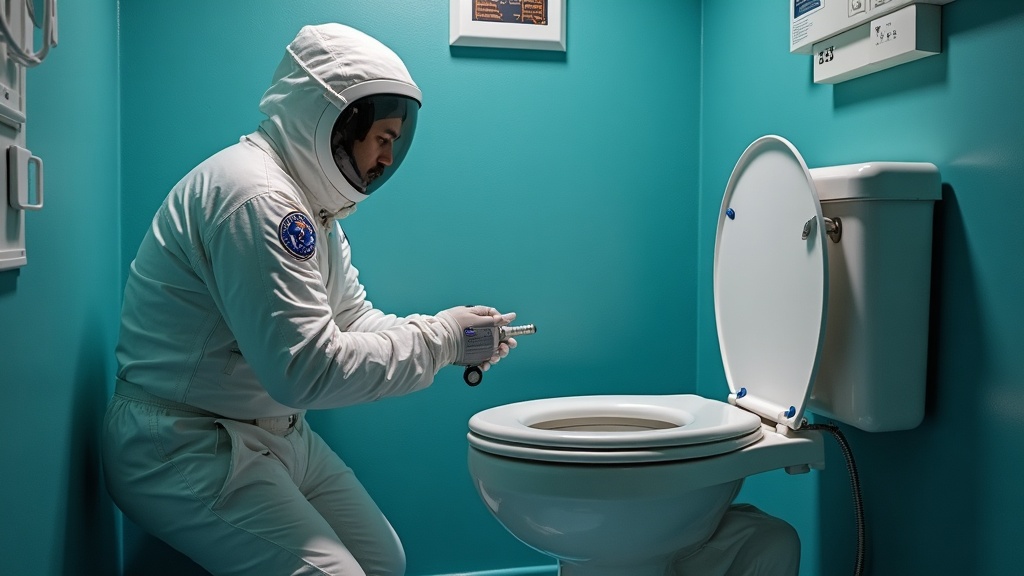
Quick Summary
From Alan Shepard urinating in his spacesuit to Buzz Aldrin's boot full of urine, discover the surprisingly complex history of how astronauts go to the bathroom in space.
In This Article
When Nature Calls at 187 Kilometres Up
At 8:15 a.m. on 5 May 1961, Alan Shepard — the man chosen to become the first American in space — was lying strapped inside a tiny Mercury capsule atop a Redstone rocket, and he desperately needed to use the bathroom. He had been sitting there for over three hours. Mission control had no answer for him. Nobody had thought to give him one.

That single, embarrassing oversight kicked off one of the most overlooked engineering challenges in the history of space exploration: how do you manage human waste in microgravity? The answer, it turns out, involves condoms, adult diapers, germicide packets, and at least one boot full of urine. The story of space toilets is equal parts ingenuity, indignity, and improvisation — and it tells us more about the realities of human spaceflight than almost any other chapter in the astronaut playbook.
The Problem Nobody Wanted to Solve
Before the space race began in earnest, very little thought had been given to astronaut bodily functions. The assumption, broadly speaking, was that missions would be short enough that the problem would simply not arise. NASA's own Dr Freeman H. Quimby captured this attitude perfectly in a 1961 reply to a curious schoolgirl who had written in to ask about space toilets. His response: the first spaceman was not expected to have to go.
That kind of optimism was not unique to NASA. Even the U.S. Air Force's U2 spy plane programme — which had been operating since the mid-1950s at altitudes requiring pilots to wear full pressure suits — struggled badly with urine collection. Early solutions included an indwelling catheter, a thin plastic tube threaded directly into the bladder, which was, predictably, both painful and prone to causing infections. A later external device using a condom-like latex sleeve was more comfortable, but a 2010 survey of U2 pilots found that 60% still reported problems including poor fit, leakage, and skin irritation.
Critically, due to the extreme secrecy surrounding the CIA-operated U2 programme, none of this hard-won knowledge was shared with NASA. The two institutions were, quite literally, reinventing the wheel — or at least the catheter.
Alan Shepard and the Accidental Breakthrough
Sephard's pre-launch predicament forced NASA's hand. With no usable collection device within reach and a hatch sealed by 70 bolts that would have taken the pad crew considerable time to unfasten, mission control initially refused his request to simply urinate in his suit, fearing the liquid would short out the biosensors monitoring his vital signs. When Shepard suggested they just switch the sensors off, they relented.
Owing to his reclined position, the urine pooled in the small of his back and soaked into his wool undergarment, where the cool pure oxygen circulating through the suit dried it out reasonably quickly. The countdown resumed, and Shepard launched at 9:34 a.m., reaching an altitude of 187.5 kilometres before splashing down in the Atlantic. The mission lasted 15 minutes and 22 seconds. The bathroom problem had lasted considerably longer.
In the immediate aftermath, NASA assigned engineer James McBarren to develop a reliable urine collection device (UCD) with BF Goodrich, the manufacturer of the Mercury spacesuits. When the company failed to produce a satisfactory design, McBarren took matters into his own hands — literally purchasing commercial condoms and testing them for fit and durability until he found one suitable for adaptation into a proper collection system. The final design featured an elasticised belt, a latex sleeve, a one-way valve, and a flat polyethylene collection bag. It was inelegant, but it worked.
The Legendary Sizing Problem (And What Actually Happened)
No account of early space hygiene would be complete without addressing what has become one of NASA's most enduring folklore stories: the condom sizing controversy. According to engineer Donald Rethke — apparently nicknamed 'Dr Flush' for his extensive work on astronaut waste systems — the original UCDs came in small, medium, and large. The problem was that no astronaut, regardless of anatomical reality, would accept anything other than a large. The solution, supposedly, was to rename the sizes to 'large', 'gigantic', and 'humongous'.
Apollo 11 astronaut Michael Collins repeated a version of this story in his 1974 autobiography, referring to sizes as 'extra large', 'immense', and 'unbelievable'. It is a great story. It is also, by most accounts, not quite true — or at least, not an official NASA policy.
Apollo 9 astronaut Rusty Schweickart offered a more grounded account: the astronauts learned quickly enough from experience what size actually worked for them. Too small and the condom would pinch off flow. Too large and you ended up wearing the contents. As Schweickart put it, that is the last time you make that mistake. The informal joke about heroic sizing names may well have circulated among the crew, but it was nature — not psychology — that enforced the correct choice.
The UCD first saw proper operational use during John Glenn's historic Mercury Atlas 6 mission on 20 February 1962. Over three orbits, Glenn used the device once, depositing 756 millilitres of urine — a figure that is over 30% above the average male bladder capacity. This is a direct consequence of microgravity: on Earth, gravity pulls urine to the bottom of the bladder, triggering nerve signals when it is about two-thirds full. In space, urine collects in a sphere and does not press the bladder walls until the organ is already well beyond its usual limit. Glenn's UCD has been on public display at the National Air and Space Museum in Washington, D.C., since 1970 — a monument to a very specific kind of engineering milestone.
Buzz Aldrin's Boot and the Apollo Era
During the Apollo programme, astronauts travelling to and from the Moon could connect their UCDs via a hose to an onboard urine transfer system, with most of the collected urine vented into space. During lunar surface operations, urine drained into a polyethylene bag worn beneath the spacesuit.
This arrangement gave rise to one of the more obscure footnotes in space history. Buzz Aldrin, the second person to walk on the Moon, holds the distinction of being the first human to urinate on the lunar surface — a fact he has acknowledged with some pride. However, the experience was not entirely without incident. Neil Armstrong's landing had been so gentle that the lunar module's legs failed to compress as designed, meaning the ladder sat higher than expected. When Aldrin jumped from the bottom rung to the surface, the jolt was greater than anticipated and damaged his UCD. For the entirety of the mission's two-hour, 31-minute lunar EVA, Aldrin was walking on the Moon with urine sloshing around in one of his boots.
The Apollo-era solution to solid waste — an altogether different and considerably more unpleasant challenge — was the fecal containment assembly (FCA), manufactured by the Whirlpool Corporation. This was, in essence, a clear plastic bag with an adhesive gasket designed to seal around the astronaut's bare buttocks. Because microgravity eliminates the natural separation that Earth's gravity provides, the bag included a small pouch through which the astronaut could insert a finger to assist the process. After use, wipes were added to the bag and sealed inside. The filled bags could not be jettisoned and had to be stored onboard. Without treatment, bacteria in the waste would produce gases — primarily methane — causing the bags to inflate and risk rupturing. Each FCA therefore came with a germicide packet that had to be kneaded into the contents to prevent fermentation. It was, by almost universal astronaut consensus, one of the most despised pieces of hardware in spaceflight history.
From Adult Diapers to the Space Station
The shift to the Space Shuttle era brought meaningful improvements, though perhaps not the ones you would expect. The first major change came in 1978 when NASA opened the astronaut corps to female candidates. The existing UCD was anatomically incompatible with half the population, prompting the development of the Disposable Absorbent Containment Trunk (DACT) — essentially a sophisticated adult nappy. These were first flown in April 1983 by the all-male crew of STS-6, the maiden Challenger mission, and two months later were worn by Sally Ride during STS-7, making her the first American woman in space.
NASA soon concluded that custom-fabricated DACTs were prohibitively expensive and switched to commercially available adult diapers known as Maximum Absorbency Garments, or MAGs. Introduced in 1988, MAGs contain sodium polyacrylate capable of absorbing up to two litres of fluid. They are still worn today under launch and re-entry suits and during spacewalks — because even with a functional toilet aboard the International Space Station, there is no bathroom in a spacesuit.
The ISS itself features two toilet systems — one in the US Orbital Segment and one in the Russian segment — both of which use airflow rather than gravity to direct waste. Urine is collected, processed, and converted back into drinking water via the station's water recovery system, a closed-loop process that recovers roughly 93% of wastewater. Solid waste is collected in sealed containers and eventually disposed of by loading onto resupply vehicles that burn up on re-entry. It is still not glamorous. But compared to a plastic bag and a finger pouch, it represents extraordinary progress.
Free Weekly Newsletter
Enjoying this guide?
Get the best articles like this one delivered to your inbox every week. No spam.
What Space Toilets Teach Us About Engineering
The history of space waste management is, at its core, a story about what happens when engineers are forced to solve problems that polite society would rather not discuss. Every advance — from McBarren's condom-based UCD to the MAG to the ISS water recovery system — came from someone being willing to sit down (metaphorically and sometimes literally) with an unglamorous problem and work through it methodically.
This matters beyond spaceflight. Technologies developed for astronaut waste management have influenced medical devices, absorbent materials used in neonatal care, and water purification systems in remote environments. The sodium polyacrylate now found in MAGs is the same material used in modern nappies and incontinence products worldwide. The closed-loop water systems developed for the ISS inform thinking about sustainable water management on Earth.
Space exploration has always generated breakthroughs in unexpected places. But perhaps none are quite as grounded — quite literally — as the ones that started with Alan Shepard asking permission to wet himself.
Frequently Asked Questions
How did astronauts go to the bathroom before space toilets existed?
Early astronauts used a combination of strategies including urine collection devices (UCDs) — latex sleeves connected to collection bags — low-residue pre-flight diets, and for solid waste, adhesive plastic bags known as fecal containment assemblies. These required manual handling and onboard storage since there was no mechanism to dispose of waste mid-flight.
Why did NASA start using adult diapers for astronauts?
NASA developed the Disposable Absorbent Containment Trunk (DACT) and later the Maximum Absorbency Garment (MAG) following the 1978 admission of female astronauts to the corps, whose anatomy was incompatible with the original condom-based urine collection device. MAGs are now standard issue for all astronauts during launch, re-entry, and spacewalks, when access to a toilet is not possible.
Is it true NASA renamed condom sizes to protect astronaut egos?
This story is more folklore than fact. While engineer Donald Rethke and astronaut Michael Collins both referenced informal name changes from 'small, medium, large' to more flattering alternatives, Apollo 9 astronaut Rusty Schweickart clarified that astronauts learned quickly from practical experience which size actually worked — getting it wrong had immediate and unpleasant consequences that overrode any ego-driven decision-making.
How do space toilets on the International Space Station work?
The ISS uses airflow instead of gravity to direct waste into collection systems. Urine is processed through the Water Recovery System, which converts it into potable water at roughly 93% efficiency. Solid waste is sealed in containers and eventually loaded onto departing cargo vehicles, which burn up in Earth's atmosphere on re-entry. Both the US and Russian segments of the station have their own toilet facilities.
Did Buzz Aldrin really urinate on the Moon?
Yes. Aldrin has confirmed that he was the first person to urinate on the lunar surface, doing so just before stepping off the lunar module ladder. However, Armstrong's unusually soft landing meant the ladder sat higher than expected, and the jolt of Aldrin's jump to the surface damaged his urine collection device — resulting in urine collecting in his boot rather than the designated bag for the duration of the two-and-a-half-hour moonwalk.
Frequently Asked Questions
When Nature Calls at 187 Kilometres Up
At 8:15 a.m. on 5 May 1961, Alan Shepard — the man chosen to become the first American in space — was lying strapped inside a tiny Mercury capsule atop a Redstone rocket, and he desperately needed to use the bathroom. He had been sitting there for over three hours. Mission control had no answer for him. Nobody had thought to give him one.
That single, embarrassing oversight kicked off one of the most overlooked engineering challenges in the history of space exploration: how do you manage human waste in microgravity? The answer, it turns out, involves condoms, adult diapers, germicide packets, and at least one boot full of urine. The story of space toilets is equal parts ingenuity, indignity, and improvisation — and it tells us more about the realities of human spaceflight than almost any other chapter in the astronaut playbook.
The Problem Nobody Wanted to Solve
Before the space race began in earnest, very little thought had been given to astronaut bodily functions. The assumption, broadly speaking, was that missions would be short enough that the problem would simply not arise. NASA's own Dr Freeman H. Quimby captured this attitude perfectly in a 1961 reply to a curious schoolgirl who had written in to ask about space toilets. His response: the first spaceman was not expected to have to go.
That kind of optimism was not unique to NASA. Even the U.S. Air Force's U2 spy plane programme — which had been operating since the mid-1950s at altitudes requiring pilots to wear full pressure suits — struggled badly with urine collection. Early solutions included an indwelling catheter, a thin plastic tube threaded directly into the bladder, which was, predictably, both painful and prone to causing infections. A later external device using a condom-like latex sleeve was more comfortable, but a 2010 survey of U2 pilots found that 60% still reported problems including poor fit, leakage, and skin irritation.
Critically, due to the extreme secrecy surrounding the CIA-operated U2 programme, none of this hard-won knowledge was shared with NASA. The two institutions were, quite literally, reinventing the wheel — or at least the catheter.
Alan Shepard and the Accidental Breakthrough
Sephard's pre-launch predicament forced NASA's hand. With no usable collection device within reach and a hatch sealed by 70 bolts that would have taken the pad crew considerable time to unfasten, mission control initially refused his request to simply urinate in his suit, fearing the liquid would short out the biosensors monitoring his vital signs. When Shepard suggested they just switch the sensors off, they relented.
Owing to his reclined position, the urine pooled in the small of his back and soaked into his wool undergarment, where the cool pure oxygen circulating through the suit dried it out reasonably quickly. The countdown resumed, and Shepard launched at 9:34 a.m., reaching an altitude of 187.5 kilometres before splashing down in the Atlantic. The mission lasted 15 minutes and 22 seconds. The bathroom problem had lasted considerably longer.
In the immediate aftermath, NASA assigned engineer James McBarren to develop a reliable urine collection device (UCD) with BF Goodrich, the manufacturer of the Mercury spacesuits. When the company failed to produce a satisfactory design, McBarren took matters into his own hands — literally purchasing commercial condoms and testing them for fit and durability until he found one suitable for adaptation into a proper collection system. The final design featured an elasticised belt, a latex sleeve, a one-way valve, and a flat polyethylene collection bag. It was inelegant, but it worked.
The Legendary Sizing Problem (And What Actually Happened)
No account of early space hygiene would be complete without addressing what has become one of NASA's most enduring folklore stories: the condom sizing controversy. According to engineer Donald Rethke — apparently nicknamed 'Dr Flush' for his extensive work on astronaut waste systems — the original UCDs came in small, medium, and large. The problem was that no astronaut, regardless of anatomical reality, would accept anything other than a large. The solution, supposedly, was to rename the sizes to 'large', 'gigantic', and 'humongous'.
Apollo 11 astronaut Michael Collins repeated a version of this story in his 1974 autobiography, referring to sizes as 'extra large', 'immense', and 'unbelievable'. It is a great story. It is also, by most accounts, not quite true — or at least, not an official NASA policy.
Apollo 9 astronaut Rusty Schweickart offered a more grounded account: the astronauts learned quickly enough from experience what size actually worked for them. Too small and the condom would pinch off flow. Too large and you ended up wearing the contents. As Schweickart put it, that is the last time you make that mistake. The informal joke about heroic sizing names may well have circulated among the crew, but it was nature — not psychology — that enforced the correct choice.
The UCD first saw proper operational use during John Glenn's historic Mercury Atlas 6 mission on 20 February 1962. Over three orbits, Glenn used the device once, depositing 756 millilitres of urine — a figure that is over 30% above the average male bladder capacity. This is a direct consequence of microgravity: on Earth, gravity pulls urine to the bottom of the bladder, triggering nerve signals when it is about two-thirds full. In space, urine collects in a sphere and does not press the bladder walls until the organ is already well beyond its usual limit. Glenn's UCD has been on public display at the National Air and Space Museum in Washington, D.C., since 1970 — a monument to a very specific kind of engineering milestone.
Buzz Aldrin's Boot and the Apollo Era
During the Apollo programme, astronauts travelling to and from the Moon could connect their UCDs via a hose to an onboard urine transfer system, with most of the collected urine vented into space. During lunar surface operations, urine drained into a polyethylene bag worn beneath the spacesuit.
This arrangement gave rise to one of the more obscure footnotes in space history. Buzz Aldrin, the second person to walk on the Moon, holds the distinction of being the first human to urinate on the lunar surface — a fact he has acknowledged with some pride. However, the experience was not entirely without incident. Neil Armstrong's landing had been so gentle that the lunar module's legs failed to compress as designed, meaning the ladder sat higher than expected. When Aldrin jumped from the bottom rung to the surface, the jolt was greater than anticipated and damaged his UCD. For the entirety of the mission's two-hour, 31-minute lunar EVA, Aldrin was walking on the Moon with urine sloshing around in one of his boots.
The Apollo-era solution to solid waste — an altogether different and considerably more unpleasant challenge — was the fecal containment assembly (FCA), manufactured by the Whirlpool Corporation. This was, in essence, a clear plastic bag with an adhesive gasket designed to seal around the astronaut's bare buttocks. Because microgravity eliminates the natural separation that Earth's gravity provides, the bag included a small pouch through which the astronaut could insert a finger to assist the process. After use, wipes were added to the bag and sealed inside. The filled bags could not be jettisoned and had to be stored onboard. Without treatment, bacteria in the waste would produce gases — primarily methane — causing the bags to inflate and risk rupturing. Each FCA therefore came with a germicide packet that had to be kneaded into the contents to prevent fermentation. It was, by almost universal astronaut consensus, one of the most despised pieces of hardware in spaceflight history.
From Adult Diapers to the Space Station
The shift to the Space Shuttle era brought meaningful improvements, though perhaps not the ones you would expect. The first major change came in 1978 when NASA opened the astronaut corps to female candidates. The existing UCD was anatomically incompatible with half the population, prompting the development of the Disposable Absorbent Containment Trunk (DACT) — essentially a sophisticated adult nappy. These were first flown in April 1983 by the all-male crew of STS-6, the maiden Challenger mission, and two months later were worn by Sally Ride during STS-7, making her the first American woman in space.
NASA soon concluded that custom-fabricated DACTs were prohibitively expensive and switched to commercially available adult diapers known as Maximum Absorbency Garments, or MAGs. Introduced in 1988, MAGs contain sodium polyacrylate capable of absorbing up to two litres of fluid. They are still worn today under launch and re-entry suits and during spacewalks — because even with a functional toilet aboard the International Space Station, there is no bathroom in a spacesuit.
The ISS itself features two toilet systems — one in the US Orbital Segment and one in the Russian segment — both of which use airflow rather than gravity to direct waste. Urine is collected, processed, and converted back into drinking water via the station's water recovery system, a closed-loop process that recovers roughly 93% of wastewater. Solid waste is collected in sealed containers and eventually disposed of by loading onto resupply vehicles that burn up on re-entry. It is still not glamorous. But compared to a plastic bag and a finger pouch, it represents extraordinary progress.
What Space Toilets Teach Us About Engineering
The history of space waste management is, at its core, a story about what happens when engineers are forced to solve problems that polite society would rather not discuss. Every advance — from McBarren's condom-based UCD to the MAG to the ISS water recovery system — came from someone being willing to sit down (metaphorically and sometimes literally) with an unglamorous problem and work through it methodically.
This matters beyond spaceflight. Technologies developed for astronaut waste management have influenced medical devices, absorbent materials used in neonatal care, and water purification systems in remote environments. The sodium polyacrylate now found in MAGs is the same material used in modern nappies and incontinence products worldwide. The closed-loop water systems developed for the ISS inform thinking about sustainable water management on Earth.
Space exploration has always generated breakthroughs in unexpected places. But perhaps none are quite as grounded — quite literally — as the ones that started with Alan Shepard asking permission to wet himself.
Frequently Asked Questions
How did astronauts go to the bathroom before space toilets existed?
Early astronauts used a combination of strategies including urine collection devices (UCDs) — latex sleeves connected to collection bags — low-residue pre-flight diets, and for solid waste, adhesive plastic bags known as fecal containment assemblies. These required manual handling and onboard storage since there was no mechanism to dispose of waste mid-flight.
Why did NASA start using adult diapers for astronauts?
NASA developed the Disposable Absorbent Containment Trunk (DACT) and later the Maximum Absorbency Garment (MAG) following the 1978 admission of female astronauts to the corps, whose anatomy was incompatible with the original condom-based urine collection device. MAGs are now standard issue for all astronauts during launch, re-entry, and spacewalks, when access to a toilet is not possible.
Is it true NASA renamed condom sizes to protect astronaut egos?
This story is more folklore than fact. While engineer Donald Rethke and astronaut Michael Collins both referenced informal name changes from 'small, medium, large' to more flattering alternatives, Apollo 9 astronaut Rusty Schweickart clarified that astronauts learned quickly from practical experience which size actually worked — getting it wrong had immediate and unpleasant consequences that overrode any ego-driven decision-making.
How do space toilets on the International Space Station work?
The ISS uses airflow instead of gravity to direct waste into collection systems. Urine is processed through the Water Recovery System, which converts it into potable water at roughly 93% efficiency. Solid waste is sealed in containers and eventually loaded onto departing cargo vehicles, which burn up in Earth's atmosphere on re-entry. Both the US and Russian segments of the station have their own toilet facilities.
Did Buzz Aldrin really urinate on the Moon?
Yes. Aldrin has confirmed that he was the first person to urinate on the lunar surface, doing so just before stepping off the lunar module ladder. However, Armstrong's unusually soft landing meant the ladder sat higher than expected, and the jolt of Aldrin's jump to the surface damaged his urine collection device — resulting in urine collecting in his boot rather than the designated bag for the duration of the two-and-a-half-hour moonwalk.
About Zeebrain Editorial
Zeebrain publishes independent analysis of markets, investing, personal finance, and business. We disclose affiliate relationships, never accept payment for coverage, and fact-check all claims against primary sources. Read our editorial policy →
How this article was produced: Zeebrain articles are created with AI assistance from primary sources (including cited videos and market data) and reviewed under our editorial standards before publication. Spot an error? Tell us and we will correct it.
More from Curiosities




Related Guides
Keep exploring this topic
Explore More Categories
Keep browsing by topic and build depth around the subjects you care about most.