Saudi Arabia vs UAE: The Cold War Reshaping the Middle East
Quick Summary
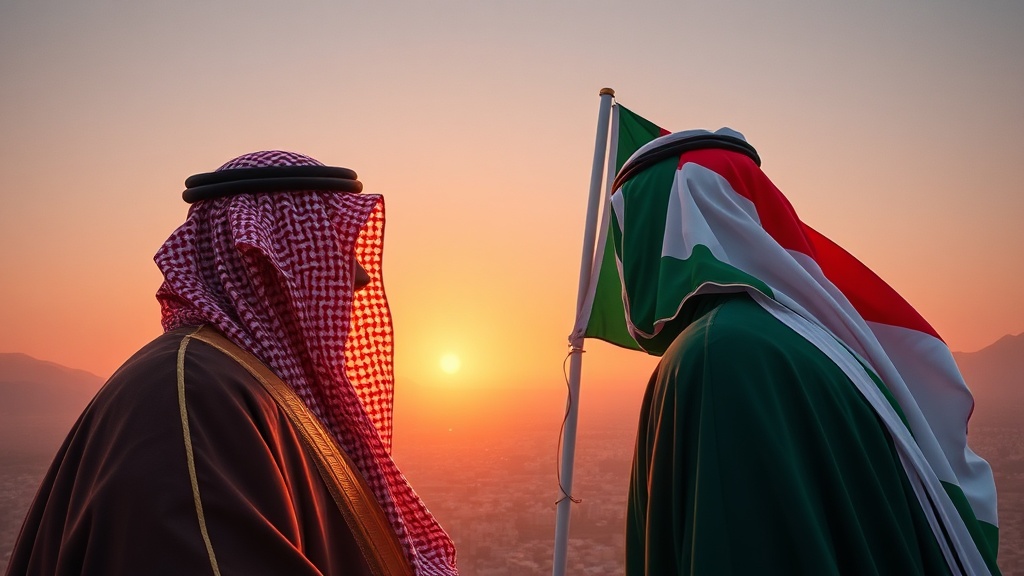
The real next war in the Middle East isn't with Iran — it's between Saudi Arabia and the UAE. Here's why their rivalry will define the region for years to come.
In This Article
The Rivalry Nobody Is Watching — But Everyone Should Be
While global headlines remain locked onto the kinetic drama of Iran's confrontations with Israel and the United States, a slower, more consequential power struggle is quietly gathering force beneath the surface. The emerging cold war between Saudi Arabia and the United Arab Emirates — two nations that spent the better part of the last decade presenting themselves as indivisible partners — is now spilling into open view. And according to most serious analysts of regional geopolitics, it is this rivalry, not the Iran question, that will determine what the Middle East actually looks like over the next decade.

This is not a story about two neighbours squabbling over borders. It is a story about two ambitious, oil-rich states pursuing irreconcilably different visions for their own survival in a post-oil world — and increasingly finding that the other's success threatens their own. Understanding the Saudi Arabia–UAE cold war means understanding why the broader Middle East is entering one of its most volatile and transformative periods since the Arab Spring.
How Two Allies Built Their Partnership — and Sowed the Seeds of Rivalry
To understand the current fracture, you have to understand just how genuine the Saudi-UAE alliance once appeared. For most of the 2010s, the two countries were locked together by a shared threat perception. The Islamic Republic of Iran — with its revolutionary ideology, its network of regional proxies, and its explicit hostility to Arab monarchies — gave Riyadh and Abu Dhabi powerful reasons to coordinate. Neither wanted to face Tehran alone.
The personal chemistry between their de facto leaders reinforced this institutional alignment. Mohamed bin Zayed, known as MBZ, had taken effective control of the UAE by 2014 and quickly identified a succession crisis brewing inside the House of Saud. He spotted in Mohamed bin Salman — then a young, largely unknown prince — a kindred spirit: someone prepared to take risks, embrace radical domestic reform, and use hard power to reshape regional realities. MBZ lobbied aggressively on MBS's behalf with American officials and Western capitals, and that support helped propel MBS to the position of defence minister in 2015 at just 29 years old, and shortly afterwards to deputy crown prince.
For a period, this arrangement worked brilliantly for the UAE. By elevating MBS and aligning with him, Abu Dhabi effectively turned Saudi Arabia — a country with four times the population and vastly more oil wealth — into a force multiplier for Emirati ambitions. Together they launched the military intervention in Yemen in 2015, imposed the blockade on Qatar in 2017, and presented a united front to the world. But even in those apparent victories, the seeds of future disagreement were being planted.
Yemen: Where the Alliance First Cracked
Yemen was supposed to be a quick, decisive intervention to roll back Iranian-backed Houthi expansion and demonstrate that the new, younger Gulf leadership could project decisive military power. It became neither quick nor decisive. For Saudi Arabia, the Yemen war gradually transformed from a strategic asset into a strategic liability of the first order.
Houthi drones and missiles began striking Saudi cities and oil infrastructure with alarming regularity. The international reputational damage from civilian casualties — caused in part by Saudi airstrikes using American-supplied munitions — eventually led the Biden administration to suspend offensive weapons sales to Riyadh in early 2021. Investors, already nervous about regional instability, grew warier still. The symbolic nadir came in March 2022 when Houthi strikes set a Saudi oil depot ablaze just 11 kilometres from the Jeddah street circuit while Formula 1 cars were actively racing, with black smoke drifting visibly over the grandstands. If there was a single image that captured how badly the Yemen adventure had gone for Saudi Arabia, that was it.
For the UAE, the calculation looked entirely different. Abu Dhabi had suffered fewer Houthi retaliatory strikes, faced less political blowback, and had used the war to quietly consolidate something far more valuable than battlefield victories: strategic control over southern Yemen's coastline and the approaches to the Bab-el-Mandeb Strait, one of the world's most critical maritime chokepoints. By backing the Southern Transitional Council, a separatist faction seeking to revive the former state of South Yemen, the UAE carved out a sphere of influence that serves its long-term maritime and commercial interests — regardless of who ultimately governs in Sanaa.
This divergence crystallised the different strategic personalities now driving each country. Saudi Arabia, burned by the Yemen experience, has pivoted toward a foreign policy of managed stability — pragmatic, transactional, and less ideologically rigid. The UAE, having emerged from Yemen with tangible strategic gains and no comparable reputational damage, has largely continued its more interventionist approach, backing secular or separatist actors across multiple theatres and remaining confrontational toward political Islam in all its forms.
A Cold War Fought Across Africa and the Horn
The Saudi-UAE rivalry has not stayed confined to the Arabian Peninsula. Its theatre has expanded dramatically, with both countries now backing opposing sides in conflicts that stretch from the Red Sea coast deep into the African continent.
In Sudan, where a catastrophic civil war erupted in 2023 between the Sudanese Armed Forces and the paramilitary Rapid Support Forces, the two Gulf states chose opposite sides. Saudi Arabia and Egypt aligned with the internationally recognised military government in Khartoum, viewing it as the legitimate authority and a bulwark against further regional chaos. The UAE, by contrast, reportedly provided critical political and material support to the RSF — partly because Riyadh and Cairo's preferred Khartoum government was seen as harbouring remnants of the old Islamist establishment from the Omar al-Bashir era, the very ideological current that Abu Dhabi most fears.
The consequences have been devastating for Sudan's civilian population, with the conflict now widely characterised as one of the world's worst ongoing humanitarian crises. But from a cold strategic standpoint, it illustrates precisely how Saudi-UAE competition is no longer merely a diplomatic rivalry — it is actively shaping the trajectory of wars.
In the Horn of Africa, the UAE has developed deep ties with Somaliland, the self-declared breakaway republic in northern Somalia, developing the port of Berbera into a significant commercial and potentially military facility. Saudi Arabia backs the Federal Government of Somalia, which views Somaliland's independence as an existential threat. The UAE has also cultivated close links with Abiy Ahmed's government in Ethiopia, while Saudi Arabia maintains its traditional relationships with Eritrea and the Somali federal authorities. In a region where Ethiopia, Eritrea, Somalia, and Somaliland are all navigating a precarious and potentially explosive set of tensions, the Gulf's proxy competition adds an accelerant to an already volatile mix.
The Economic War That Could Dwarf All Others
If the foreign policy divergence between Saudi Arabia and the UAE were the only dimension of their rivalry, it would already be significant. But the more fundamental and ultimately more consequential battleground is economic — and it strikes at the existential question facing both countries: what happens when the oil runs out, or when the world no longer wants it?
The UAE addressed this question earlier than almost any other Gulf state. Over several decades, Dubai and Abu Dhabi transformed themselves into the region's dominant hubs for international finance, luxury tourism, airline connectivity, and business services. Emirates and Etihad became the world's most recognisable long-haul carriers. Dubai became the address of choice for multinational corporations seeking a Middle Eastern base. Abu Dhabi became a centre for sovereign wealth and cultural institutions. Together they made the UAE the Gulf's most economically diversified state, with oil now accounting for roughly 25 percent of GDP.
Saudi Arabia is now attempting to replicate — and surpass — that achievement at a dramatically larger scale, and with the explicit aim of competing directly with the UAE for the same investors, tourists, and corporate headquarters. Vision 2030, MBS's signature economic transformation programme, targets precisely the industries where the UAE currently leads. Neom, The Line, and the Red Sea Project are designed to position Saudi Arabia as a global luxury tourism destination. The creation of Riyadh Air in 2023, backed by billions in state capital, directly challenges Emirates and Etihad for regional and long-haul routes. And the 2022 decree requiring foreign firms to relocate their regional headquarters to Saudi soil to qualify for government contracts was, in effect, a direct ultimatum to the thousands of multinationals that had long used Dubai as their Middle Eastern base.
For the UAE, this is not an abstract competitive threat. It is an existential one. The country's entire post-oil model depends on maintaining its position as the region's preeminent business, financial, and tourism hub. If Saudi Arabia — with its vastly larger population, its enormous domestic market, and its willingness to deploy state capital at scale — successfully competes for those same roles, the UAE's economic model faces structural pressure it has never previously confronted.
There is a historical echo worth noting here. For most of the twentieth century, Bahrain was the Gulf's financial and commercial centre. When Saudi Arabia and the UAE built up their own capacities, Bahrain was steadily eclipsed. UAE leadership is acutely aware that Saudi Arabia is now attempting to do to Dubai and Abu Dhabi precisely what Dubai and Abu Dhabi once did to Manama.
Iran's Decline and the Removal of the Glue That Held Them Together
Perhaps the most underappreciated dynamic in the Saudi-UAE relationship is how much of their alliance was always contingent on a shared external threat rather than genuinely shared interests. Iran provided the geopolitical glue. As long as the Islamic Republic remained a powerful, destabilising force threatening both monarchies, their differences could be managed and their cooperation could be maintained.
But Iran's regional position has been significantly weakened by its direct and proxy conflicts with Israel and the United States. Hezbollah, Tehran's most powerful non-state partner, has been severely degraded by Israeli military operations in Lebanon. The Assad regime in Syria — an Iranian client for decades — collapsed in late 2024. Iranian missile and drone capabilities have been tested and partially countered. The overall picture is of an Iran that is still dangerous but considerably diminished as a regional hegemon.
Free Weekly Newsletter
Enjoying this guide?
Get the best articles like this one delivered to your inbox every week. No spam.
As that external pressure eases, the logic of Saudi-Emirati solidarity erodes with it. Without a common enemy imposing discipline on the relationship, the underlying divergences in interests, ideology, and ambition have room to surface — and surface they have. The December 2025 episode in Yemen, where Saudi warplanes directly struck a UAE weapons shipment bound for UAE-backed separatists, was not a diplomatic misunderstanding. It was a visible expression of a rivalry that no longer has any compelling reason to stay hidden.
What Comes Next — and Why It Matters Beyond the Region
The Saudi-UAE cold war will not produce the kind of dramatic, explosive confrontation that characterises hot wars. Both states are too rational, too invested in their international reputations, and too economically intertwined with the global system to risk direct military conflict with each other. What it will produce is something arguably more consequential over the long run: a sustained, multi-theatre competition that shapes governance, conflict outcomes, and economic development across a vast swath of the globe.
In Sudan, that competition is already contributing to one of the world's worst humanitarian catastrophes. In the Horn of Africa, it is reshaping the balance of power between states and between central governments and separatist movements. In Yemen, it is complicating every attempt at a durable peace settlement. In the broader Gulf economy, it is driving an investment arms race that will reshape infrastructure, aviation, tourism, and finance across multiple continents.
For Western policymakers, investors, and businesses, the implications are significant. A decade of analysis that treated Saudi Arabia and the UAE as a unified Gulf bloc is now analytically obsolete. The two countries will increasingly need to be understood, engaged, and negotiated with as distinct — and sometimes opposing — actors. Companies choosing where to base regional operations, governments deciding who to arm and who to sanction, and multilateral institutions trying to mediate regional conflicts will all need to account for the reality that Riyadh and Abu Dhabi may want very different outcomes.
The Middle East's next defining rivalry has already begun. It just hasn't fully announced itself yet.
Frequently Asked Questions
What is the Saudi Arabia–UAE cold war?
The Saudi Arabia–UAE cold war refers to the growing geopolitical, economic, and strategic rivalry between Saudi Arabia and the United Arab Emirates. Despite appearing as close allies throughout the 2010s, the two countries have increasingly diverged on foreign policy across Yemen, Sudan, Somalia, Libya, and Syria, while also competing directly in economic sectors such as tourism, aviation, finance, and business services. The rivalry has intensified as their shared threat from Iran has diminished.
Why did Saudi Arabia and the UAE fall out?
Several factors drove the divergence. Their objectives in Yemen gradually split apart, with Saudi Arabia seeking stability and the UAE consolidating influence over southern Yemen's coastline. MBS's aggressive foreign policy generated severe reputational damage for Riyadh, prompting a strategic pivot toward stability and pragmatic diplomacy that the UAE did not follow. Economic competition also intensified as Saudi Arabia's Vision 2030 programme directly challenged UAE dominance in tourism, aviation, and regional business headquarters.
How does the Saudi-UAE rivalry affect conflicts in Africa?
The rivalry has significant consequences for conflicts in Sudan and the Horn of Africa. In Sudan, Saudi Arabia and Egypt back the internationally recognised military government, while the UAE has reportedly supported the rebel Rapid Support Forces — contributing to a conflict that the UN has described as one of the world's worst humanitarian crises. In the Horn, the UAE backs Somaliland's de facto independence and has cultivated ties with Ethiopia, while Saudi Arabia supports the Federal Government of Somalia and its opposition to Somaliland's secession.
Could Saudi Arabia and the UAE ever go to war directly?
A direct military confrontation between Saudi Arabia and the UAE is considered extremely unlikely in the near term. Both states are deeply embedded in international economic systems, have significant reputational interests to protect, and maintain close ties with the United States and other Western powers that would apply enormous pressure against direct conflict. The rivalry is far more likely to play out through proxy competition, economic strategy, and diplomatic positioning — a cold war in the most literal sense, with its most damaging effects felt in the third countries where they back opposing sides.
What is Vision 2030 and why does it threaten the UAE?
Vision 2030 is Saudi Crown Prince MBS's flagship programme to diversify the Saudi economy away from oil dependency by developing tourism, entertainment, aviation, finance, and technology sectors. Because the UAE — particularly Dubai and Abu Dhabi — has long dominated these exact industries in the Middle East, Saudi Arabia's large-scale investment in competing offerings such as Neom, the Red Sea Project, Riyadh Air, and new business hub incentives poses a direct structural challenge to the UAE's economic model and its position as the region's premier commercial centre.
Frequently Asked Questions
The Rivalry Nobody Is Watching — But Everyone Should Be
While global headlines remain locked onto the kinetic drama of Iran's confrontations with Israel and the United States, a slower, more consequential power struggle is quietly gathering force beneath the surface. The emerging cold war between Saudi Arabia and the United Arab Emirates — two nations that spent the better part of the last decade presenting themselves as indivisible partners — is now spilling into open view. And according to most serious analysts of regional geopolitics, it is this rivalry, not the Iran question, that will determine what the Middle East actually looks like over the next decade.
This is not a story about two neighbours squabbling over borders. It is a story about two ambitious, oil-rich states pursuing irreconcilably different visions for their own survival in a post-oil world — and increasingly finding that the other's success threatens their own. Understanding the Saudi Arabia–UAE cold war means understanding why the broader Middle East is entering one of its most volatile and transformative periods since the Arab Spring.
How Two Allies Built Their Partnership — and Sowed the Seeds of Rivalry
To understand the current fracture, you have to understand just how genuine the Saudi-UAE alliance once appeared. For most of the 2010s, the two countries were locked together by a shared threat perception. The Islamic Republic of Iran — with its revolutionary ideology, its network of regional proxies, and its explicit hostility to Arab monarchies — gave Riyadh and Abu Dhabi powerful reasons to coordinate. Neither wanted to face Tehran alone.
The personal chemistry between their de facto leaders reinforced this institutional alignment. Mohamed bin Zayed, known as MBZ, had taken effective control of the UAE by 2014 and quickly identified a succession crisis brewing inside the House of Saud. He spotted in Mohamed bin Salman — then a young, largely unknown prince — a kindred spirit: someone prepared to take risks, embrace radical domestic reform, and use hard power to reshape regional realities. MBZ lobbied aggressively on MBS's behalf with American officials and Western capitals, and that support helped propel MBS to the position of defence minister in 2015 at just 29 years old, and shortly afterwards to deputy crown prince.
For a period, this arrangement worked brilliantly for the UAE. By elevating MBS and aligning with him, Abu Dhabi effectively turned Saudi Arabia — a country with four times the population and vastly more oil wealth — into a force multiplier for Emirati ambitions. Together they launched the military intervention in Yemen in 2015, imposed the blockade on Qatar in 2017, and presented a united front to the world. But even in those apparent victories, the seeds of future disagreement were being planted.
Yemen: Where the Alliance First Cracked
Yemen was supposed to be a quick, decisive intervention to roll back Iranian-backed Houthi expansion and demonstrate that the new, younger Gulf leadership could project decisive military power. It became neither quick nor decisive. For Saudi Arabia, the Yemen war gradually transformed from a strategic asset into a strategic liability of the first order.
Houthi drones and missiles began striking Saudi cities and oil infrastructure with alarming regularity. The international reputational damage from civilian casualties — caused in part by Saudi airstrikes using American-supplied munitions — eventually led the Biden administration to suspend offensive weapons sales to Riyadh in early 2021. Investors, already nervous about regional instability, grew warier still. The symbolic nadir came in March 2022 when Houthi strikes set a Saudi oil depot ablaze just 11 kilometres from the Jeddah street circuit while Formula 1 cars were actively racing, with black smoke drifting visibly over the grandstands. If there was a single image that captured how badly the Yemen adventure had gone for Saudi Arabia, that was it.
For the UAE, the calculation looked entirely different. Abu Dhabi had suffered fewer Houthi retaliatory strikes, faced less political blowback, and had used the war to quietly consolidate something far more valuable than battlefield victories: strategic control over southern Yemen's coastline and the approaches to the Bab-el-Mandeb Strait, one of the world's most critical maritime chokepoints. By backing the Southern Transitional Council, a separatist faction seeking to revive the former state of South Yemen, the UAE carved out a sphere of influence that serves its long-term maritime and commercial interests — regardless of who ultimately governs in Sanaa.
This divergence crystallised the different strategic personalities now driving each country. Saudi Arabia, burned by the Yemen experience, has pivoted toward a foreign policy of managed stability — pragmatic, transactional, and less ideologically rigid. The UAE, having emerged from Yemen with tangible strategic gains and no comparable reputational damage, has largely continued its more interventionist approach, backing secular or separatist actors across multiple theatres and remaining confrontational toward political Islam in all its forms.
A Cold War Fought Across Africa and the Horn
The Saudi-UAE rivalry has not stayed confined to the Arabian Peninsula. Its theatre has expanded dramatically, with both countries now backing opposing sides in conflicts that stretch from the Red Sea coast deep into the African continent.
In Sudan, where a catastrophic civil war erupted in 2023 between the Sudanese Armed Forces and the paramilitary Rapid Support Forces, the two Gulf states chose opposite sides. Saudi Arabia and Egypt aligned with the internationally recognised military government in Khartoum, viewing it as the legitimate authority and a bulwark against further regional chaos. The UAE, by contrast, reportedly provided critical political and material support to the RSF — partly because Riyadh and Cairo's preferred Khartoum government was seen as harbouring remnants of the old Islamist establishment from the Omar al-Bashir era, the very ideological current that Abu Dhabi most fears.
The consequences have been devastating for Sudan's civilian population, with the conflict now widely characterised as one of the world's worst ongoing humanitarian crises. But from a cold strategic standpoint, it illustrates precisely how Saudi-UAE competition is no longer merely a diplomatic rivalry — it is actively shaping the trajectory of wars.
In the Horn of Africa, the UAE has developed deep ties with Somaliland, the self-declared breakaway republic in northern Somalia, developing the port of Berbera into a significant commercial and potentially military facility. Saudi Arabia backs the Federal Government of Somalia, which views Somaliland's independence as an existential threat. The UAE has also cultivated close links with Abiy Ahmed's government in Ethiopia, while Saudi Arabia maintains its traditional relationships with Eritrea and the Somali federal authorities. In a region where Ethiopia, Eritrea, Somalia, and Somaliland are all navigating a precarious and potentially explosive set of tensions, the Gulf's proxy competition adds an accelerant to an already volatile mix.
The Economic War That Could Dwarf All Others
If the foreign policy divergence between Saudi Arabia and the UAE were the only dimension of their rivalry, it would already be significant. But the more fundamental and ultimately more consequential battleground is economic — and it strikes at the existential question facing both countries: what happens when the oil runs out, or when the world no longer wants it?
The UAE addressed this question earlier than almost any other Gulf state. Over several decades, Dubai and Abu Dhabi transformed themselves into the region's dominant hubs for international finance, luxury tourism, airline connectivity, and business services. Emirates and Etihad became the world's most recognisable long-haul carriers. Dubai became the address of choice for multinational corporations seeking a Middle Eastern base. Abu Dhabi became a centre for sovereign wealth and cultural institutions. Together they made the UAE the Gulf's most economically diversified state, with oil now accounting for roughly 25 percent of GDP.
Saudi Arabia is now attempting to replicate — and surpass — that achievement at a dramatically larger scale, and with the explicit aim of competing directly with the UAE for the same investors, tourists, and corporate headquarters. Vision 2030, MBS's signature economic transformation programme, targets precisely the industries where the UAE currently leads. Neom, The Line, and the Red Sea Project are designed to position Saudi Arabia as a global luxury tourism destination. The creation of Riyadh Air in 2023, backed by billions in state capital, directly challenges Emirates and Etihad for regional and long-haul routes. And the 2022 decree requiring foreign firms to relocate their regional headquarters to Saudi soil to qualify for government contracts was, in effect, a direct ultimatum to the thousands of multinationals that had long used Dubai as their Middle Eastern base.
For the UAE, this is not an abstract competitive threat. It is an existential one. The country's entire post-oil model depends on maintaining its position as the region's preeminent business, financial, and tourism hub. If Saudi Arabia — with its vastly larger population, its enormous domestic market, and its willingness to deploy state capital at scale — successfully competes for those same roles, the UAE's economic model faces structural pressure it has never previously confronted.
There is a historical echo worth noting here. For most of the twentieth century, Bahrain was the Gulf's financial and commercial centre. When Saudi Arabia and the UAE built up their own capacities, Bahrain was steadily eclipsed. UAE leadership is acutely aware that Saudi Arabia is now attempting to do to Dubai and Abu Dhabi precisely what Dubai and Abu Dhabi once did to Manama.
Iran's Decline and the Removal of the Glue That Held Them Together
Perhaps the most underappreciated dynamic in the Saudi-UAE relationship is how much of their alliance was always contingent on a shared external threat rather than genuinely shared interests. Iran provided the geopolitical glue. As long as the Islamic Republic remained a powerful, destabilising force threatening both monarchies, their differences could be managed and their cooperation could be maintained.
But Iran's regional position has been significantly weakened by its direct and proxy conflicts with Israel and the United States. Hezbollah, Tehran's most powerful non-state partner, has been severely degraded by Israeli military operations in Lebanon. The Assad regime in Syria — an Iranian client for decades — collapsed in late 2024. Iranian missile and drone capabilities have been tested and partially countered. The overall picture is of an Iran that is still dangerous but considerably diminished as a regional hegemon.
As that external pressure eases, the logic of Saudi-Emirati solidarity erodes with it. Without a common enemy imposing discipline on the relationship, the underlying divergences in interests, ideology, and ambition have room to surface — and surface they have. The December 2025 episode in Yemen, where Saudi warplanes directly struck a UAE weapons shipment bound for UAE-backed separatists, was not a diplomatic misunderstanding. It was a visible expression of a rivalry that no longer has any compelling reason to stay hidden.
What Comes Next — and Why It Matters Beyond the Region
The Saudi-UAE cold war will not produce the kind of dramatic, explosive confrontation that characterises hot wars. Both states are too rational, too invested in their international reputations, and too economically intertwined with the global system to risk direct military conflict with each other. What it will produce is something arguably more consequential over the long run: a sustained, multi-theatre competition that shapes governance, conflict outcomes, and economic development across a vast swath of the globe.
In Sudan, that competition is already contributing to one of the world's worst humanitarian catastrophes. In the Horn of Africa, it is reshaping the balance of power between states and between central governments and separatist movements. In Yemen, it is complicating every attempt at a durable peace settlement. In the broader Gulf economy, it is driving an investment arms race that will reshape infrastructure, aviation, tourism, and finance across multiple continents.
For Western policymakers, investors, and businesses, the implications are significant. A decade of analysis that treated Saudi Arabia and the UAE as a unified Gulf bloc is now analytically obsolete. The two countries will increasingly need to be understood, engaged, and negotiated with as distinct — and sometimes opposing — actors. Companies choosing where to base regional operations, governments deciding who to arm and who to sanction, and multilateral institutions trying to mediate regional conflicts will all need to account for the reality that Riyadh and Abu Dhabi may want very different outcomes.
The Middle East's next defining rivalry has already begun. It just hasn't fully announced itself yet.
Frequently Asked Questions
What is the Saudi Arabia–UAE cold war?
The Saudi Arabia–UAE cold war refers to the growing geopolitical, economic, and strategic rivalry between Saudi Arabia and the United Arab Emirates. Despite appearing as close allies throughout the 2010s, the two countries have increasingly diverged on foreign policy across Yemen, Sudan, Somalia, Libya, and Syria, while also competing directly in economic sectors such as tourism, aviation, finance, and business services. The rivalry has intensified as their shared threat from Iran has diminished.
Why did Saudi Arabia and the UAE fall out?
Several factors drove the divergence. Their objectives in Yemen gradually split apart, with Saudi Arabia seeking stability and the UAE consolidating influence over southern Yemen's coastline. MBS's aggressive foreign policy generated severe reputational damage for Riyadh, prompting a strategic pivot toward stability and pragmatic diplomacy that the UAE did not follow. Economic competition also intensified as Saudi Arabia's Vision 2030 programme directly challenged UAE dominance in tourism, aviation, and regional business headquarters.
How does the Saudi-UAE rivalry affect conflicts in Africa?
The rivalry has significant consequences for conflicts in Sudan and the Horn of Africa. In Sudan, Saudi Arabia and Egypt back the internationally recognised military government, while the UAE has reportedly supported the rebel Rapid Support Forces — contributing to a conflict that the UN has described as one of the world's worst humanitarian crises. In the Horn, the UAE backs Somaliland's de facto independence and has cultivated ties with Ethiopia, while Saudi Arabia supports the Federal Government of Somalia and its opposition to Somaliland's secession.
Could Saudi Arabia and the UAE ever go to war directly?
A direct military confrontation between Saudi Arabia and the UAE is considered extremely unlikely in the near term. Both states are deeply embedded in international economic systems, have significant reputational interests to protect, and maintain close ties with the United States and other Western powers that would apply enormous pressure against direct conflict. The rivalry is far more likely to play out through proxy competition, economic strategy, and diplomatic positioning — a cold war in the most literal sense, with its most damaging effects felt in the third countries where they back opposing sides.
What is Vision 2030 and why does it threaten the UAE?
Vision 2030 is Saudi Crown Prince MBS's flagship programme to diversify the Saudi economy away from oil dependency by developing tourism, entertainment, aviation, finance, and technology sectors. Because the UAE — particularly Dubai and Abu Dhabi — has long dominated these exact industries in the Middle East, Saudi Arabia's large-scale investment in competing offerings such as Neom, the Red Sea Project, Riyadh Air, and new business hub incentives poses a direct structural challenge to the UAE's economic model and its position as the region's premier commercial centre.
About Zeebrain Editorial
Zeebrain publishes independent analysis of markets, investing, personal finance, and business. We disclose affiliate relationships, never accept payment for coverage, and fact-check all claims against primary sources. Read our editorial policy →
How this article was produced: Zeebrain articles are created with AI assistance from primary sources (including cited videos and market data) and reviewed under our editorial standards before publication. Spot an error? Tell us and we will correct it.
More from Curiosities




Related Guides
Keep exploring this topic
UAE Yemen STC Strategy: Analyzing Regional Power Dynamics
Curiosities · Yemen · UAE
Strait of Hormuz: Why Geography Matters More Than Military Power
Curiosities · Strait of Hormuz · Iran conflict
Who Is Pope Francis? Life, Legacy, and His Impact on the Modern Church
Curiosities
How Was William Wallace Captured? The Real Story
Curiosities
Explore More Categories
Keep browsing by topic and build depth around the subjects you care about most.