Why Spain Chose to Fight the USA in 1898 — And Lost Everything
Quick Summary
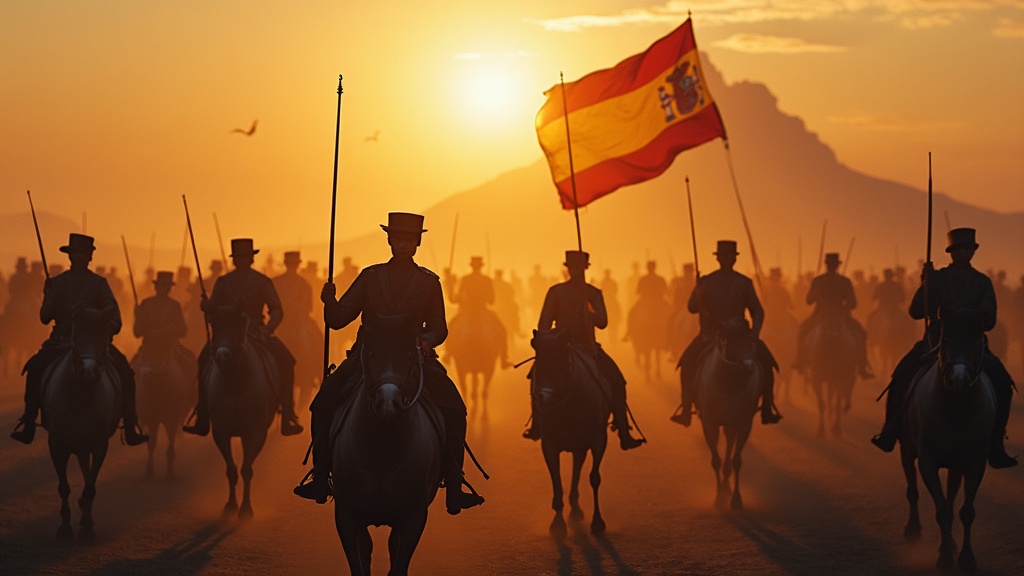
Spain knew it would likely lose. So why did it declare war on the USA in 1898? The answer reveals pride, politics, and a dying empire's last desperate gamble.
In This Article
The Empire That Refused to Die Quietly
There is a particular kind of tragedy reserved for great powers in decline — the moment they know the sun is setting, yet choose to stare directly into it anyway. In 1898, Spain stood at exactly that precipice. Its empire, once the most sprawling the world had ever seen, had been contracting for decades. Cuba was in open revolt. The Philippines were restless. And now, the United States of America — young, loud, and increasingly hungry — was circling.
The Spanish-American War is often remembered as a foregone conclusion, a brief imperial transaction in which Washington flexed its muscles and Madrid quietly surrendered its last great colonies. But that framing misses the real story entirely. Because Spain didn't sleepwalk into this conflict. Its leaders knew, at least privately, that the odds were stacked brutally against them. And yet they chose war anyway.
Understanding why Spain declared war on the United States in 1898 means understanding something far more human than military strategy: the crushing weight of national identity, the dangerous theatre of political survival, and the seductive lie that honour can be preserved through sacrifice — even a futile one.
Cuba Was Not Just a Colony — It Was a Symbol
To understand Spain's decision, you must first understand what Cuba meant to the Spanish psyche in 1898. This wasn't merely a Caribbean island generating sugar revenue. Cuba was, in the minds of many Spaniards, the birthplace of the empire itself — a living monument to the age when Spain bestrode the Atlantic world like a colossus. Losing Cuba through negotiation, through simply handing it over to American demands, would have been experienced not as a political setback but as a kind of national amputation.
By the mid-1890s, Cuban rebels under leaders like José Martí and later Antonio Maceo had transformed a simmering insurgency into a full-scale war of independence. Spain's response was characteristically brutal. General Valeriano Weyler introduced the reconcentrado policy — forcing hundreds of thousands of Cuban civilians into fortified camps, where disease and starvation killed them in staggering numbers. Far from suppressing the rebellion, these tactics handed American newspapers exactly the kind of inflammatory material their editors craved.
William Randolph Hearst's New York Journal and Joseph Pulitzer's New York World engaged in what became known as yellow journalism — vivid, often exaggerated accounts of Spanish atrocities that whipped American public opinion into a frenzy. The suffering was real enough, but the coverage transformed it into something politically combustible. By early 1898, many Americans didn't just want Spain out of Cuba. They wanted war.
The Military, the Monarchy, and the Fear of Revolution
Spain's Prime Minister Práxedes Mateo Sagasta was not a reckless man. He understood, with cold clarity, that Spain could not win a prolonged military confrontation with the United States. He had quietly been pursuing a diplomatic path — offering Cuba greater autonomy within the empire, negotiating ceasefires, attempting to defuse American anger before it ignited into something irreversible.
But Sagasta was governing a country in which the military held enormous political leverage, and the officer class made no secret of its contempt for negotiated retreat. To the generals and admirals in Madrid, any settlement that handed Cuba to American pressure — or worse, to the rebels — would be an intolerable stain on Spanish military honour. The implicit threat was not merely political embarrassment. It was the spectre of a military that might not remain loyal to a government it deemed cowardly.
Beyond the barracks, Sagasta faced an equally dangerous force: public opinion. Spanish newspapers and political orators had spent months telling the Spanish people that their nation was more than capable of standing up to the Americans — that the United States army was small and inexperienced, that Spanish naval tradition counted for something, that national willpower could compensate for material disadvantage. These were, in most respects, dangerous myths. But they were myths the Spanish public had come to believe, and any politician seen to be surrendering without a fight risked not just his career but the stability of the constitutional monarchy itself. Revolution, to men like Sagasta, was a far more immediate terror than defeat by the Americans.
The Military Mismatch No One Wanted to Admit
Behind the public bravado, Spanish military planners were under no real illusions. The United States possessed a significantly larger and more modern economy, a navy that had been systematically modernised throughout the 1880s and 1890s under the influence of Alfred Thayer Mahan's theories of sea power, and access to industrial resources that Spain could not begin to match.
On paper, Spain's army was impressive — roughly 200,000 soldiers. But the reality was grimmer. The vast majority of those troops were already deployed in Cuba and the Philippines, where tropical disease had been doing as much damage as enemy bullets. Yellow fever, malaria, and dysentery had ravaged Spanish forces in both theatres. The men still in Spain were thousands of miles from the front lines, and getting them there would require naval supremacy that Madrid did not possess.
The Spanish Navy was divided across three separate theatres — the Atlantic, the Pacific, and home waters — which meant the Americans could concentrate their superior fleet against each Spanish squadron in turn. There was genuine hope, particularly among European naval observers who doubted American combat experience, that the Spanish Navy might outperform expectations. That hope evaporated almost instantly at Manila Bay on May 1, 1898, when Commodore George Dewey's Asiatic Squadron destroyed the Spanish Pacific fleet in a single morning, suffering not a single combat death in the process.
The Great Power Fantasy That Never Materialised
One of the most revealing aspects of Spain's decision to go to war is what it expected to happen afterward — specifically, the belief held by some Spanish politicians that Europe's great powers would never allow the United States to strip Spain of its empire unchallenged.
This hope was not entirely irrational, at least on its surface. European powers had long operated on the principle that no single nation should be allowed to accumulate so much influence that it threatened the balance of power. Surely, the thinking went, France, Germany, or Britain would step in to check American ambitions.
The reality proved far more cynical. Britain, far from being a natural Spanish ally, had spent decades regarding Spain as a declining irrelevance — a once-great power that had failed to modernise, failed to industrialise at pace, and failed to produce the kind of enlightened, Protestant, Anglo-Saxon culture that Victorian Britain considered the hallmark of genuine civilisation. More practically, the British were in the midst of carefully cultivating warmer relations with Washington, eager to bring the United States into a more active role in world affairs. If America's rise came partly at Spain's expense, London was perfectly comfortable with that arrangement.
France watched with deep anxiety. French strategists understood that an American victory would create a new imperial naval power with footholds in both the Caribbean and the Pacific — dangerously close to French colonial interests in both regions. But France was in no position to intervene militarily without exposing itself to German opportunism on the continent. French diplomats attempted to mediate, to bring the conflict to an early close before American territorial gains became too sweeping, but Washington made clear it wanted no European interference whatsoever. France was reduced to hoping.
Germany pursued a more active — and ultimately equally futile — strategy. Kaiser Wilhelm II's government sent warships to shadow the American fleet in the Philippines, toying with the idea of acquiring the islands themselves, or at least establishing a base there, should the United States choose not to retain them. German diplomats attempted to construct a European coalition statement that would pressure Washington to moderate its demands. Every potential ally refused. In the end, Germany's posturing achieved nothing except briefly alarming American commanders, who were watching German vessels with considerable suspicion.
Spain had gambled that European self-interest would ride to its rescue. It was, in hindsight, perhaps the most expensive miscalculation of the entire war.
The Last Stand That Saved No One
Even after the early catastrophes at Manila Bay and Santiago de Cuba, Spanish leadership clung to one final hope: that determined resistance would inflict sufficient casualties on American forces to turn public opinion in the United States against the war, forcing Washington to negotiate a settlement that allowed Spain to retain at least some of its holdings — perhaps the Philippines, perhaps even a degree of formal presence in Cuba.
This was not a completely unreasonable strategy in theory. The United States Army had expanded rapidly at the outbreak of war but remained poorly organised and logistically strained. Heat, disease, and supply failures plagued American forces in Cuba just as they had plagued the Spanish. A sufficiently costly and prolonged campaign might indeed have tested American political resolve.
But the American victories came too quickly and too decisively for Spanish resistance to accumulate the necessary weight. By July 1898, Santiago de Cuba had fallen. By August, Manila was in American hands. Spain sued for peace, and the Treaty of Paris, signed in December 1898, stripped Spain not only of Cuba but of Puerto Rico, Guam, and the Philippines — the latter purchased by the United States for twenty million dollars, as though to add commercial humiliation to military defeat.
The political class that had promised the Spanish people a war of national honour had delivered a catastrophe of national diminishment. The monarchy survived. The revolution that Sagasta had feared never came. But something arguably more corrosive settled over Spain instead — a profound disillusionment that would echo through Spanish politics and culture for decades, and whose aftershocks can be traced, not unreasonably, all the way to the convulsions of the 1930s.
What 1898 Really Tells Us About Declining Powers
The Spanish-American War is typically taught as a story about America's emergence onto the world stage — and so it was. But viewed from Madrid rather than Washington, it tells a different and perhaps more instructive story about the choices nations make when faced with irreversible decline.
Free Weekly Newsletter
Enjoying this guide?
Get the best articles like this one delivered to your inbox every week. No spam.
Spain in 1898 was caught in a trap of its own construction. Decades of imperial mythology had made retreat politically impossible, even when retreat was strategically necessary. Military officers had acquired enough political influence to make pragmatic statesmanship feel like betrayal. And the hope that external actors — great powers with their own interests — would intervene to save Spain from the consequences of its own weakness proved to be precisely the kind of wishful thinking that desperate governments are most prone to.
None of this excuses the brutality of Spain's counterinsurgency campaigns in Cuba and the Philippines. The suffering inflicted on civilian populations there was real and enormous, whatever one thinks of American motives for intervening. But understanding why Spain fought — really understanding it, beyond the simple answer of national pride — reveals the intricate machinery of political fear, institutional pressure, and collective self-deception that drives nations into wars they cannot win.
The Spanish empire did not die in 1898. It had been dying for a century. What 1898 provided was simply the moment the death became undeniable — and the price of that denial was everything Spain had left.
Frequently Asked Questions
Why did Spain declare war on the United States in 1898 rather than simply withdrawing from Cuba?
Spain's decision was driven by a combination of intense domestic pressures rather than any genuine belief it could win. The military establishment in Madrid made clear that a negotiated withdrawal from Cuba would be considered a dishonourable capitulation and implied the army would not accept it. Political leaders also feared that publicly abandoning Cuba — seen as the birthplace of the Spanish empire — would trigger popular unrest and potentially threaten the constitutional monarchy. War, even a losing war, was seen as more politically survivable than retreat.
Did Spain believe it could actually win the Spanish-American War?
Publicly, Spanish politicians and military figures claimed the war was winnable, pointing to the relatively small size of the peacetime US Army and the perceived inexperience of American naval forces. Privately, many senior figures — particularly naval officers — understood that the United States held decisive advantages in industrial capacity, modern warships, and the ability to concentrate its forces. The hope was less about outright victory and more about making the war costly enough to force a negotiated settlement before total defeat.
Did any European great powers support Spain during the Spanish-American War?
None intervened militarily. France expressed diplomatic concern about growing American power but was unwilling to risk its own security or trade relations with the United States. Germany shadowed American fleets in the Philippines and sought to build a European coalition statement in Spain's favour, but no country agreed to sign. Britain, far from supporting Spain, quietly backed American ambitions, seeing a rising English-speaking Protestant power as aligned with British interests. Spain's hope of European intervention proved to be a fundamental miscalculation.
What were the long-term consequences of the Spanish-American War for Spain?
The treaty of 1898 stripped Spain of Cuba, Puerto Rico, the Philippines, and Guam — the last significant remnants of its global empire. The political and psychological impact was profound. A generation of Spanish intellectuals known as the Generación del 98 grappled directly with the trauma of national humiliation, producing work that questioned Spain's identity, its institutions, and its place in the modern world. The instability and disillusionment that followed contributed to decades of political turbulence, culminating in the Spanish Civil War of 1936–1939. The wounds of 1898 ran very deep, and very long.
Frequently Asked Questions
The Empire That Refused to Die Quietly
There is a particular kind of tragedy reserved for great powers in decline — the moment they know the sun is setting, yet choose to stare directly into it anyway. In 1898, Spain stood at exactly that precipice. Its empire, once the most sprawling the world had ever seen, had been contracting for decades. Cuba was in open revolt. The Philippines were restless. And now, the United States of America — young, loud, and increasingly hungry — was circling.
The Spanish-American War is often remembered as a foregone conclusion, a brief imperial transaction in which Washington flexed its muscles and Madrid quietly surrendered its last great colonies. But that framing misses the real story entirely. Because Spain didn't sleepwalk into this conflict. Its leaders knew, at least privately, that the odds were stacked brutally against them. And yet they chose war anyway.
Understanding why Spain declared war on the United States in 1898 means understanding something far more human than military strategy: the crushing weight of national identity, the dangerous theatre of political survival, and the seductive lie that honour can be preserved through sacrifice — even a futile one.
Cuba Was Not Just a Colony — It Was a Symbol
To understand Spain's decision, you must first understand what Cuba meant to the Spanish psyche in 1898. This wasn't merely a Caribbean island generating sugar revenue. Cuba was, in the minds of many Spaniards, the birthplace of the empire itself — a living monument to the age when Spain bestrode the Atlantic world like a colossus. Losing Cuba through negotiation, through simply handing it over to American demands, would have been experienced not as a political setback but as a kind of national amputation.
By the mid-1890s, Cuban rebels under leaders like José Martí and later Antonio Maceo had transformed a simmering insurgency into a full-scale war of independence. Spain's response was characteristically brutal. General Valeriano Weyler introduced the reconcentrado policy — forcing hundreds of thousands of Cuban civilians into fortified camps, where disease and starvation killed them in staggering numbers. Far from suppressing the rebellion, these tactics handed American newspapers exactly the kind of inflammatory material their editors craved.
William Randolph Hearst's New York Journal and Joseph Pulitzer's New York World engaged in what became known as yellow journalism — vivid, often exaggerated accounts of Spanish atrocities that whipped American public opinion into a frenzy. The suffering was real enough, but the coverage transformed it into something politically combustible. By early 1898, many Americans didn't just want Spain out of Cuba. They wanted war.
The Military, the Monarchy, and the Fear of Revolution
Spain's Prime Minister Práxedes Mateo Sagasta was not a reckless man. He understood, with cold clarity, that Spain could not win a prolonged military confrontation with the United States. He had quietly been pursuing a diplomatic path — offering Cuba greater autonomy within the empire, negotiating ceasefires, attempting to defuse American anger before it ignited into something irreversible.
But Sagasta was governing a country in which the military held enormous political leverage, and the officer class made no secret of its contempt for negotiated retreat. To the generals and admirals in Madrid, any settlement that handed Cuba to American pressure — or worse, to the rebels — would be an intolerable stain on Spanish military honour. The implicit threat was not merely political embarrassment. It was the spectre of a military that might not remain loyal to a government it deemed cowardly.
Beyond the barracks, Sagasta faced an equally dangerous force: public opinion. Spanish newspapers and political orators had spent months telling the Spanish people that their nation was more than capable of standing up to the Americans — that the United States army was small and inexperienced, that Spanish naval tradition counted for something, that national willpower could compensate for material disadvantage. These were, in most respects, dangerous myths. But they were myths the Spanish public had come to believe, and any politician seen to be surrendering without a fight risked not just his career but the stability of the constitutional monarchy itself. Revolution, to men like Sagasta, was a far more immediate terror than defeat by the Americans.
The Military Mismatch No One Wanted to Admit
Behind the public bravado, Spanish military planners were under no real illusions. The United States possessed a significantly larger and more modern economy, a navy that had been systematically modernised throughout the 1880s and 1890s under the influence of Alfred Thayer Mahan's theories of sea power, and access to industrial resources that Spain could not begin to match.
On paper, Spain's army was impressive — roughly 200,000 soldiers. But the reality was grimmer. The vast majority of those troops were already deployed in Cuba and the Philippines, where tropical disease had been doing as much damage as enemy bullets. Yellow fever, malaria, and dysentery had ravaged Spanish forces in both theatres. The men still in Spain were thousands of miles from the front lines, and getting them there would require naval supremacy that Madrid did not possess.
The Spanish Navy was divided across three separate theatres — the Atlantic, the Pacific, and home waters — which meant the Americans could concentrate their superior fleet against each Spanish squadron in turn. There was genuine hope, particularly among European naval observers who doubted American combat experience, that the Spanish Navy might outperform expectations. That hope evaporated almost instantly at Manila Bay on May 1, 1898, when Commodore George Dewey's Asiatic Squadron destroyed the Spanish Pacific fleet in a single morning, suffering not a single combat death in the process.
The Great Power Fantasy That Never Materialised
One of the most revealing aspects of Spain's decision to go to war is what it expected to happen afterward — specifically, the belief held by some Spanish politicians that Europe's great powers would never allow the United States to strip Spain of its empire unchallenged.
This hope was not entirely irrational, at least on its surface. European powers had long operated on the principle that no single nation should be allowed to accumulate so much influence that it threatened the balance of power. Surely, the thinking went, France, Germany, or Britain would step in to check American ambitions.
The reality proved far more cynical. Britain, far from being a natural Spanish ally, had spent decades regarding Spain as a declining irrelevance — a once-great power that had failed to modernise, failed to industrialise at pace, and failed to produce the kind of enlightened, Protestant, Anglo-Saxon culture that Victorian Britain considered the hallmark of genuine civilisation. More practically, the British were in the midst of carefully cultivating warmer relations with Washington, eager to bring the United States into a more active role in world affairs. If America's rise came partly at Spain's expense, London was perfectly comfortable with that arrangement.
France watched with deep anxiety. French strategists understood that an American victory would create a new imperial naval power with footholds in both the Caribbean and the Pacific — dangerously close to French colonial interests in both regions. But France was in no position to intervene militarily without exposing itself to German opportunism on the continent. French diplomats attempted to mediate, to bring the conflict to an early close before American territorial gains became too sweeping, but Washington made clear it wanted no European interference whatsoever. France was reduced to hoping.
Germany pursued a more active — and ultimately equally futile — strategy. Kaiser Wilhelm II's government sent warships to shadow the American fleet in the Philippines, toying with the idea of acquiring the islands themselves, or at least establishing a base there, should the United States choose not to retain them. German diplomats attempted to construct a European coalition statement that would pressure Washington to moderate its demands. Every potential ally refused. In the end, Germany's posturing achieved nothing except briefly alarming American commanders, who were watching German vessels with considerable suspicion.
Spain had gambled that European self-interest would ride to its rescue. It was, in hindsight, perhaps the most expensive miscalculation of the entire war.
The Last Stand That Saved No One
Even after the early catastrophes at Manila Bay and Santiago de Cuba, Spanish leadership clung to one final hope: that determined resistance would inflict sufficient casualties on American forces to turn public opinion in the United States against the war, forcing Washington to negotiate a settlement that allowed Spain to retain at least some of its holdings — perhaps the Philippines, perhaps even a degree of formal presence in Cuba.
This was not a completely unreasonable strategy in theory. The United States Army had expanded rapidly at the outbreak of war but remained poorly organised and logistically strained. Heat, disease, and supply failures plagued American forces in Cuba just as they had plagued the Spanish. A sufficiently costly and prolonged campaign might indeed have tested American political resolve.
But the American victories came too quickly and too decisively for Spanish resistance to accumulate the necessary weight. By July 1898, Santiago de Cuba had fallen. By August, Manila was in American hands. Spain sued for peace, and the Treaty of Paris, signed in December 1898, stripped Spain not only of Cuba but of Puerto Rico, Guam, and the Philippines — the latter purchased by the United States for twenty million dollars, as though to add commercial humiliation to military defeat.
The political class that had promised the Spanish people a war of national honour had delivered a catastrophe of national diminishment. The monarchy survived. The revolution that Sagasta had feared never came. But something arguably more corrosive settled over Spain instead — a profound disillusionment that would echo through Spanish politics and culture for decades, and whose aftershocks can be traced, not unreasonably, all the way to the convulsions of the 1930s.
What 1898 Really Tells Us About Declining Powers
The Spanish-American War is typically taught as a story about America's emergence onto the world stage — and so it was. But viewed from Madrid rather than Washington, it tells a different and perhaps more instructive story about the choices nations make when faced with irreversible decline.
Spain in 1898 was caught in a trap of its own construction. Decades of imperial mythology had made retreat politically impossible, even when retreat was strategically necessary. Military officers had acquired enough political influence to make pragmatic statesmanship feel like betrayal. And the hope that external actors — great powers with their own interests — would intervene to save Spain from the consequences of its own weakness proved to be precisely the kind of wishful thinking that desperate governments are most prone to.
None of this excuses the brutality of Spain's counterinsurgency campaigns in Cuba and the Philippines. The suffering inflicted on civilian populations there was real and enormous, whatever one thinks of American motives for intervening. But understanding why Spain fought — really understanding it, beyond the simple answer of national pride — reveals the intricate machinery of political fear, institutional pressure, and collective self-deception that drives nations into wars they cannot win.
The Spanish empire did not die in 1898. It had been dying for a century. What 1898 provided was simply the moment the death became undeniable — and the price of that denial was everything Spain had left.
Frequently Asked Questions
Why did Spain declare war on the United States in 1898 rather than simply withdrawing from Cuba?
Spain's decision was driven by a combination of intense domestic pressures rather than any genuine belief it could win. The military establishment in Madrid made clear that a negotiated withdrawal from Cuba would be considered a dishonourable capitulation and implied the army would not accept it. Political leaders also feared that publicly abandoning Cuba — seen as the birthplace of the Spanish empire — would trigger popular unrest and potentially threaten the constitutional monarchy. War, even a losing war, was seen as more politically survivable than retreat.
Did Spain believe it could actually win the Spanish-American War?
Publicly, Spanish politicians and military figures claimed the war was winnable, pointing to the relatively small size of the peacetime US Army and the perceived inexperience of American naval forces. Privately, many senior figures — particularly naval officers — understood that the United States held decisive advantages in industrial capacity, modern warships, and the ability to concentrate its forces. The hope was less about outright victory and more about making the war costly enough to force a negotiated settlement before total defeat.
Did any European great powers support Spain during the Spanish-American War?
None intervened militarily. France expressed diplomatic concern about growing American power but was unwilling to risk its own security or trade relations with the United States. Germany shadowed American fleets in the Philippines and sought to build a European coalition statement in Spain's favour, but no country agreed to sign. Britain, far from supporting Spain, quietly backed American ambitions, seeing a rising English-speaking Protestant power as aligned with British interests. Spain's hope of European intervention proved to be a fundamental miscalculation.
What were the long-term consequences of the Spanish-American War for Spain?
The treaty of 1898 stripped Spain of Cuba, Puerto Rico, the Philippines, and Guam — the last significant remnants of its global empire. The political and psychological impact was profound. A generation of Spanish intellectuals known as the Generación del 98 grappled directly with the trauma of national humiliation, producing work that questioned Spain's identity, its institutions, and its place in the modern world. The instability and disillusionment that followed contributed to decades of political turbulence, culminating in the Spanish Civil War of 1936–1939. The wounds of 1898 ran very deep, and very long.
About Zeebrain Editorial
Zeebrain publishes independent analysis of markets, investing, personal finance, and business. We disclose affiliate relationships, never accept payment for coverage, and fact-check all claims against primary sources. Read our editorial policy →
How this article was produced: Zeebrain articles are created with AI assistance from primary sources (including cited videos and market data) and reviewed under our editorial standards before publication. Spot an error? Tell us and we will correct it.
More from History & Mysteries

Related Guides
Keep exploring this topic
Explore More Categories
Keep browsing by topic and build depth around the subjects you care about most.