New Guinea: The World's Most Unknown Island
Quick Summary
New Guinea hides glaciers, extinct animals, and millions of uncounted people. Discover why this vast island remains one of Earth's last true frontiers.
In This Article
The Island That Shouldn't Still Be a Mystery
In an age when satellites map ocean floors and algorithms predict weather patterns weeks in advance, it seems almost offensive that an entire island — a massive, populated, biologically explosive island — can still be largely unknown to science, to governments, and to the outside world. Yet that is precisely the situation with New Guinea, a place so routinely underestimated that most people couldn't confidently point to it on a map, let alone tell you anything meaningful about what lives there.

That ignorance isn't really our fault. Flat maps built on the Mercator projection, designed centuries ago to help sailors navigate straight lines, systematically shrink equatorial landmasses. New Guinea, sitting just below the equator, gets squeezed into apparent insignificance. In reality, it is the second largest island on the planet, trailing only Greenland and only barely. Laid over Europe, it would stretch from England to the Black Sea. Laid over the United States, it would reach from Long Island down to the outskirts of Dallas. It is enormous — and almost everything about it is underreported, underexplored, and underestimated.
A Landscape Designed to Keep Secrets
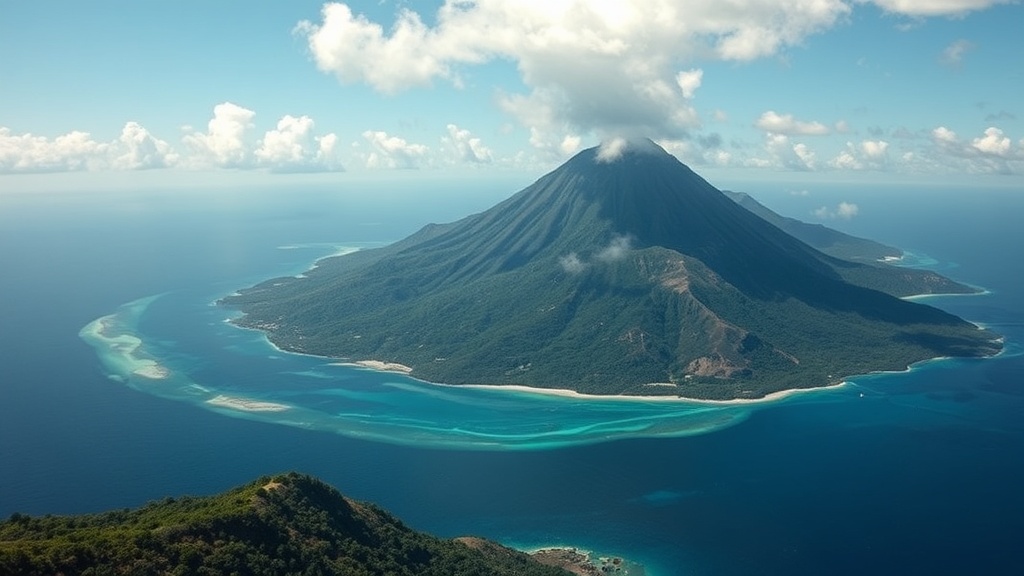
To understand why New Guinea remains so unknown, you have to reckon with its geography, which seems purpose-built to defeat human curiosity. Roughly 80% of the island is blanketed by dense tropical rainforest, the third largest rainforest system on Earth behind only the Amazon and the Congo. Some researchers have started calling it the Second Amazon, a label that captures both its scale and its ecological richness — though it still doesn't quite convey how vertical the place is.
Running down the spine of the island is the New Guinea Highlands, a mountain chain comparable in size and elevation to the Rocky Mountains of North America. These are not gentle rolling hills. They are the highest peaks found anywhere between the Himalayas and the Andes — a truly staggering distinction for an island. The combination of near-impenetrable rainforest at lower elevations and dramatic, isolating mountain terrain at higher ones creates a landscape that actively resists exploration. Valleys can be separated by ridgelines so steep and dense with vegetation that neighbouring communities remained unaware of each other's existence until the 20th century.
This geography also explains one of New Guinea's most counterintuitive features: it contains glaciers. On the Indonesian western half of the island, the peak of Puncak Jaya rises to 4,884 metres — the highest point on any island in the world. At that altitude, even at the equator, temperatures drop far enough to turn New Guinea's abundant rainfall into snow, which compacts over thousands of years into glacial ice. When Dutch explorer Jan Carstensz reported seeing snow and glaciers near the equator in 1623, his contemporaries mocked him for nearly three centuries. Western science didn't confirm the glaciers' existence until Dutch expeditions between 1909 and 1913.
Those glaciers are now vanishing at a devastating pace. From an area of roughly 19.3 square kilometres in 1850, they had shrunk by nearly two-thirds by 1972. By 2018, they had lost more than 97% of their original extent. A study published in March 2025, based on 2024 satellite data, found that just 0.165 square kilometres of glacial ice remained — a 67% decline from even the 2018 measurements. At current rates, New Guinea's glaciers will be gone entirely by around 2030, ending a chapter of the island's climate history that stretches back tens of thousands of years.
Species That Refuse to Stay Extinct
Biologically, New Guinea is in a class of its own. Second only to the Amazon in the rate of new species discovery, the island has yielded literally thousands of formally described new species since 2010 alone. Most are small — insects, plants, spiders — but periodically, something larger and more dramatic surfaces from the rainforest.
In 2025, a biologist from the Czech Academy of Sciences captured the first-ever photographs of the subalpine woolly rat in its natural habitat. This is not a creature that had eluded cameras by being particularly small or cryptic — it measures over 75 centimetres in length and weighs nearly two kilograms. It had simply been living, undisturbed, in the highland jungles, known to science only through a handful of preserved museum specimens.
More dramatic still is the case of the Dinagat moonrat — actually, the better-known example from New Guinea is the Wondiwoi tree kangaroo. Discovered in the 1930s and then not seen again for decades, it was eventually classified as extinct before a researcher photographed a living specimen in 2018. Then came the rediscovery of Attenborough's long-beaked echidna in 2023. Known only from a single preserved specimen collected in 1961 and stored in a museum in the Netherlands, it was considered extinct until a research team filmed a live individual in the Cyclops Mountains — at significant personal cost. One team member fell through a moss pit into an undiscovered cave system and broke his arm in two places. Another endured a leech attached to his eyeball for three days. The Cyclops Mountains rewarded these sacrifices with half a dozen new cave-dwelling species, but the echidna footage was the headline find.
These rediscoveries have added serious weight to speculation about the thylacine, or Tasmanian tiger. This large carnivorous marsupial once ranged across the ancient supercontinent of Sahul, which included both Australia and New Guinea when sea levels were lower. It disappeared from mainland Australia around 3,200 years ago, likely following the arrival of the dingo — which never reached Tasmania, where the species survived until European colonisation. A Tasmanian government bounty programme decimated the population, and the last known individual died in Hobart Zoo in 1936. The species was formally declared extinct in 1982.
And yet. Given that New Guinea's unexplored interior recently gave up both the Wondiwoi tree kangaroo and Attenborough's echidna decades after their supposed extinctions, the possibility of a surviving thylacine population cannot be dismissed as pure fantasy. It remains remote. But remote is not impossible, and in New Guinea, impossible has a habit of being proven wrong.
A Country That Doesn't Know How Many People It Has
New Guinea is politically divided into two halves: the Indonesian provinces of West Papua and Papua to the west, and the independent nation of Papua New Guinea to the east. Papua New Guinea holds a distinction that is both remarkable and troubling: it is the only country in the world with a genuinely unknown population.
The most recent national census, conducted in 2024, produced an official figure of 10.18 million people. That number has been widely challenged. A separate study funded by Australia and conducted by the UN in 2022, using satellite data and spatial analysis rather than ground-level counting, estimated the actual population at closer to 17 million. The discrepancy — nearly seven million people — is not a rounding error. It represents a potential undercounting of roughly 40% of the population.
The reasons are structural and geographical. Only around 13% of Papua New Guinea's population lives in urban centres, the lowest urbanisation rate of any country on Earth. The vast majority live in remote highland communities accessible only by light aircraft or helicopter. The logistics of conducting a rigorous census under these conditions are genuinely prohibitive. A warehouse holding census materials caught fire during the 2024 count. Forms went missing. Entire communities went uncounted. The last census broadly considered reliable was conducted in 2000 — more than a quarter century ago.
Western New Guinea, under Indonesian administration, presents a different demographic picture. Its official population sits at around 5.5 million, potentially less than a third of the eastern half despite covering a similar geographic area. The explanation lies largely in terrain: the western highlands drop steeply into mangrove-choked lowlands with few natural harbours, making large-scale settlement difficult. The eastern highlands, by contrast, contain a broad, agriculturally fertile plateau between lower parallel ranges, and the mountains themselves reach the coast in places, creating natural coves that enabled port cities like Port Moresby and Lae to establish themselves.
One Island, One Thousand Languages
Perhaps no single fact about New Guinea captures its extraordinary internal diversity more vividly than this: more than 1,000 separate languages are spoken across the island. That is approximately one in every seven languages currently spoken on Earth, concentrated on a single landmass. Papua New Guinea alone accounts for more than 840 of those languages — nearly double the linguistic diversity of India, despite being a fraction of its geographic size.
Critically, most of these languages are not dialects of a common root. They are genuinely distinct, mutually unintelligible languages that developed independently over thousands of years in communities separated by mountains and forest. The island has never sustained a centralised political authority strong enough to impose linguistic unification, as empires and nation-states did elsewhere. The result is the most linguistically fractured nation on the planet.
Papua New Guinea has two official lingua franca languages: Tok Pisin, an English-based creole, and Hiri Motu, an indigenous trade language. But fewer than half of the population speaks either with any confidence. This is not merely a cultural curiosity — it has direct practical consequences for governance, healthcare, education, and the ability to conduct anything as basic as a national census.
Tok Pisin itself is a linguistically fascinating object. Constructed from English vocabulary mapped onto a simplified grammatical structure, it generates some genuinely inventive compound expressions. 'Gras bilong fes' — literally 'grass belong face' — means moustache. 'Taim bilong kol' — 'time belong cold' — means winter. These coinages reflect a practical, image-driven approach to language that mirrors the environment that produced it: direct, resourceful, and shaped by what's immediately visible.
Free Weekly Newsletter
Enjoying this guide?
Get the best articles like this one delivered to your inbox every week. No spam.
Why New Guinea Demands More Attention
New Guinea is not a curiosity at the edge of the world. It is one of the most ecologically significant, culturally complex, and scientifically important places on the planet. Its rainforests represent one of our last major reservoirs of undiscovered biodiversity. Its glaciers are a front-line indicator of climate change, disappearing in real time. Its languages are an irreplaceable archive of human cognitive and cultural diversity, many of them unrecorded and at risk of extinction. And its people — somewhere between 10 and 17 million of them in the east alone — remain undercounted, underserved, and largely invisible to international attention.
The island's obscurity is not accidental. It is the product of geography that punishes movement, colonial histories that drew borders without understanding what lay inside them, and a global media landscape that consistently looks elsewhere. But the discoveries keep coming — a woolly rat the size of a cat, a living echidna thought gone for sixty years, entire cave systems stumbled into through a moss floor. New Guinea is not finished surprising us. We are simply not paying close enough attention.
Frequently Asked Questions
How large is New Guinea compared to other islands?
New Guinea is the second largest island in the world, behind only Greenland. It is significantly larger than Mercator-projection maps suggest — laid over Europe, it would stretch from England to the Black Sea, and across the United States it would reach from Long Island to near Dallas, Texas.
Does New Guinea really have glaciers near the equator?
Yes. The summit of Puncak Jaya on the Indonesian western half of the island reaches 4,884 metres, high enough for temperatures to produce snow and glacial ice despite the equatorial location. However, those glaciers are retreating rapidly due to climate change and are expected to disappear entirely by around 2030, based on data published in 2025.
Why doesn't Papua New Guinea know its own population?
The combination of extremely low urbanisation (around 13%), rugged terrain accessible only by aircraft in many areas, over 840 spoken languages complicating data collection, and logistical failures during census operations means accurate counting is nearly impossible. The 2024 census produced an official figure of 10.18 million, while a UN-backed satellite study estimated the true figure closer to 17 million.
Could the thylacine still be alive in New Guinea?
There is no confirmed evidence that the thylacine survives anywhere. The last known individual died in Hobart Zoo in 1936, and the species was declared extinct in 1982. However, the recent rediscoveries of the Wondiwoi tree kangaroo (2018) and Attenborough's long-beaked echidna (2023) in New Guinea — both long classified as extinct — demonstrate that the island's interior can conceal large animals for decades. The thylacine's former range included New Guinea, making it the most plausible location for any hypothetical surviving population, though this remains highly speculative.
What makes New Guinea so linguistically diverse?
New Guinea's extreme terrain — steep mountain ranges and dense rainforest — created profound geographical isolation between communities over thousands of years. With no centralised political authority ever imposing a dominant language, groups developed independent languages in isolation. Today, more than 1,000 languages are spoken across the island, roughly one in seven of all languages on Earth.
Frequently Asked Questions
The Island That Shouldn't Still Be a Mystery
In an age when satellites map ocean floors and algorithms predict weather patterns weeks in advance, it seems almost offensive that an entire island — a massive, populated, biologically explosive island — can still be largely unknown to science, to governments, and to the outside world. Yet that is precisely the situation with New Guinea, a place so routinely underestimated that most people couldn't confidently point to it on a map, let alone tell you anything meaningful about what lives there.
That ignorance isn't really our fault. Flat maps built on the Mercator projection, designed centuries ago to help sailors navigate straight lines, systematically shrink equatorial landmasses. New Guinea, sitting just below the equator, gets squeezed into apparent insignificance. In reality, it is the second largest island on the planet, trailing only Greenland and only barely. Laid over Europe, it would stretch from England to the Black Sea. Laid over the United States, it would reach from Long Island down to the outskirts of Dallas. It is enormous — and almost everything about it is underreported, underexplored, and underestimated.
A Landscape Designed to Keep Secrets
To understand why New Guinea remains so unknown, you have to reckon with its geography, which seems purpose-built to defeat human curiosity. Roughly 80% of the island is blanketed by dense tropical rainforest, the third largest rainforest system on Earth behind only the Amazon and the Congo. Some researchers have started calling it the Second Amazon, a label that captures both its scale and its ecological richness — though it still doesn't quite convey how vertical the place is.
Running down the spine of the island is the New Guinea Highlands, a mountain chain comparable in size and elevation to the Rocky Mountains of North America. These are not gentle rolling hills. They are the highest peaks found anywhere between the Himalayas and the Andes — a truly staggering distinction for an island. The combination of near-impenetrable rainforest at lower elevations and dramatic, isolating mountain terrain at higher ones creates a landscape that actively resists exploration. Valleys can be separated by ridgelines so steep and dense with vegetation that neighbouring communities remained unaware of each other's existence until the 20th century.
This geography also explains one of New Guinea's most counterintuitive features: it contains glaciers. On the Indonesian western half of the island, the peak of Puncak Jaya rises to 4,884 metres — the highest point on any island in the world. At that altitude, even at the equator, temperatures drop far enough to turn New Guinea's abundant rainfall into snow, which compacts over thousands of years into glacial ice. When Dutch explorer Jan Carstensz reported seeing snow and glaciers near the equator in 1623, his contemporaries mocked him for nearly three centuries. Western science didn't confirm the glaciers' existence until Dutch expeditions between 1909 and 1913.
Those glaciers are now vanishing at a devastating pace. From an area of roughly 19.3 square kilometres in 1850, they had shrunk by nearly two-thirds by 1972. By 2018, they had lost more than 97% of their original extent. A study published in March 2025, based on 2024 satellite data, found that just 0.165 square kilometres of glacial ice remained — a 67% decline from even the 2018 measurements. At current rates, New Guinea's glaciers will be gone entirely by around 2030, ending a chapter of the island's climate history that stretches back tens of thousands of years.
Species That Refuse to Stay Extinct
Biologically, New Guinea is in a class of its own. Second only to the Amazon in the rate of new species discovery, the island has yielded literally thousands of formally described new species since 2010 alone. Most are small — insects, plants, spiders — but periodically, something larger and more dramatic surfaces from the rainforest.
In 2025, a biologist from the Czech Academy of Sciences captured the first-ever photographs of the subalpine woolly rat in its natural habitat. This is not a creature that had eluded cameras by being particularly small or cryptic — it measures over 75 centimetres in length and weighs nearly two kilograms. It had simply been living, undisturbed, in the highland jungles, known to science only through a handful of preserved museum specimens.
More dramatic still is the case of the Dinagat moonrat — actually, the better-known example from New Guinea is the Wondiwoi tree kangaroo. Discovered in the 1930s and then not seen again for decades, it was eventually classified as extinct before a researcher photographed a living specimen in 2018. Then came the rediscovery of Attenborough's long-beaked echidna in 2023. Known only from a single preserved specimen collected in 1961 and stored in a museum in the Netherlands, it was considered extinct until a research team filmed a live individual in the Cyclops Mountains — at significant personal cost. One team member fell through a moss pit into an undiscovered cave system and broke his arm in two places. Another endured a leech attached to his eyeball for three days. The Cyclops Mountains rewarded these sacrifices with half a dozen new cave-dwelling species, but the echidna footage was the headline find.
These rediscoveries have added serious weight to speculation about the thylacine, or Tasmanian tiger. This large carnivorous marsupial once ranged across the ancient supercontinent of Sahul, which included both Australia and New Guinea when sea levels were lower. It disappeared from mainland Australia around 3,200 years ago, likely following the arrival of the dingo — which never reached Tasmania, where the species survived until European colonisation. A Tasmanian government bounty programme decimated the population, and the last known individual died in Hobart Zoo in 1936. The species was formally declared extinct in 1982.
And yet. Given that New Guinea's unexplored interior recently gave up both the Wondiwoi tree kangaroo and Attenborough's echidna decades after their supposed extinctions, the possibility of a surviving thylacine population cannot be dismissed as pure fantasy. It remains remote. But remote is not impossible, and in New Guinea, impossible has a habit of being proven wrong.
A Country That Doesn't Know How Many People It Has
New Guinea is politically divided into two halves: the Indonesian provinces of West Papua and Papua to the west, and the independent nation of Papua New Guinea to the east. Papua New Guinea holds a distinction that is both remarkable and troubling: it is the only country in the world with a genuinely unknown population.
The most recent national census, conducted in 2024, produced an official figure of 10.18 million people. That number has been widely challenged. A separate study funded by Australia and conducted by the UN in 2022, using satellite data and spatial analysis rather than ground-level counting, estimated the actual population at closer to 17 million. The discrepancy — nearly seven million people — is not a rounding error. It represents a potential undercounting of roughly 40% of the population.
The reasons are structural and geographical. Only around 13% of Papua New Guinea's population lives in urban centres, the lowest urbanisation rate of any country on Earth. The vast majority live in remote highland communities accessible only by light aircraft or helicopter. The logistics of conducting a rigorous census under these conditions are genuinely prohibitive. A warehouse holding census materials caught fire during the 2024 count. Forms went missing. Entire communities went uncounted. The last census broadly considered reliable was conducted in 2000 — more than a quarter century ago.
Western New Guinea, under Indonesian administration, presents a different demographic picture. Its official population sits at around 5.5 million, potentially less than a third of the eastern half despite covering a similar geographic area. The explanation lies largely in terrain: the western highlands drop steeply into mangrove-choked lowlands with few natural harbours, making large-scale settlement difficult. The eastern highlands, by contrast, contain a broad, agriculturally fertile plateau between lower parallel ranges, and the mountains themselves reach the coast in places, creating natural coves that enabled port cities like Port Moresby and Lae to establish themselves.
One Island, One Thousand Languages
Perhaps no single fact about New Guinea captures its extraordinary internal diversity more vividly than this: more than 1,000 separate languages are spoken across the island. That is approximately one in every seven languages currently spoken on Earth, concentrated on a single landmass. Papua New Guinea alone accounts for more than 840 of those languages — nearly double the linguistic diversity of India, despite being a fraction of its geographic size.
Critically, most of these languages are not dialects of a common root. They are genuinely distinct, mutually unintelligible languages that developed independently over thousands of years in communities separated by mountains and forest. The island has never sustained a centralised political authority strong enough to impose linguistic unification, as empires and nation-states did elsewhere. The result is the most linguistically fractured nation on the planet.
Papua New Guinea has two official lingua franca languages: Tok Pisin, an English-based creole, and Hiri Motu, an indigenous trade language. But fewer than half of the population speaks either with any confidence. This is not merely a cultural curiosity — it has direct practical consequences for governance, healthcare, education, and the ability to conduct anything as basic as a national census.
Tok Pisin itself is a linguistically fascinating object. Constructed from English vocabulary mapped onto a simplified grammatical structure, it generates some genuinely inventive compound expressions. 'Gras bilong fes' — literally 'grass belong face' — means moustache. 'Taim bilong kol' — 'time belong cold' — means winter. These coinages reflect a practical, image-driven approach to language that mirrors the environment that produced it: direct, resourceful, and shaped by what's immediately visible.
Why New Guinea Demands More Attention
New Guinea is not a curiosity at the edge of the world. It is one of the most ecologically significant, culturally complex, and scientifically important places on the planet. Its rainforests represent one of our last major reservoirs of undiscovered biodiversity. Its glaciers are a front-line indicator of climate change, disappearing in real time. Its languages are an irreplaceable archive of human cognitive and cultural diversity, many of them unrecorded and at risk of extinction. And its people — somewhere between 10 and 17 million of them in the east alone — remain undercounted, underserved, and largely invisible to international attention.
The island's obscurity is not accidental. It is the product of geography that punishes movement, colonial histories that drew borders without understanding what lay inside them, and a global media landscape that consistently looks elsewhere. But the discoveries keep coming — a woolly rat the size of a cat, a living echidna thought gone for sixty years, entire cave systems stumbled into through a moss floor. New Guinea is not finished surprising us. We are simply not paying close enough attention.
Frequently Asked Questions
How large is New Guinea compared to other islands?
New Guinea is the second largest island in the world, behind only Greenland. It is significantly larger than Mercator-projection maps suggest — laid over Europe, it would stretch from England to the Black Sea, and across the United States it would reach from Long Island to near Dallas, Texas.
Does New Guinea really have glaciers near the equator?
Yes. The summit of Puncak Jaya on the Indonesian western half of the island reaches 4,884 metres, high enough for temperatures to produce snow and glacial ice despite the equatorial location. However, those glaciers are retreating rapidly due to climate change and are expected to disappear entirely by around 2030, based on data published in 2025.
Why doesn't Papua New Guinea know its own population?
The combination of extremely low urbanisation (around 13%), rugged terrain accessible only by aircraft in many areas, over 840 spoken languages complicating data collection, and logistical failures during census operations means accurate counting is nearly impossible. The 2024 census produced an official figure of 10.18 million, while a UN-backed satellite study estimated the true figure closer to 17 million.
Could the thylacine still be alive in New Guinea?
There is no confirmed evidence that the thylacine survives anywhere. The last known individual died in Hobart Zoo in 1936, and the species was declared extinct in 1982. However, the recent rediscoveries of the Wondiwoi tree kangaroo (2018) and Attenborough's long-beaked echidna (2023) in New Guinea — both long classified as extinct — demonstrate that the island's interior can conceal large animals for decades. The thylacine's former range included New Guinea, making it the most plausible location for any hypothetical surviving population, though this remains highly speculative.
What makes New Guinea so linguistically diverse?
New Guinea's extreme terrain — steep mountain ranges and dense rainforest — created profound geographical isolation between communities over thousands of years. With no centralised political authority ever imposing a dominant language, groups developed independent languages in isolation. Today, more than 1,000 languages are spoken across the island, roughly one in seven of all languages on Earth.
About Zeebrain Editorial
Zeebrain publishes independent analysis of markets, investing, personal finance, and business. We disclose affiliate relationships, never accept payment for coverage, and fact-check all claims against primary sources. Read our editorial policy →
How this article was produced: Zeebrain articles are created with AI assistance from primary sources (including cited videos and market data) and reviewed under our editorial standards before publication. Spot an error? Tell us and we will correct it.
More from Curiosities



Related Guides
Keep exploring this topic
Explore More Categories
Keep browsing by topic and build depth around the subjects you care about most.