The American Civil War: How a Nation Tore Itself Apart
Quick Summary
Discover the real causes of the American Civil War — from slavery and sectionalism to Lincoln's rise. A deep, narrative-driven history that goes beyond the textbook.
In This Article
When a Nation Built on Freedom Couldn't Agree on What Freedom Meant
Imagine writing the most radical political document of the modern age — one declaring that all men are created equal — and then, within the same generation, watching that promise collapse under the weight of its own contradictions. The American Civil War did not erupt suddenly. It was the slow, agonising result of decades of deferred decisions, moral compromise, and a nation so deeply divided that it could no longer share the same flag. Understanding how the United States arrived at its bloodiest conflict means tracing a fault line that was baked into the republic's very foundation.
The American Civil War, which officially began in April 1861, claimed more than 620,000 lives — more than any other conflict in American history. But numbers alone don't capture the weight of what happened. This was a war about identity, power, and whether the idea of America was even worth preserving. To understand it, we have to go back — further than Fort Sumter, further than Lincoln, all the way back to the moment the Founding Fathers blinked.
The Original Sin: Slavery and the Founding Compromise
Thomas Jefferson drafted a condemnation of slavery in the original Declaration of Independence. It was removed. That single editorial decision — driven by the practical need to secure Southern support — set the stage for everything that followed. The Founders knew slavery was incompatible with their stated ideals. They chose political unity over moral clarity, and they left the question open like a wound that would never quite heal.
For the first half of the nineteenth century, American politicians became increasingly skilled at kicking this particular can down the road. The Missouri Compromise of 1820 admitted Missouri as a slave state and Maine as a free state, drawing a geographic line at latitude 36°30′ and declaring that slavery would be prohibited north of it. It was an elegant solution, and it lasted about thirty years before the pressure of westward expansion shattered it completely.
Every new territory added to the United States reopened the same question: slave or free? And every answer had consequences. If slave states outnumbered free states in the Senate, they could block abolitionist legislation. If free states pulled ahead, the South feared losing its economic and political footing entirely. The balance wasn't just symbolic — it was a structural pillar holding up a deeply unstable union.
Two Americas: The Economic Divide That Made War Inevitable
By the 1840s, the North and the South weren't just politically different — they were economically incompatible. Northern cities were industrialising rapidly, building factories, expanding railroads, and drawing in immigrant labour. The Northern economy, increasingly complex and diversified, had little structural need for enslaved labour.
The South, by contrast, had built its entire agricultural economy on cotton, tobacco, and rice — all labour-intensive crops that plantation owners insisted required enslaved workers to remain profitable. When Eli Whitney's cotton gin arrived in 1793, it didn't reduce the demand for enslaved people. It exploded it. Cotton became king, and slavery became the throne it sat upon.
This economic divergence created two genuinely different cultures, two different senses of identity, and two very different ideas about what America was supposed to be. Northerners increasingly saw Southern slavery as a moral stain and an economic threat — large plantations could undercut free labourers and consume land that white settlers wanted for themselves. Southerners, meanwhile, came to see any Northern interference as an existential threat to their way of life. Mistrust calcified into contempt, and contempt hardened into something far more dangerous.
Bleeding Kansas and the Road to Radical Action
The Kansas-Nebraska Act of 1854 was supposed to resolve tensions through democracy. Instead, it detonated them. Senator Stephen Douglas, eager to build a transcontinental railroad through Illinois, proposed that the new territories of Kansas and Nebraska be allowed to decide the slavery question through popular vote — a doctrine called "popular sovereignty." The act effectively nullified the Missouri Compromise and sent shock waves through the North.
What followed was one of the most darkly chaotic episodes in pre-war American history. Pro-slavery and anti-slavery settlers flooded into Kansas to swing the vote, and they brought weapons. The territory descended into guerrilla violence. "Bleeding Kansas," as it came to be known, was a preview of the larger war to come — a place where the political had become lethally personal.
Among those who arrived in Kansas was John Brown, a former businessman turned radical abolitionist who had failed at nearly every commercial venture he'd attempted but had found his purpose in the destruction of slavery. After a pro-slavery raid on an anti-slavery settlement, Brown led a retaliatory attack on a pro-slavery camp along Pottawatomie Creek, killing five men. It was brutal, extrajudicial, and — depending on who was telling the story — either terrorism or righteous vengeance. Brown would later attempt to ignite a full-scale slave uprising by seizing the federal arsenal at Harpers Ferry, Virginia, in 1859. He was captured by a force commanded by Robert E. Lee, tried for treason, and hanged. In the North, he became a martyr. In the South, he became proof that the North wanted war.
Abraham Lincoln and the Spark That Lit the Powder Keg
Abraham Lincoln was not, by the standards of his era, a radical. He believed slavery was a moral evil — he said so clearly and repeatedly in some of the most powerful political oratory of the nineteenth century. His 1858 "House Divided" speech warned that the United States could not survive permanently half slave and half free. But his immediate policy goal was not abolition. It was containment: prevent the expansion of slavery into new territories, and trust that it would eventually die out on its own.
That nuance was entirely lost on the South. When Lincoln secured the Republican Party nomination in 1860 and then won the presidency — without even appearing on the ballot in ten Southern states — the reaction was immediate and visceral. For Southern leaders, a Lincoln presidency represented the final proof that they had lost their voice in the federal government. One by one, eleven Southern states voted to leave the Union, forming the Confederate States of America and electing Jefferson Davis as their president.
The seceding states were not shy about their reasons. South Carolina's declaration of secession explicitly cited Northern hostility to slavery. Mississippi's declaration opened with the blunt statement that their position was "thoroughly identified with the institution of slavery." Confederate Vice President Alexander Stephens gave a speech declaring that the new government rested upon what he called "the great truth" of racial inequality. These were not dog whistles. They were founding documents.
Lincoln, for his part, declared secession an illegitimate rebellion and vowed to preserve the Union. "In your hands, my dissatisfied fellow countrymen, and not in mine, is the momentous issue of civil war," he said at his inauguration. "You have no oath registered in heaven to destroy the government, while I shall have the most solemn one to preserve, protect, and defend it."
Fort Sumter: The Shot That Ended All Pretence
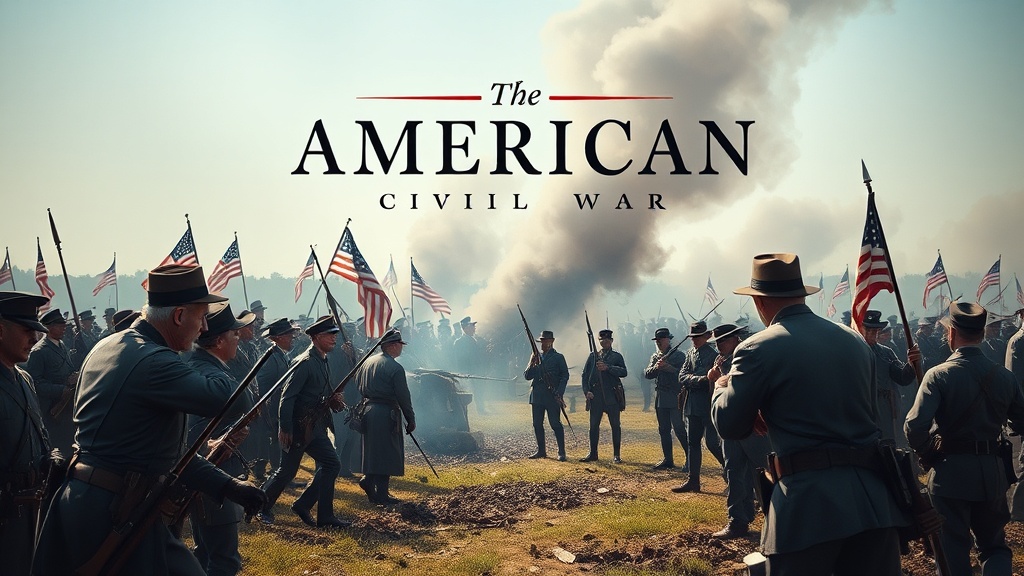
The pretence of peace ended on the morning of April 12, 1861. Fort Sumter, a federal garrison sitting in the harbour of Charleston, South Carolina, had been under Confederate siege for months. The small Union force inside was running low on supplies, and Lincoln announced he would be sending a resupply ship — a deliberate but non-aggressive move designed to force the Confederacy's hand without firing the first shot.
Confederate General P.G.T. Beauregard demanded the fort's surrender. When the Union commander refused, Confederate artillery opened fire. The bombardment lasted thirty-four hours. Remarkably, no Union soldiers were killed in the fighting itself — two died in a post-surrender cannon accident — but the symbolic damage was total. The Civil War had begun.
Lincoln called for 75,000 volunteers to suppress the rebellion. Men signed up in their thousands, on both sides, many expecting a short, almost sporting conflict. Few could have imagined what was actually coming. The Union strategy, devised partly by the aging but strategically astute General Winfield Scott, involved a naval blockade to strangle Southern supply lines, control of the Mississippi River to split the Confederacy in two, and a direct campaign against Richmond, Virginia, the Confederate capital. The Confederates, outnumbered and outindustrialised, were banking on something harder to quantify: the will to fight for home soil, and the hope that a prolonged conflict would exhaust the North's appetite for war.
Free Weekly Newsletter
Enjoying this guide?
Get the best articles like this one delivered to your inbox every week. No spam.
Both sides were wrong about how quickly it would end. Neither side was wrong about how much it would cost.
What the Civil War Truly Reveals About the American Experiment
The American Civil War is not simply a chapter in a history textbook. It is a referendum on what the United States actually was — and what it was willing to become. The political debates that preceded it were not just arguments about tariffs or states' rights, though those featured prominently in the rhetoric. At the core, they were arguments about whether the founding promise of liberty was real or performative, universal or conditional.
For the four million enslaved men, women, and children living in America at the war's outbreak, the conflict was never abstract. It was not about electoral college margins or constitutional interpretation. It was about whether they would live and die as property or as people. The political theatre that surrounded the lead-up to the war — the compromises, the speeches, the legal manoeuvres — had human lives as its ultimate currency.
The war that followed would last four years, reshape the constitutional order, and leave scars that the United States is, in many ways, still tracing. Understanding its origins is not an academic exercise. It is a prerequisite for understanding America itself — its idealism and its failures, its grandeur and its shame, and the permanent, unresolved tension between the nation it declared itself to be and the nation it has always been working to become.
Frequently Asked Questions
What were the main causes of the American Civil War?
The American Civil War had multiple interlocking causes, but slavery was the central and overriding one. Economic differences between the industrialised North and the plantation-based South, disagreements over states' rights versus federal authority, and the question of whether slavery should expand into new western territories all contributed. However, as the secession declarations of Southern states make explicitly clear, the defence of slavery was the primary motivation for leaving the Union.
Was Abraham Lincoln an abolitionist when the Civil War began?
Not in the strict sense. Lincoln believed slavery was morally wrong and said so publicly, but his initial political position was to prevent its expansion rather than abolish it outright. He believed that containing slavery geographically would allow it to die out naturally over time. The Civil War itself would eventually force a far more radical stance, culminating in the Emancipation Proclamation of 1863.
Why did Southern states believe they had the right to secede?
Many Southerners argued that the United States was a voluntary compact of sovereign states, and that any state retained the right to withdraw from that compact if it felt its fundamental interests were being violated. They pointed to the Tenth Amendment and the general principle of states' rights. However, Lincoln and most Northern leaders rejected this interpretation entirely, viewing the Union as a permanent and indissoluble nation rather than a loose confederation.
Who fired the first shots of the American Civil War?
Confederate forces fired the first shots of the American Civil War at Fort Sumter, South Carolina, on April 12, 1861. Confederate General P.G.T. Beauregard ordered the bombardment after the Union garrison, commanded by Major Robert Anderson, refused to surrender the federal fort. The attack gave Lincoln the political justification he needed to mobilise the Union's full military response and frame the conflict as a suppression of rebellion rather than an act of Northern aggression.
Frequently Asked Questions
When a Nation Built on Freedom Couldn't Agree on What Freedom Meant
Imagine writing the most radical political document of the modern age — one declaring that all men are created equal — and then, within the same generation, watching that promise collapse under the weight of its own contradictions. The American Civil War did not erupt suddenly. It was the slow, agonising result of decades of deferred decisions, moral compromise, and a nation so deeply divided that it could no longer share the same flag. Understanding how the United States arrived at its bloodiest conflict means tracing a fault line that was baked into the republic's very foundation.
The American Civil War, which officially began in April 1861, claimed more than 620,000 lives — more than any other conflict in American history. But numbers alone don't capture the weight of what happened. This was a war about identity, power, and whether the idea of America was even worth preserving. To understand it, we have to go back — further than Fort Sumter, further than Lincoln, all the way back to the moment the Founding Fathers blinked.
The Original Sin: Slavery and the Founding Compromise
Thomas Jefferson drafted a condemnation of slavery in the original Declaration of Independence. It was removed. That single editorial decision — driven by the practical need to secure Southern support — set the stage for everything that followed. The Founders knew slavery was incompatible with their stated ideals. They chose political unity over moral clarity, and they left the question open like a wound that would never quite heal.
For the first half of the nineteenth century, American politicians became increasingly skilled at kicking this particular can down the road. The Missouri Compromise of 1820 admitted Missouri as a slave state and Maine as a free state, drawing a geographic line at latitude 36°30′ and declaring that slavery would be prohibited north of it. It was an elegant solution, and it lasted about thirty years before the pressure of westward expansion shattered it completely.
Every new territory added to the United States reopened the same question: slave or free? And every answer had consequences. If slave states outnumbered free states in the Senate, they could block abolitionist legislation. If free states pulled ahead, the South feared losing its economic and political footing entirely. The balance wasn't just symbolic — it was a structural pillar holding up a deeply unstable union.
Two Americas: The Economic Divide That Made War Inevitable
By the 1840s, the North and the South weren't just politically different — they were economically incompatible. Northern cities were industrialising rapidly, building factories, expanding railroads, and drawing in immigrant labour. The Northern economy, increasingly complex and diversified, had little structural need for enslaved labour.
The South, by contrast, had built its entire agricultural economy on cotton, tobacco, and rice — all labour-intensive crops that plantation owners insisted required enslaved workers to remain profitable. When Eli Whitney's cotton gin arrived in 1793, it didn't reduce the demand for enslaved people. It exploded it. Cotton became king, and slavery became the throne it sat upon.
This economic divergence created two genuinely different cultures, two different senses of identity, and two very different ideas about what America was supposed to be. Northerners increasingly saw Southern slavery as a moral stain and an economic threat — large plantations could undercut free labourers and consume land that white settlers wanted for themselves. Southerners, meanwhile, came to see any Northern interference as an existential threat to their way of life. Mistrust calcified into contempt, and contempt hardened into something far more dangerous.
Bleeding Kansas and the Road to Radical Action
The Kansas-Nebraska Act of 1854 was supposed to resolve tensions through democracy. Instead, it detonated them. Senator Stephen Douglas, eager to build a transcontinental railroad through Illinois, proposed that the new territories of Kansas and Nebraska be allowed to decide the slavery question through popular vote — a doctrine called "popular sovereignty." The act effectively nullified the Missouri Compromise and sent shock waves through the North.
What followed was one of the most darkly chaotic episodes in pre-war American history. Pro-slavery and anti-slavery settlers flooded into Kansas to swing the vote, and they brought weapons. The territory descended into guerrilla violence. "Bleeding Kansas," as it came to be known, was a preview of the larger war to come — a place where the political had become lethally personal.
Among those who arrived in Kansas was John Brown, a former businessman turned radical abolitionist who had failed at nearly every commercial venture he'd attempted but had found his purpose in the destruction of slavery. After a pro-slavery raid on an anti-slavery settlement, Brown led a retaliatory attack on a pro-slavery camp along Pottawatomie Creek, killing five men. It was brutal, extrajudicial, and — depending on who was telling the story — either terrorism or righteous vengeance. Brown would later attempt to ignite a full-scale slave uprising by seizing the federal arsenal at Harpers Ferry, Virginia, in 1859. He was captured by a force commanded by Robert E. Lee, tried for treason, and hanged. In the North, he became a martyr. In the South, he became proof that the North wanted war.
Abraham Lincoln and the Spark That Lit the Powder Keg
Abraham Lincoln was not, by the standards of his era, a radical. He believed slavery was a moral evil — he said so clearly and repeatedly in some of the most powerful political oratory of the nineteenth century. His 1858 "House Divided" speech warned that the United States could not survive permanently half slave and half free. But his immediate policy goal was not abolition. It was containment: prevent the expansion of slavery into new territories, and trust that it would eventually die out on its own.
That nuance was entirely lost on the South. When Lincoln secured the Republican Party nomination in 1860 and then won the presidency — without even appearing on the ballot in ten Southern states — the reaction was immediate and visceral. For Southern leaders, a Lincoln presidency represented the final proof that they had lost their voice in the federal government. One by one, eleven Southern states voted to leave the Union, forming the Confederate States of America and electing Jefferson Davis as their president.
The seceding states were not shy about their reasons. South Carolina's declaration of secession explicitly cited Northern hostility to slavery. Mississippi's declaration opened with the blunt statement that their position was "thoroughly identified with the institution of slavery." Confederate Vice President Alexander Stephens gave a speech declaring that the new government rested upon what he called "the great truth" of racial inequality. These were not dog whistles. They were founding documents.
Lincoln, for his part, declared secession an illegitimate rebellion and vowed to preserve the Union. "In your hands, my dissatisfied fellow countrymen, and not in mine, is the momentous issue of civil war," he said at his inauguration. "You have no oath registered in heaven to destroy the government, while I shall have the most solemn one to preserve, protect, and defend it."
Fort Sumter: The Shot That Ended All Pretence
The pretence of peace ended on the morning of April 12, 1861. Fort Sumter, a federal garrison sitting in the harbour of Charleston, South Carolina, had been under Confederate siege for months. The small Union force inside was running low on supplies, and Lincoln announced he would be sending a resupply ship — a deliberate but non-aggressive move designed to force the Confederacy's hand without firing the first shot.
Confederate General P.G.T. Beauregard demanded the fort's surrender. When the Union commander refused, Confederate artillery opened fire. The bombardment lasted thirty-four hours. Remarkably, no Union soldiers were killed in the fighting itself — two died in a post-surrender cannon accident — but the symbolic damage was total. The Civil War had begun.
Lincoln called for 75,000 volunteers to suppress the rebellion. Men signed up in their thousands, on both sides, many expecting a short, almost sporting conflict. Few could have imagined what was actually coming. The Union strategy, devised partly by the aging but strategically astute General Winfield Scott, involved a naval blockade to strangle Southern supply lines, control of the Mississippi River to split the Confederacy in two, and a direct campaign against Richmond, Virginia, the Confederate capital. The Confederates, outnumbered and outindustrialised, were banking on something harder to quantify: the will to fight for home soil, and the hope that a prolonged conflict would exhaust the North's appetite for war.
Both sides were wrong about how quickly it would end. Neither side was wrong about how much it would cost.
What the Civil War Truly Reveals About the American Experiment
The American Civil War is not simply a chapter in a history textbook. It is a referendum on what the United States actually was — and what it was willing to become. The political debates that preceded it were not just arguments about tariffs or states' rights, though those featured prominently in the rhetoric. At the core, they were arguments about whether the founding promise of liberty was real or performative, universal or conditional.
For the four million enslaved men, women, and children living in America at the war's outbreak, the conflict was never abstract. It was not about electoral college margins or constitutional interpretation. It was about whether they would live and die as property or as people. The political theatre that surrounded the lead-up to the war — the compromises, the speeches, the legal manoeuvres — had human lives as its ultimate currency.
The war that followed would last four years, reshape the constitutional order, and leave scars that the United States is, in many ways, still tracing. Understanding its origins is not an academic exercise. It is a prerequisite for understanding America itself — its idealism and its failures, its grandeur and its shame, and the permanent, unresolved tension between the nation it declared itself to be and the nation it has always been working to become.
Frequently Asked Questions
What were the main causes of the American Civil War?
The American Civil War had multiple interlocking causes, but slavery was the central and overriding one. Economic differences between the industrialised North and the plantation-based South, disagreements over states' rights versus federal authority, and the question of whether slavery should expand into new western territories all contributed. However, as the secession declarations of Southern states make explicitly clear, the defence of slavery was the primary motivation for leaving the Union.
Was Abraham Lincoln an abolitionist when the Civil War began?
Not in the strict sense. Lincoln believed slavery was morally wrong and said so publicly, but his initial political position was to prevent its expansion rather than abolish it outright. He believed that containing slavery geographically would allow it to die out naturally over time. The Civil War itself would eventually force a far more radical stance, culminating in the Emancipation Proclamation of 1863.
Why did Southern states believe they had the right to secede?
Many Southerners argued that the United States was a voluntary compact of sovereign states, and that any state retained the right to withdraw from that compact if it felt its fundamental interests were being violated. They pointed to the Tenth Amendment and the general principle of states' rights. However, Lincoln and most Northern leaders rejected this interpretation entirely, viewing the Union as a permanent and indissoluble nation rather than a loose confederation.
Who fired the first shots of the American Civil War?
Confederate forces fired the first shots of the American Civil War at Fort Sumter, South Carolina, on April 12, 1861. Confederate General P.G.T. Beauregard ordered the bombardment after the Union garrison, commanded by Major Robert Anderson, refused to surrender the federal fort. The attack gave Lincoln the political justification he needed to mobilise the Union's full military response and frame the conflict as a suppression of rebellion rather than an act of Northern aggression.
About Zeebrain Editorial
Zeebrain publishes independent analysis of markets, investing, personal finance, and business. We disclose affiliate relationships, never accept payment for coverage, and fact-check all claims against primary sources. Read our editorial policy →
How this article was produced: Zeebrain articles are created with AI assistance from primary sources (including cited videos and market data) and reviewed under our editorial standards before publication. Spot an error? Tell us and we will correct it.
More from History & Mysteries

Related Guides
Keep exploring this topic
How the 1876 Election Almost Triggered a Second Civil War
History & Mysteries · 1876 election · American Civil War
The American Civil War: How the Union Turned the Tide
History & Mysteries · American Civil War · Ulysses S. Grant
Why Spain Chose to Fight the USA in 1898 — And Lost Everything
History & Mysteries · Spanish-American War · Spanish Empire
Why Mao Won the Chinese Civil War: The Full Story
History & Mysteries
Explore More Categories
Keep browsing by topic and build depth around the subjects you care about most.