How the 1876 Election Almost Triggered a Second Civil War
Quick Summary
The 1876 US election between Hayes and Tilden came dangerously close to reigniting civil war. Here's the full, dramatic story of how America pulled back from the brink.
In This Article
The Election That Nearly Tore America Apart — Again
Eleven years after Appomattox, the wounds of the American Civil War had not healed. They had merely scabbed over — thin, fragile, and ready to crack open at the slightest provocation. The 1876 US presidential election provided that provocation in abundance. What began as a routine contest between two unremarkable candidates spiralled into a constitutional crisis so severe that troops were mobilised, secret inaugurations were planned, and former Confederate generals began quietly counting their men. For several months, the United States teetered on the edge of tearing itself apart for the second time in a generation.
This is not a forgotten footnote. It is one of the most consequential — and least understood — political crises in American history. And the closer you look at it, the more alarming it becomes.
The Powder Keg: Reconstruction and Its Discontents
To understand why the 1876 election carried the weight it did, you have to understand the world it arrived into. Reconstruction — the federal programme designed to reintegrate the defeated Confederate states into the Union after 1865 — was, by almost any measure, a failure of political nerve dressed up as policy.
The theory was noble enough. Formerly enslaved people were granted citizenship and equal rights under the 14th Amendment. Confederate states were placed under military governance until they complied with federal demands, ratified the amendment, and demonstrated some basic commitment to the new order. In practice, the moment these states were readmitted, many of them passed sweeping legislation that effectively re-enslaved their Black populations through legal rather than literal chains. Literacy tests, property requirements, poll taxes — none of these mentioned race explicitly, yet all of them were designed with surgical precision to strip Black citizens of their newly granted rights.
The federal government, for all its wartime ferocity, looked the other way. Reconstruction was deeply unpopular in the North, perceived as expensive, corrupt, and endlessly complicated. By the mid-1870s, most Northerners simply wanted it to be over. Southern white resistance, meanwhile, had hardened into something organised and violent. Paramilitary groups terrorised Black voters and Republican officials with near-total impunity. The stage was set for an election that would decide not just who governed, but whether the post-war settlement would survive at all.
Two Men, Three States, and a Crisis Without a Rulebook
The 1876 election pitted Republican Rutherford B. Hayes, the moderate governor of Ohio, against Democrat Samuel J. Tilden, the reform-minded governor of New York. Hayes represented a softer Republican approach to the South — conciliation over confrontation. Tilden, wealthy and politically shrewd, had built his reputation fighting corruption and enjoyed broad support among Southern whites who simply wanted federal troops off their soil and Reconstruction buried.
On election night, the results appeared to hand Tilden a decisive victory. He won the popular vote convincingly and seemed to have secured enough electoral college votes to claim the presidency without dispute. Then the Republican Party looked more carefully at three Southern states — Florida, Louisiana, and South Carolina — and suddenly everything was in play.
The irregularities in these states were real, though both parties had been enthusiastically creative in manufacturing them. In Florida and Louisiana, Democratic ballots had been deliberately designed to mimic Republican ones, confusing illiterate voters — a population that was large, by design, given decades of denied education. South Carolina, with characteristic audacity, had somehow produced more votes than it had eligible voters. Republican-controlled election boards in all three states began disqualifying Democratic votes wholesale. Hayes was handed all three states and, with them, the presidency by a single electoral vote.
The Democratic response was volcanic. Hayes was immediately dubbed 'Rutherfraud' and 'His Fraudulency' by opponents who felt — with considerable justification — that the election had been stolen in broad daylight. The constitutional machinery for resolving such a dispute barely existed. The vice president, who would ordinarily certify the results, was conveniently dead. His replacement as Senate president was a Republican, whom no Democrat would accept as an honest broker. And the Democrat-controlled House of Representatives argued, under the 12th Amendment, that the decision rightfully belonged to them — a claim Republicans flatly rejected.
Militias, Secret Ceremonies, and the Smell of Gunpowder
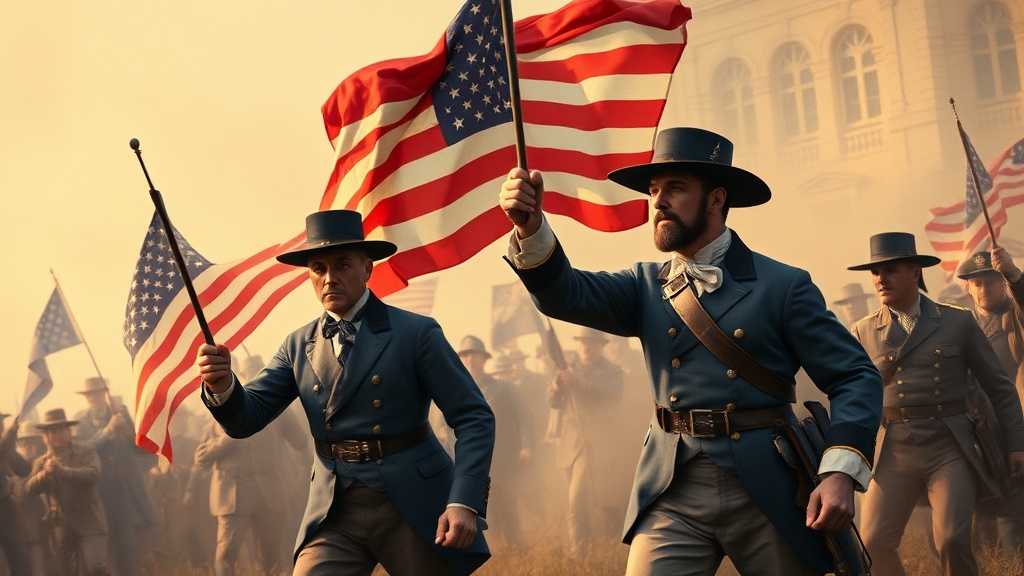
What followed was not merely political theatre. It had the texture of genuine pre-war tension. President Ulysses S. Grant — deeply unpopular but still in office — ordered thousands of troops into and around Washington DC to protect Hayes during the transition. Hayes's inauguration was quietly moved forward by a full day and conducted privately inside the White House to avoid any public confrontation. Democrats were barred from the subsequent public ceremony entirely.
On the other side, Democratic governors across multiple states made public noises about mobilising their militias. Union General George B. McClellan — yes, the same McClellan who had frustrated Lincoln during the war — was quietly gathering veterans and holding conversations with former Confederate commanders, apparently preparing for the possibility of armed conflict. Tilden's supporters floated the idea of staging a rival inauguration ceremony in New York City, openly challenging the legitimacy of Hayes's presidency before it had even formally begun.
The phrase on many lips was 'Mexicanization' — a pointed and somewhat patronising reference to the political instability of neighbouring Mexico, where rival factions frequently resolved election disputes through violence rather than law. Americans on both sides understood, with genuine dread, that this was the direction they were heading.
The Commission That Saved — and Condemned — a Nation
Faced with the very real possibility of a second civil war, Washington did what Washington does in moments of existential crisis: it formed a committee. The Electoral Commission of 1877 was a fifteen-member body comprising seven Democrats, seven Republicans, and one supposedly independent Supreme Court justice — David Davis — who was universally regarded as a man of genuine integrity.
The Democrats, sensing an opportunity, promptly offered Davis a Senate seat from Illinois. He accepted. Then, to his credit and perhaps their horror, he concluded that accepting the seat made his presence on the commission an obvious conflict of interest and resigned from it. The remaining Supreme Court justices were all Republicans. His replacement was, naturally, a Republican. The commission then voted along strict party lines on every single contested question, awarding Hayes all three disputed states and, with them, the presidency.
The final tally: Hayes, 185 electoral votes. Tilden, 184.
One vote. After months of crisis, potential civil war, and a constitutional system pushed to its absolute limits, the margin was a single electoral college vote.
Congress was bound, under the terms of the commission, to accept its ruling unless both chambers rejected it. The Democrat-controlled House voted to reject. The Republican Senate did not. Hayes became president. The House subsequently passed a resolution — symbolic, toothless, but furious in intent — declaring Tilden the rightful winner and Hayes's presidency illegitimate. It changed nothing.
Why the War Didn't Come — and What It Cost
Tilden's acceptance of defeat was not gracious, but it was consequential. He was, by all accounts, extraordinarily wealthy — wealthy enough to have funded a serious challenge. His allies were asking him to do exactly that. He declined. Whether this was fatalism, political exhaustion, or a cold calculation that the fight wasn't worth winning, historians still debate. But his passivity in the crucial weeks before the commission's ruling allowed the temperature to drop enough that his supporters — still furious, but no longer actively loading rifles — stepped back from the edge.
Hayes, by contrast, never wavered. He behaved from the moment the results were disputed as though the presidency was already his, treating any challenge as an assault on democracy itself. The psychological advantage this gave him was considerable.
The so-called Corrupt Bargain of 1877 — the popular theory that Democrats agreed to give Hayes the presidency in exchange for ending Reconstruction and withdrawing federal troops from the South — is almost certainly a myth, or at least a vast oversimplification. Hayes did withdraw the troops. He did effectively end Reconstruction. But there is no credible evidence of a formal deal. Hayes was simply a more moderate Republican who genuinely believed his party had been too heavy-handed with the South. The outcome, from the perspective of Black Americans in the South, was catastrophic regardless of whether a backroom deal was struck. Reconstruction's end left them exposed to decades of systemic terror, disenfranchisement, and violence that would not be meaningfully addressed until the Civil Rights movement nearly a century later.
Free Weekly Newsletter
Enjoying this guide?
Get the best articles like this one delivered to your inbox every week. No spam.
The real reason civil war was averted in 1877 was not institutional genius. The institutions, frankly, barely held. What prevented catastrophe was a widely shared — if imperfect — cultural commitment to the idea that democratic processes, however flawed, were preferable to armed conflict. Politicians on both sides had lived through the Civil War, or grown up in its shadow. They knew, viscerally and personally, what it cost. That knowledge was enough, just barely, to keep the guns in their holsters.
What 1876 Tells Us About Democracy's Fragility
The 1876 election is not simply a historical curiosity. It is a case study in how democratic systems can fail — not through any single act of villainy, but through the accumulation of bad faith, procedural gaps, partisan manipulation, and the gradual erosion of shared norms. The United States in 1876 had no standardised ballots, no independent electoral commission, no clear constitutional mechanism for resolving disputed results, and a political culture still poisoned by a decade of post-war resentment.
What it did have, just barely, was enough people in enough positions of influence who understood that the alternative to imperfect democracy was something far worse. The margin was terrifyingly thin. One different decision by Tilden — to fund his allies' preparations, to show up forcefully at the right moment — and the story might have ended very differently.
The 1876 election is a reminder that democracy is not self-sustaining. It requires active, deliberate maintenance by people willing to accept outcomes they despise — not because those outcomes are just, but because the process that produced them is worth preserving. In 1877, just enough Americans made that choice. The rest, as history so painfully records, was left unpaid.
Frequently Asked Questions
Who actually won the 1876 presidential election?
Samuel J. Tilden won the popular vote by a clear margin of roughly 250,000 votes. He also initially appeared to have won the electoral college. However, following disputes over returns in Florida, Louisiana, and South Carolina — all of which involved credible evidence of fraud and voter suppression on both sides — a specially convened Electoral Commission awarded all three states, and therefore the presidency, to Republican Rutherford B. Hayes by a margin of 185 to 184 electoral votes.
What was the Corrupt Bargain of 1877?
The Corrupt Bargain of 1877 refers to the popular — but largely unsubstantiated — theory that Democratic Party leaders agreed to accept Hayes's presidency in exchange for the Republican promise to end Reconstruction and withdraw federal troops from the South. Hayes did both of these things after taking office, but no documentary evidence of a formal agreement exists. Historians broadly believe the 'bargain' is more myth than reality, and that Hayes's actions reflected his own moderate political beliefs rather than a negotiated settlement.
How close did the United States actually come to a second civil war in 1876?
Very close, in the sense that the conditions for armed conflict were present: mobilised militias, troops deployed in Washington DC, rival inauguration plans, and political leaders openly discussing the possibility of war. However, several factors prevented escalation — most significantly Tilden's passivity, Hayes's confidence, the Electoral Commission's binding decision, and a broadly shared cultural reluctance to revisit the horrors of the Civil War. The crisis was real; the catastrophe was, narrowly, avoided.
What were the long-term consequences of the 1876 election?
The most significant long-term consequence was the effective end of Reconstruction. With federal troops withdrawn from the South and Republican political will exhausted, Southern states were free to implement the systematic disenfranchisement and oppression of Black citizens that would define the Jim Crow era for the next eight decades. The 1876 election did not cause this outcome alone, but it removed the last meaningful federal resistance to it. For Black Americans in the South, the resolution of the 1876 crisis represented not a peaceful settlement, but an abandonment.
Why did the Electoral Commission side with Hayes?
The commission was supposed to include one genuinely independent member — Supreme Court Justice David Davis — who would serve as the deciding vote. When Illinois Democrats offered Davis a Senate seat (hoping to win his favour), he accepted the position but, feeling compromised, resigned from the commission. All remaining Supreme Court justices were Republicans. The commission subsequently voted along strict party lines on every contested question, 8 to 7, in favour of Hayes. The process was technically legal but widely regarded, even at the time, as deeply partisan.
Frequently Asked Questions
The Election That Nearly Tore America Apart — Again
Eleven years after Appomattox, the wounds of the American Civil War had not healed. They had merely scabbed over — thin, fragile, and ready to crack open at the slightest provocation. The 1876 US presidential election provided that provocation in abundance. What began as a routine contest between two unremarkable candidates spiralled into a constitutional crisis so severe that troops were mobilised, secret inaugurations were planned, and former Confederate generals began quietly counting their men. For several months, the United States teetered on the edge of tearing itself apart for the second time in a generation.
This is not a forgotten footnote. It is one of the most consequential — and least understood — political crises in American history. And the closer you look at it, the more alarming it becomes.
The Powder Keg: Reconstruction and Its Discontents
To understand why the 1876 election carried the weight it did, you have to understand the world it arrived into. Reconstruction — the federal programme designed to reintegrate the defeated Confederate states into the Union after 1865 — was, by almost any measure, a failure of political nerve dressed up as policy.
The theory was noble enough. Formerly enslaved people were granted citizenship and equal rights under the 14th Amendment. Confederate states were placed under military governance until they complied with federal demands, ratified the amendment, and demonstrated some basic commitment to the new order. In practice, the moment these states were readmitted, many of them passed sweeping legislation that effectively re-enslaved their Black populations through legal rather than literal chains. Literacy tests, property requirements, poll taxes — none of these mentioned race explicitly, yet all of them were designed with surgical precision to strip Black citizens of their newly granted rights.
The federal government, for all its wartime ferocity, looked the other way. Reconstruction was deeply unpopular in the North, perceived as expensive, corrupt, and endlessly complicated. By the mid-1870s, most Northerners simply wanted it to be over. Southern white resistance, meanwhile, had hardened into something organised and violent. Paramilitary groups terrorised Black voters and Republican officials with near-total impunity. The stage was set for an election that would decide not just who governed, but whether the post-war settlement would survive at all.
Two Men, Three States, and a Crisis Without a Rulebook
The 1876 election pitted Republican Rutherford B. Hayes, the moderate governor of Ohio, against Democrat Samuel J. Tilden, the reform-minded governor of New York. Hayes represented a softer Republican approach to the South — conciliation over confrontation. Tilden, wealthy and politically shrewd, had built his reputation fighting corruption and enjoyed broad support among Southern whites who simply wanted federal troops off their soil and Reconstruction buried.
On election night, the results appeared to hand Tilden a decisive victory. He won the popular vote convincingly and seemed to have secured enough electoral college votes to claim the presidency without dispute. Then the Republican Party looked more carefully at three Southern states — Florida, Louisiana, and South Carolina — and suddenly everything was in play.
The irregularities in these states were real, though both parties had been enthusiastically creative in manufacturing them. In Florida and Louisiana, Democratic ballots had been deliberately designed to mimic Republican ones, confusing illiterate voters — a population that was large, by design, given decades of denied education. South Carolina, with characteristic audacity, had somehow produced more votes than it had eligible voters. Republican-controlled election boards in all three states began disqualifying Democratic votes wholesale. Hayes was handed all three states and, with them, the presidency by a single electoral vote.
The Democratic response was volcanic. Hayes was immediately dubbed 'Rutherfraud' and 'His Fraudulency' by opponents who felt — with considerable justification — that the election had been stolen in broad daylight. The constitutional machinery for resolving such a dispute barely existed. The vice president, who would ordinarily certify the results, was conveniently dead. His replacement as Senate president was a Republican, whom no Democrat would accept as an honest broker. And the Democrat-controlled House of Representatives argued, under the 12th Amendment, that the decision rightfully belonged to them — a claim Republicans flatly rejected.
Militias, Secret Ceremonies, and the Smell of Gunpowder
What followed was not merely political theatre. It had the texture of genuine pre-war tension. President Ulysses S. Grant — deeply unpopular but still in office — ordered thousands of troops into and around Washington DC to protect Hayes during the transition. Hayes's inauguration was quietly moved forward by a full day and conducted privately inside the White House to avoid any public confrontation. Democrats were barred from the subsequent public ceremony entirely.
On the other side, Democratic governors across multiple states made public noises about mobilising their militias. Union General George B. McClellan — yes, the same McClellan who had frustrated Lincoln during the war — was quietly gathering veterans and holding conversations with former Confederate commanders, apparently preparing for the possibility of armed conflict. Tilden's supporters floated the idea of staging a rival inauguration ceremony in New York City, openly challenging the legitimacy of Hayes's presidency before it had even formally begun.
The phrase on many lips was 'Mexicanization' — a pointed and somewhat patronising reference to the political instability of neighbouring Mexico, where rival factions frequently resolved election disputes through violence rather than law. Americans on both sides understood, with genuine dread, that this was the direction they were heading.
The Commission That Saved — and Condemned — a Nation
Faced with the very real possibility of a second civil war, Washington did what Washington does in moments of existential crisis: it formed a committee. The Electoral Commission of 1877 was a fifteen-member body comprising seven Democrats, seven Republicans, and one supposedly independent Supreme Court justice — David Davis — who was universally regarded as a man of genuine integrity.
The Democrats, sensing an opportunity, promptly offered Davis a Senate seat from Illinois. He accepted. Then, to his credit and perhaps their horror, he concluded that accepting the seat made his presence on the commission an obvious conflict of interest and resigned from it. The remaining Supreme Court justices were all Republicans. His replacement was, naturally, a Republican. The commission then voted along strict party lines on every single contested question, awarding Hayes all three disputed states and, with them, the presidency.
The final tally: Hayes, 185 electoral votes. Tilden, 184.
One vote. After months of crisis, potential civil war, and a constitutional system pushed to its absolute limits, the margin was a single electoral college vote.
Congress was bound, under the terms of the commission, to accept its ruling unless both chambers rejected it. The Democrat-controlled House voted to reject. The Republican Senate did not. Hayes became president. The House subsequently passed a resolution — symbolic, toothless, but furious in intent — declaring Tilden the rightful winner and Hayes's presidency illegitimate. It changed nothing.
Why the War Didn't Come — and What It Cost
Tilden's acceptance of defeat was not gracious, but it was consequential. He was, by all accounts, extraordinarily wealthy — wealthy enough to have funded a serious challenge. His allies were asking him to do exactly that. He declined. Whether this was fatalism, political exhaustion, or a cold calculation that the fight wasn't worth winning, historians still debate. But his passivity in the crucial weeks before the commission's ruling allowed the temperature to drop enough that his supporters — still furious, but no longer actively loading rifles — stepped back from the edge.
Hayes, by contrast, never wavered. He behaved from the moment the results were disputed as though the presidency was already his, treating any challenge as an assault on democracy itself. The psychological advantage this gave him was considerable.
The so-called Corrupt Bargain of 1877 — the popular theory that Democrats agreed to give Hayes the presidency in exchange for ending Reconstruction and withdrawing federal troops from the South — is almost certainly a myth, or at least a vast oversimplification. Hayes did withdraw the troops. He did effectively end Reconstruction. But there is no credible evidence of a formal deal. Hayes was simply a more moderate Republican who genuinely believed his party had been too heavy-handed with the South. The outcome, from the perspective of Black Americans in the South, was catastrophic regardless of whether a backroom deal was struck. Reconstruction's end left them exposed to decades of systemic terror, disenfranchisement, and violence that would not be meaningfully addressed until the Civil Rights movement nearly a century later.
The real reason civil war was averted in 1877 was not institutional genius. The institutions, frankly, barely held. What prevented catastrophe was a widely shared — if imperfect — cultural commitment to the idea that democratic processes, however flawed, were preferable to armed conflict. Politicians on both sides had lived through the Civil War, or grown up in its shadow. They knew, viscerally and personally, what it cost. That knowledge was enough, just barely, to keep the guns in their holsters.
What 1876 Tells Us About Democracy's Fragility
The 1876 election is not simply a historical curiosity. It is a case study in how democratic systems can fail — not through any single act of villainy, but through the accumulation of bad faith, procedural gaps, partisan manipulation, and the gradual erosion of shared norms. The United States in 1876 had no standardised ballots, no independent electoral commission, no clear constitutional mechanism for resolving disputed results, and a political culture still poisoned by a decade of post-war resentment.
What it did have, just barely, was enough people in enough positions of influence who understood that the alternative to imperfect democracy was something far worse. The margin was terrifyingly thin. One different decision by Tilden — to fund his allies' preparations, to show up forcefully at the right moment — and the story might have ended very differently.
The 1876 election is a reminder that democracy is not self-sustaining. It requires active, deliberate maintenance by people willing to accept outcomes they despise — not because those outcomes are just, but because the process that produced them is worth preserving. In 1877, just enough Americans made that choice. The rest, as history so painfully records, was left unpaid.
Frequently Asked Questions
Who actually won the 1876 presidential election?
Samuel J. Tilden won the popular vote by a clear margin of roughly 250,000 votes. He also initially appeared to have won the electoral college. However, following disputes over returns in Florida, Louisiana, and South Carolina — all of which involved credible evidence of fraud and voter suppression on both sides — a specially convened Electoral Commission awarded all three states, and therefore the presidency, to Republican Rutherford B. Hayes by a margin of 185 to 184 electoral votes.
What was the Corrupt Bargain of 1877?
The Corrupt Bargain of 1877 refers to the popular — but largely unsubstantiated — theory that Democratic Party leaders agreed to accept Hayes's presidency in exchange for the Republican promise to end Reconstruction and withdraw federal troops from the South. Hayes did both of these things after taking office, but no documentary evidence of a formal agreement exists. Historians broadly believe the 'bargain' is more myth than reality, and that Hayes's actions reflected his own moderate political beliefs rather than a negotiated settlement.
How close did the United States actually come to a second civil war in 1876?
Very close, in the sense that the conditions for armed conflict were present: mobilised militias, troops deployed in Washington DC, rival inauguration plans, and political leaders openly discussing the possibility of war. However, several factors prevented escalation — most significantly Tilden's passivity, Hayes's confidence, the Electoral Commission's binding decision, and a broadly shared cultural reluctance to revisit the horrors of the Civil War. The crisis was real; the catastrophe was, narrowly, avoided.
What were the long-term consequences of the 1876 election?
The most significant long-term consequence was the effective end of Reconstruction. With federal troops withdrawn from the South and Republican political will exhausted, Southern states were free to implement the systematic disenfranchisement and oppression of Black citizens that would define the Jim Crow era for the next eight decades. The 1876 election did not cause this outcome alone, but it removed the last meaningful federal resistance to it. For Black Americans in the South, the resolution of the 1876 crisis represented not a peaceful settlement, but an abandonment.
Why did the Electoral Commission side with Hayes?
The commission was supposed to include one genuinely independent member — Supreme Court Justice David Davis — who would serve as the deciding vote. When Illinois Democrats offered Davis a Senate seat (hoping to win his favour), he accepted the position but, feeling compromised, resigned from the commission. All remaining Supreme Court justices were Republicans. The commission subsequently voted along strict party lines on every contested question, 8 to 7, in favour of Hayes. The process was technically legal but widely regarded, even at the time, as deeply partisan.
About Zeebrain Editorial
Zeebrain publishes independent analysis of markets, investing, personal finance, and business. We disclose affiliate relationships, never accept payment for coverage, and fact-check all claims against primary sources. Read our editorial policy →
How this article was produced: Zeebrain articles are created with AI assistance from primary sources (including cited videos and market data) and reviewed under our editorial standards before publication. Spot an error? Tell us and we will correct it.
More from History & Mysteries



Related Guides
Keep exploring this topic
The American Civil War: How a Nation Tore Itself Apart
History & Mysteries · American Civil War · Abraham Lincoln
The American Civil War: How the Union Turned the Tide
History & Mysteries · American Civil War · Ulysses S. Grant
Why Mao Won the Chinese Civil War: The Full Story
History & Mysteries
Why Only Germany Paid WWI Reparations: The Full Story
History & Mysteries
Explore More Categories
Keep browsing by topic and build depth around the subjects you care about most.