Why Teddy Roosevelt Never Got to Fight in World War One
Quick Summary
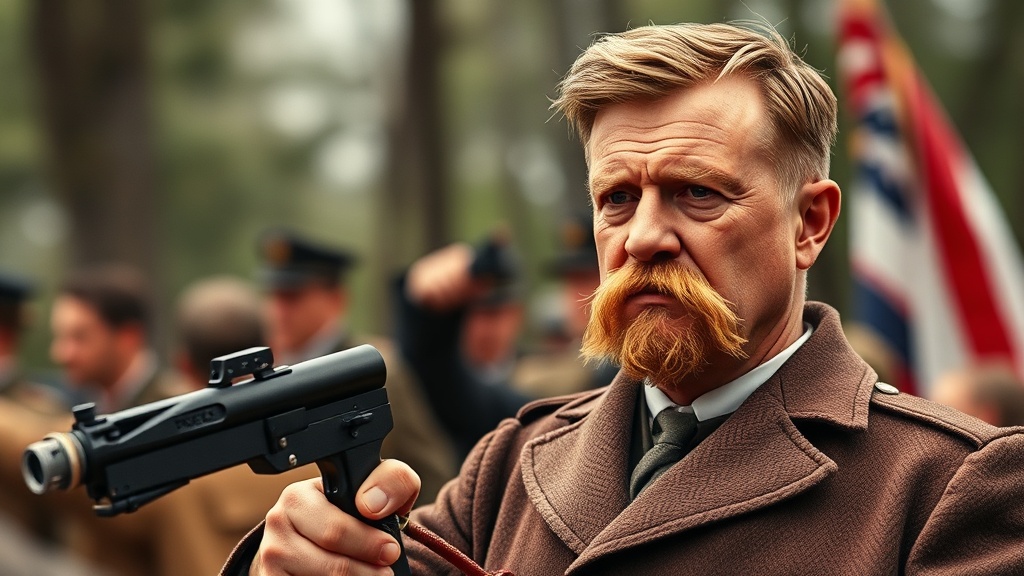
Teddy Roosevelt desperately wanted to fight in WWI. Congress even passed a law to let him. So why did Wilson say no? The answer is messier than you think.
In This Article
Why Teddy Roosevelt Never Got to Fight in World War One
Imagine a former president — war hero, Nobel Peace Prize laureate, the most recognisable face in America — begging to be sent to the trenches of the Western Front. Imagine Congress passing a law practically written around his name. Imagine the French military cheering at the very idea of him arriving on their soil. And then imagine the sitting president quietly, almost spitefully, saying no.
This is exactly what happened in 1917, and it remains one of the great what-ifs of the First World War. Theodore Roosevelt's attempt to fight in World War One was denied — not because he lacked courage, not because the law forbade it, and not entirely because he was a 58-year-old, partially blind man with a catalogue of tropical diseases. It was denied largely because of politics, ego, and the particular brand of bitterness that only former allies turned enemies can generate.
The story of why Teddy Roosevelt wasn't allowed to fight in World War One cuts to the heart of how personal ambition, wartime strategy, and democratic power can collide in ways that are equal parts tragic and farcical.
The Man Who Was Built for War
To understand why Roosevelt wanted to go to France so badly, you have to understand what war had already done for him. In 1898, he was Assistant Secretary of the Navy — a comfortable, influential desk job under President William McKinley. When the Spanish-American War broke out, he resigned. He didn't have to. He chose to.
What followed was the stuff of American legend. Roosevelt organised the First United States Volunteer Cavalry — the famous Rough Riders — and led a charge up Kettle Hill and the San Juan Heights in Cuba that turned him into a national hero almost overnight. He returned home to a ticker-tape future: Governor of New York, then Vice President, then, after McKinley's assassination in 1901, President of the United States at just 42 years old.
War had made Roosevelt. Not just politically, but psychologically. He believed deeply in what he called the strenuous life — the idea that hardship, physical courage, and sacrifice were not just virtues but civic duties. To Roosevelt, a man who stayed home while others fought was barely a man at all. He said so, loudly and repeatedly, which made his eventual exclusion from World War One all the more personally devastating.
Roosevelt vs. Wilson: A Feud That Shaped a War
By the time the guns of August fired in 1914, Theodore Roosevelt had been out of the White House for five years, but he had never really left the stage. His decision to run as a third-party candidate in 1912 — convinced that his successor and former friend William Howard Taft had betrayed the progressive cause — split the Republican vote and handed the presidency to Woodrow Wilson, a man Roosevelt would come to regard with something close to contempt.
Wilson's response to the war in Europe was, in Roosevelt's eyes, a moral catastrophe dressed up as diplomacy. While Wilson preached strict neutrality and offered to mediate, Roosevelt was travelling across America — including to heavily German-American and Irish-American communities — condemning the Kaiser's invasion of Belgium and arguing that American silence was not neutrality but cowardice. When Germany sank the RMS Lusitania in 1915, killing 1,198 people including 128 Americans, Roosevelt's outrage became operatic. Wilson's measured response — trusting that Germany would feel suitably chastened and moderate its submarine warfare — struck Roosevelt as dangerously naive.
The personal attacks escalated. Roosevelt questioned Wilson's character, his patriotism, and his competence. He backed Republican candidates against him in 1916. When Wilson narrowly won re-election, the relationship between the two men was essentially a cold war conducted through newspaper columns and public speeches.
This backstory matters enormously. Because when Roosevelt came to Wilson in 1917 — after the Zimmermann Telegram and Germany's resumption of unrestricted submarine warfare had finally brought the US into the conflict — and offered to bury the hatchet in exchange for a commission to raise and lead a volunteer force to France, he was asking a favour from a man who had very good reasons not to grant it.
The Law That Should Have Let Him Fight
What makes Roosevelt's exclusion from World War One so legally and historically peculiar is that Congress essentially passed a bill designed to send him to France. The Selective Service Act of 1917 included a provision allowing the government to raise volunteer divisions — approximately 70,000 men — who would sail to France as a vanguard, bolstering Allied lines while the larger conscripted American Expeditionary Forces were being trained and organised.
The act never mentioned Roosevelt by name. It didn't need to. Everyone in Washington knew perfectly well what the provision was for. Roosevelt had already begun recruiting officers and making preparations. Influential Republican Senator Warren G. Harding — later to become president himself — had helped shepherd the legislation through. The French government was, by multiple accounts, genuinely enthusiastic about the prospect. Roosevelt's fame in France and Britain was enormous, and Allied military leaders believed his mere presence on the Western Front would deliver a significant morale boost to exhausted troops.
But the act contained a crucial detail: the activation of those volunteer divisions was left to the discretion of the President as commander-in-chief. Wilson had the legal authority to simply decline. And he did.
Four Reasons Wilson Said No
Wilson's refusal was not the product of a single calculation. It was the convergence of several concerns, some militarily legitimate, others nakedly political.
The most reasonable objection concerned the nature of modern warfare. The War Department genuinely worried that Roosevelt's military thinking was frozen in 1898 — that he would arrive on the Western Front with the mindset of a cavalry officer and walk his volunteers into industrial slaughter. The trenches of France bore no resemblance to the hills of Cuba. Poison gas, massed artillery, and machine-gun nests had turned warfare into something that demanded specialised, methodical training. Sending an ageing, chronically ill former president to lead enthusiastic but potentially under-prepared volunteers risked not just lives but America's reputation with its Allies.
Roosevelt countered this directly, arguing that he and his officers would be fully trained in modern warfare before deployment, including gas attack protocols. He was not, he insisted, proposing to lead a cavalry charge through no man's land. But the concern lingered.
The second issue was command structure. Roosevelt had left the army as a colonel. His volunteers would theoretically sit within a larger Allied command hierarchy. The prospect of a general issuing orders to a former commander-in-chief — a man legendarily inclined to do exactly what he wanted regardless of instructions — created an almost comedic institutional dilemma. And if Roosevelt disobeyed orders? No one seriously believed you could court-martial the most beloved man in America in the middle of a war.
The third concern was the morale paradox. Supporters of Roosevelt's deployment argued that his presence would electrify Allied spirits. His opponents in Wilson's government argued the opposite risk: that if Roosevelt were killed — and the Western Front was killing men at an almost incomprehensible rate — the propaganda victory for the Central Powers would be enormous, and the blow to American morale potentially catastrophic.
But the fourth reason — the real reason, the one that Wilson's advisers understood and Roosevelt understood and history has largely confirmed — was pure political calculation. Wilson had won the 1916 election by fewer than 600,000 popular votes. He was thinking about a third term. He had watched Roosevelt dominate American political life for two decades. He knew exactly what a triumphant return from the Western Front would mean.
If Roosevelt died in France, Wilson would be the man who sent him there. If Roosevelt survived and performed heroically, he would return as something approaching a demigod — untouchable in any future election, the Republican ticket incarnate. There was no version of Roosevelt going to war that ended well for Woodrow Wilson's political future. And so Wilson said no, and the decision, as commander-in-chief, was final.
What Roosevelt Did Instead — And What It Cost Him
Rejected, Roosevelt did what Roosevelt always did: he became a very loud, very public problem for the administration. He savaged Wilson's management of the war effort, argued that America's slow mobilisation was costing Allied lives, and declared that Wilson's vision for post-war peace — the famous Fourteen Points and the proposed League of Nations — was dangerously weak.
His alternative vision was characteristically muscular. Rather than a League of Nations that relied on goodwill and moral authority, Roosevelt advocated for what he called a league to enforce peace — an international body with real teeth, obligating great powers to take collective military action against any nation that violated arbitration rulings. In practice, this was its own kind of idealism, and the great powers were no more enthusiastic about it than they were about Wilson's version. But it reflected Roosevelt's consistent worldview: that power without the credible willingness to use it was not power at all.
Free Weekly Newsletter
Enjoying this guide?
Get the best articles like this one delivered to your inbox every week. No spam.
Meanwhile, his four sons all served. Two were wounded. Quentin Roosevelt, his youngest, was shot down over France in July 1918 at the age of 20. The news broke something in the old man that his famous resilience could not repair. Friends and family noted the change immediately. The fire went out.
By the time the Armistice was signed in November 1918, Roosevelt was gravely ill — the accumulated consequence of years of tropical disease, relentless physical punishment, and the specific grief of a father who had cheered his sons toward a war he had not been permitted to join himself. He died on 14 January 1919, aged 60. The war he had fought so hard to be part of had outlasted him by only ten weeks.
The Larger Lesson of a Decision Denied
It is easy, at this distance, to see Wilson's refusal as petty — the settling of a personal score dressed up in the language of military prudence. And there is truth in that reading. The animosity between the two men was real, and Wilson's political calculations were undeniably part of the equation.
But the decision was not entirely without merit. The Western Front in 1917 was not a place for symbolic gestures. The Allies had just survived the catastrophic failure of the Nivelle Offensive, which had triggered widespread mutinies in the French army. Morale was fragile, not merely on the Allied side but across the entire war. The idea that inserting a 58-year-old celebrity soldier into that environment — however charismatic, however brave — would have improved military outcomes rather than complicated them requires a significant leap of faith.
What Roosevelt's story ultimately illustrates is something more universal: that even the most powerful individuals operate within systems that can deny them the very things they want most. Roosevelt helped shape the American century. He built the Panama Canal, busted the trusts, created the national park system, and won a Nobel Peace Prize for mediating the Russo-Japanese War. He charged up a hill in Cuba and made himself a president. But when he asked to go to France, the answer was no — delivered by a smaller man, for reasons that mixed legitimate caution with unmistakable spite.
History is full of roads not taken. This one, at least, has the decency to be interesting.
Frequently Asked Questions
Why did Theodore Roosevelt want to fight in World War One?
Roosevelt believed deeply in personal military service as a civic duty, and he feared that American neutrality would leave the US without influence in shaping the post-war world. He also held a genuine conviction — part pragmatism, part romanticism — that leading men into battle was the highest expression of patriotism. Some accounts suggest he was also privately aware that his health was declining rapidly and that dying in glorious combat would have been, in his own words, preferable to wasting away from tropical disease.
Did Congress actually pass a law to let Roosevelt fight?
Effectively, yes. The Selective Service Act of 1917 included a provision allowing the President to raise volunteer divisions to be deployed to France ahead of the main conscripted force. While Roosevelt was never named in the legislation, it was broadly understood in Washington that the provision existed to enable his deployment. The critical detail was that activating those divisions remained at the President's discretion — which meant Wilson could legally block it simply by declining to act.
Why did Woodrow Wilson refuse to let Roosevelt go to war?
Wilson's refusal was driven by a combination of factors. Military planners worried Roosevelt's tactics were outdated and that sending an ailing former president to the trenches served no real strategic purpose. There were also genuine concerns that his death on the battlefield would be a propaganda gift to Germany. But the dominant reason was political: Wilson recognised that a heroic Roosevelt returning from France would be an unstoppable electoral force, capable of ending the Democratic Party's grip on the White House. After years of bitter personal attacks from Roosevelt, Wilson was also, by most accounts, not inclined toward generosity.
What happened to Roosevelt after he was denied a commission?
Roosevelt threw himself into criticising Wilson's war leadership and his plans for the post-war peace settlement. All four of his sons served in the war; two were wounded and one, Quentin, was killed in aerial combat over France in 1918. Roosevelt never recovered from his youngest son's death. Combined with the cumulative toll of his various illnesses, he died in January 1919, just weeks after the Armistice ended the war he had so desperately wanted to be part of.
How did Roosevelt's experience in the Spanish-American War influence his desire to fight in WWI?
The Spanish-American War of 1898 was the defining episode of Roosevelt's public identity. His leadership of the Rough Riders and the charge at San Juan Heights transformed him from a promising politician into a national hero, and ultimately propelled him toward the governorship of New York and, eventually, the White House. War had made him, in the most literal political sense. By 1917, he genuinely believed that America joining the Allies was strategically and morally essential — but there was also a deeply personal dimension: he could not imagine a major war happening without him in it.
Frequently Asked Questions
The Man Who Was Built for War
To understand why Roosevelt wanted to go to France so badly, you have to understand what war had already done for him. In 1898, he was Assistant Secretary of the Navy — a comfortable, influential desk job under President William McKinley. When the Spanish-American War broke out, he resigned. He didn't have to. He chose to.
What followed was the stuff of American legend. Roosevelt organised the First United States Volunteer Cavalry — the famous Rough Riders — and led a charge up Kettle Hill and the San Juan Heights in Cuba that turned him into a national hero almost overnight. He returned home to a ticker-tape future: Governor of New York, then Vice President, then, after McKinley's assassination in 1901, President of the United States at just 42 years old.
War had made Roosevelt. Not just politically, but psychologically. He believed deeply in what he called the strenuous life — the idea that hardship, physical courage, and sacrifice were not just virtues but civic duties. To Roosevelt, a man who stayed home while others fought was barely a man at all. He said so, loudly and repeatedly, which made his eventual exclusion from World War One all the more personally devastating.
Roosevelt vs. Wilson: A Feud That Shaped a War
By the time the guns of August fired in 1914, Theodore Roosevelt had been out of the White House for five years, but he had never really left the stage. His decision to run as a third-party candidate in 1912 — convinced that his successor and former friend William Howard Taft had betrayed the progressive cause — split the Republican vote and handed the presidency to Woodrow Wilson, a man Roosevelt would come to regard with something close to contempt.
Wilson's response to the war in Europe was, in Roosevelt's eyes, a moral catastrophe dressed up as diplomacy. While Wilson preached strict neutrality and offered to mediate, Roosevelt was travelling across America — including to heavily German-American and Irish-American communities — condemning the Kaiser's invasion of Belgium and arguing that American silence was not neutrality but cowardice. When Germany sank the RMS Lusitania in 1915, killing 1,198 people including 128 Americans, Roosevelt's outrage became operatic. Wilson's measured response — trusting that Germany would feel suitably chastened and moderate its submarine warfare — struck Roosevelt as dangerously naive.
The personal attacks escalated. Roosevelt questioned Wilson's character, his patriotism, and his competence. He backed Republican candidates against him in 1916. When Wilson narrowly won re-election, the relationship between the two men was essentially a cold war conducted through newspaper columns and public speeches.
This backstory matters enormously. Because when Roosevelt came to Wilson in 1917 — after the Zimmermann Telegram and Germany's resumption of unrestricted submarine warfare had finally brought the US into the conflict — and offered to bury the hatchet in exchange for a commission to raise and lead a volunteer force to France, he was asking a favour from a man who had very good reasons not to grant it.
The Law That Should Have Let Him Fight
What makes Roosevelt's exclusion from World War One so legally and historically peculiar is that Congress essentially passed a bill designed to send him to France. The Selective Service Act of 1917 included a provision allowing the government to raise volunteer divisions — approximately 70,000 men — who would sail to France as a vanguard, bolstering Allied lines while the larger conscripted American Expeditionary Forces were being trained and organised.
The act never mentioned Roosevelt by name. It didn't need to. Everyone in Washington knew perfectly well what the provision was for. Roosevelt had already begun recruiting officers and making preparations. Influential Republican Senator Warren G. Harding — later to become president himself — had helped shepherd the legislation through. The French government was, by multiple accounts, genuinely enthusiastic about the prospect. Roosevelt's fame in France and Britain was enormous, and Allied military leaders believed his mere presence on the Western Front would deliver a significant morale boost to exhausted troops.
But the act contained a crucial detail: the activation of those volunteer divisions was left to the discretion of the President as commander-in-chief. Wilson had the legal authority to simply decline. And he did.
Four Reasons Wilson Said No
Wilson's refusal was not the product of a single calculation. It was the convergence of several concerns, some militarily legitimate, others nakedly political.
The most reasonable objection concerned the nature of modern warfare. The War Department genuinely worried that Roosevelt's military thinking was frozen in 1898 — that he would arrive on the Western Front with the mindset of a cavalry officer and walk his volunteers into industrial slaughter. The trenches of France bore no resemblance to the hills of Cuba. Poison gas, massed artillery, and machine-gun nests had turned warfare into something that demanded specialised, methodical training. Sending an ageing, chronically ill former president to lead enthusiastic but potentially under-prepared volunteers risked not just lives but America's reputation with its Allies.
Roosevelt countered this directly, arguing that he and his officers would be fully trained in modern warfare before deployment, including gas attack protocols. He was not, he insisted, proposing to lead a cavalry charge through no man's land. But the concern lingered.
The second issue was command structure. Roosevelt had left the army as a colonel. His volunteers would theoretically sit within a larger Allied command hierarchy. The prospect of a general issuing orders to a former commander-in-chief — a man legendarily inclined to do exactly what he wanted regardless of instructions — created an almost comedic institutional dilemma. And if Roosevelt disobeyed orders? No one seriously believed you could court-martial the most beloved man in America in the middle of a war.
The third concern was the morale paradox. Supporters of Roosevelt's deployment argued that his presence would electrify Allied spirits. His opponents in Wilson's government argued the opposite risk: that if Roosevelt were killed — and the Western Front was killing men at an almost incomprehensible rate — the propaganda victory for the Central Powers would be enormous, and the blow to American morale potentially catastrophic.
But the fourth reason — the real reason, the one that Wilson's advisers understood and Roosevelt understood and history has largely confirmed — was pure political calculation. Wilson had won the 1916 election by fewer than 600,000 popular votes. He was thinking about a third term. He had watched Roosevelt dominate American political life for two decades. He knew exactly what a triumphant return from the Western Front would mean.
If Roosevelt died in France, Wilson would be the man who sent him there. If Roosevelt survived and performed heroically, he would return as something approaching a demigod — untouchable in any future election, the Republican ticket incarnate. There was no version of Roosevelt going to war that ended well for Woodrow Wilson's political future. And so Wilson said no, and the decision, as commander-in-chief, was final.
What Roosevelt Did Instead — And What It Cost Him
Rejected, Roosevelt did what Roosevelt always did: he became a very loud, very public problem for the administration. He savaged Wilson's management of the war effort, argued that America's slow mobilisation was costing Allied lives, and declared that Wilson's vision for post-war peace — the famous Fourteen Points and the proposed League of Nations — was dangerously weak.
His alternative vision was characteristically muscular. Rather than a League of Nations that relied on goodwill and moral authority, Roosevelt advocated for what he called a league to enforce peace — an international body with real teeth, obligating great powers to take collective military action against any nation that violated arbitration rulings. In practice, this was its own kind of idealism, and the great powers were no more enthusiastic about it than they were about Wilson's version. But it reflected Roosevelt's consistent worldview: that power without the credible willingness to use it was not power at all.
Meanwhile, his four sons all served. Two were wounded. Quentin Roosevelt, his youngest, was shot down over France in July 1918 at the age of 20. The news broke something in the old man that his famous resilience could not repair. Friends and family noted the change immediately. The fire went out.
By the time the Armistice was signed in November 1918, Roosevelt was gravely ill — the accumulated consequence of years of tropical disease, relentless physical punishment, and the specific grief of a father who had cheered his sons toward a war he had not been permitted to join himself. He died on 14 January 1919, aged 60. The war he had fought so hard to be part of had outlasted him by only ten weeks.
The Larger Lesson of a Decision Denied
It is easy, at this distance, to see Wilson's refusal as petty — the settling of a personal score dressed up in the language of military prudence. And there is truth in that reading. The animosity between the two men was real, and Wilson's political calculations were undeniably part of the equation.
But the decision was not entirely without merit. The Western Front in 1917 was not a place for symbolic gestures. The Allies had just survived the catastrophic failure of the Nivelle Offensive, which had triggered widespread mutinies in the French army. Morale was fragile, not merely on the Allied side but across the entire war. The idea that inserting a 58-year-old celebrity soldier into that environment — however charismatic, however brave — would have improved military outcomes rather than complicated them requires a significant leap of faith.
What Roosevelt's story ultimately illustrates is something more universal: that even the most powerful individuals operate within systems that can deny them the very things they want most. Roosevelt helped shape the American century. He built the Panama Canal, busted the trusts, created the national park system, and won a Nobel Peace Prize for mediating the Russo-Japanese War. He charged up a hill in Cuba and made himself a president. But when he asked to go to France, the answer was no — delivered by a smaller man, for reasons that mixed legitimate caution with unmistakable spite.
History is full of roads not taken. This one, at least, has the decency to be interesting.
Frequently Asked Questions
Why did Theodore Roosevelt want to fight in World War One?
Roosevelt believed deeply in personal military service as a civic duty, and he feared that American neutrality would leave the US without influence in shaping the post-war world. He also held a genuine conviction — part pragmatism, part romanticism — that leading men into battle was the highest expression of patriotism. Some accounts suggest he was also privately aware that his health was declining rapidly and that dying in glorious combat would have been, in his own words, preferable to wasting away from tropical disease.
Did Congress actually pass a law to let Roosevelt fight?
Effectively, yes. The Selective Service Act of 1917 included a provision allowing the President to raise volunteer divisions to be deployed to France ahead of the main conscripted force. While Roosevelt was never named in the legislation, it was broadly understood in Washington that the provision existed to enable his deployment. The critical detail was that activating those divisions remained at the President's discretion — which meant Wilson could legally block it simply by declining to act.
Why did Woodrow Wilson refuse to let Roosevelt go to war?
Wilson's refusal was driven by a combination of factors. Military planners worried Roosevelt's tactics were outdated and that sending an ailing former president to the trenches served no real strategic purpose. There were also genuine concerns that his death on the battlefield would be a propaganda gift to Germany. But the dominant reason was political: Wilson recognised that a heroic Roosevelt returning from France would be an unstoppable electoral force, capable of ending the Democratic Party's grip on the White House. After years of bitter personal attacks from Roosevelt, Wilson was also, by most accounts, not inclined toward generosity.
What happened to Roosevelt after he was denied a commission?
Roosevelt threw himself into criticising Wilson's war leadership and his plans for the post-war peace settlement. All four of his sons served in the war; two were wounded and one, Quentin, was killed in aerial combat over France in 1918. Roosevelt never recovered from his youngest son's death. Combined with the cumulative toll of his various illnesses, he died in January 1919, just weeks after the Armistice ended the war he had so desperately wanted to be part of.
How did Roosevelt's experience in the Spanish-American War influence his desire to fight in WWI?
The Spanish-American War of 1898 was the defining episode of Roosevelt's public identity. His leadership of the Rough Riders and the charge at San Juan Heights transformed him from a promising politician into a national hero, and ultimately propelled him toward the governorship of New York and, eventually, the White House. War had made him, in the most literal political sense. By 1917, he genuinely believed that America joining the Allies was strategically and morally essential — but there was also a deeply personal dimension: he could not imagine a major war happening without him in it.
About Zeebrain Editorial
Zeebrain publishes independent analysis of markets, investing, personal finance, and business. We disclose affiliate relationships, never accept payment for coverage, and fact-check all claims against primary sources. Read our editorial policy →
How this article was produced: Zeebrain articles are created with AI assistance from primary sources (including cited videos and market data) and reviewed under our editorial standards before publication. Spot an error? Tell us and we will correct it.
More from History & Mysteries

Related Guides
Keep exploring this topic
The Russian Revolution: How an Empire Collapsed in Days
History & Mysteries · Russian Revolution · Bolsheviks
Why Austria-Hungary Failed So Badly in World War One
History & Mysteries · Austria-Hungary · World War One
Why Mao Won the Chinese Civil War: The Full Story
History & Mysteries
Why Only Germany Paid WWI Reparations: The Full Story
History & Mysteries
Explore More Categories
Keep browsing by topic and build depth around the subjects you care about most.