Why Austria-Hungary Failed So Badly in World War One
Quick Summary
Austria-Hungary declared the war but couldn't fight it. Discover the deep structural, political, and military failures that doomed the Habsburg Empire from day one.
In This Article
The Empire That Started a War It Couldn't Win
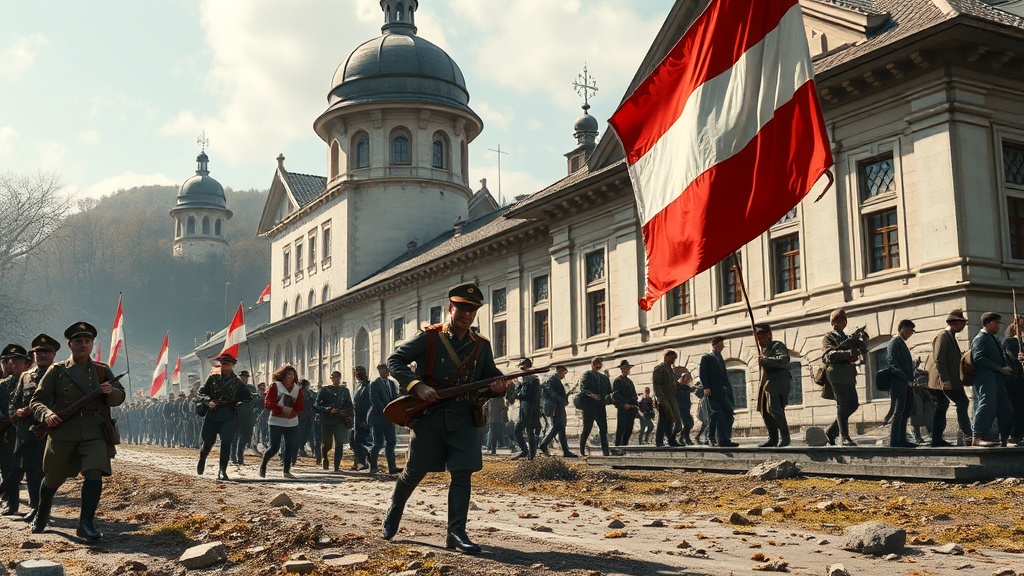
On 28 July 1914, Austria-Hungary became the first great power to formally declare war — setting in motion the most catastrophic conflict the world had yet witnessed. It is one of history's great ironies, then, that the empire which lit the fuse would spend the next four years struggling to survive the explosion it created. Austria-Hungary's performance in World War One was, by almost any measurable standard, a disaster. It failed to conquer a nation a fraction of its size. It haemorrhaged men on the Eastern Front at a pace that beggared belief. It required repeated German intervention just to keep its armies from total collapse. And by 1918, the empire itself had ceased to exist.
But catastrophic military failure rarely has a single cause. The story of why Austria-Hungary performed so abysmally is, in truth, the story of a state that was structurally, politically, and militarily ill-equipped for modern industrial warfare long before the first shot was fired. To understand what happened on the battlefields of Serbia and Galicia, you have to understand what was happening — and what had been happening for decades — inside the empire itself.
A Dual Monarchy Built on Compromise, Not Strength
Austria-Hungary was, at its core, a political compromise masquerading as a great power. Born from the humiliation of the 1866 Austro-Prussian War, the Dual Monarchy was the Habsburg dynasty's desperate attempt to hold together a crumbling empire by offering Hungary near-equal status. Emperor Franz Joseph became simultaneously Emperor of Austria and King of Hungary, ruling two distinct states bound together largely by his own person and a shared foreign policy.
This arrangement carried a fatal structural flaw: Hungary had enormous influence over imperial policy and used it aggressively. Hungarian politicians routinely withheld consent for military spending, not out of pacifism, but out of a calculated prioritisation of domestic economic development over imperial preparedness. The result was an army chronically underfunded relative to its great power rivals. Some conscripts completed their service having fired a weapon only a handful of times. Training was curtailed. Equipment procurement was delayed. The standing Common Army — the one force that drew soldiers from across the empire — was perpetually starved of the resources it needed.
Compare this to Austria-Hungary's future adversaries. Russia had fought a major war in 1904. Italy had campaigned in Libya in 1911. Serbia had been bloodied and sharpened by two Balkan Wars as recently as 1913. When the guns of August 1914 finally roared, Austria-Hungary's military leadership was working from a playbook last updated in 1866. Their enemies were working from lived experience.
The Tower of Babel Problem: Language, Loyalty, and the Limits of Command
If the political structure was the empire's first wound, the ethnic and linguistic reality of its army was the second. Austria-Hungary was home to Germans, Hungarians, Czechs, Poles, Ukrainians, Romanians, Serbs, Slovaks, Slovenes, Italians, and Croats — and its army reflected every strand of that diversity. Roughly 27% of soldiers were German speakers, 22% Hungarian, 14% Czech, with the remaining percentages distributed across a mosaic of other languages and dialects.
Crucially, regiments were not grouped by language but by geographic region, meaning that soldiers from multiple linguistic backgrounds were routinely thrown together under officers who often couldn't — or simply wouldn't — speak their men's languages. Officers were technically required to learn the languages of their subordinates. In practice, many refused, viewing minority languages as beneath their dignity. Those few who genuinely mastered the task were disproportionately killed in the brutal opening months of the war, and their replacements had no time to learn before deployment.
The lower ranks faced a mirror-image problem. Soldiers were expected to memorise a series of German or Hungarian commands. For populations with high rates of illiteracy, this was a deeply unreliable system. In the chaos of battle, orders dissolved into noise. Units misunderstood, hesitated, or acted on instinct rather than instruction. The Austro-Hungarian army was, in the most literal sense, speaking different languages when it needed to speak as one.
There was also the matter of political loyalty. Soldiers from Galicia — a region split between Polish and Ukrainian populations — had little appetite for fighting their ethnic kin across the Russian border. To prevent potential defections and subversion, some units had to be redeployed far from their homelands, adding logistical complexity and delay. Serbian military intelligence exploited this ethnic patchwork ruthlessly: Serbian army units reportedly posed as Bosnian or Croatian soldiers from Austria-Hungary, using familiar languages and identities to lure Habsburg troops into lethal ambushes.
Conrad von Hötzendorf: The General Who Believed in His Own Genius
Into this already fragile structure stepped Franz Conrad von Hötzendorf, Chief of the Austro-Hungarian General Staff and one of the war's most consequential architects of disaster. Conrad was, in the parlance of modern organisational psychology, a classic case of high confidence inversely correlated with actual competence.
Like many European commanders of his generation, Conrad worshipped at the altar of the offensive. The doctrine was seductive in its simplicity: soldiers on the attack were too busy surviving to desert; soldiers on the defensive grew lazy, demoralised, and unreliable. The answer, therefore, was always to attack — and to attack everywhere at once. Conrad's opening gambit was to launch simultaneous all-out offensives against both Serbia and Russia, a plan that would have tested even a well-resourced, battle-hardened military.
Austria-Hungary was neither.
Conrad's plans collapsed almost immediately upon contact with reality. He demanded his armies traverse difficult terrain in brutal weather on aggressive timetables, expecting 100% operational efficiency and near-infinite tolerance for casualties. When his subordinates failed to deliver the impossible, Conrad's response was not self-reflection but blame. The problem, in his estimation, was never his strategy — it was the incompetence of the men beneath him. He controlled promotions and dismissals, which meant he surrounded himself with officers unlikely to challenge him. His relationship with German military leadership, meanwhile, was poisonous; German commanders viewed him, not unfairly, as dangerously inept.
Franz Joseph, by 1914 an elderly and ailing emperor with a personal track record of military failure dating back to 1859, largely stayed out of military affairs. The last time he had personally directed a war, against France and Sardinia, it had ended in defeat. He had no appetite to repeat the experience. And so Conrad operated with minimal imperial oversight, making catastrophic decisions with relative impunity.
The Serbian Catastrophe and the Collapse of the Eastern Front
The obsession with crushing Serbia was perhaps Austria-Hungary's most self-destructive strategic fixation. Serbian forces were battle-hardened veterans of the Balkan Wars, fighting on home terrain with the fierce motivation of a nation defending its existence. The Austro-Hungarian political establishment, consumed by the desire to punish Belgrade, fundamentally underestimated what that fight would actually require.
Conrad allocated nearly twice as many soldiers to the Serbian front as to the Russian one — a decision that looks extraordinary given that Russia was, by any rational calculation, the greater existential threat. The opening invasion of Serbia in late July 1914 committed close to half a million men. By the end of that year, approximately half of those men were casualties. The Serbian army, though ultimately forced to retreat in devastating circumstances in 1915, had already inflicted wounds on the Habsburg military from which it would never fully recover.
On the Eastern Front, the story was equally grim. The campaign in Galicia saw vast swaths of the professional officer corps killed or captured in the opening months. These were the men who, for all their flaws, had training, experience, and institutional knowledge. Their replacements were rushed into service without adequate preparation. By mid-1915, the Austro-Hungarian military was so hollowed out that it required permanent German supervision and support to remain a functional fighting force. It was, in strategic terms, no longer an independent great power but a dependent partner — propped up by the very ally whose aggression it had been designed to complement.
Structural Decay: Why Recovery Was Never Really Possible
Perhaps the most tragic dimension of Austria-Hungary's World War One experience is that by the time the scale of the catastrophe became clear, the damage was effectively irreversible. Armies can absorb losses if they have the institutional infrastructure to train, equip, and motivate replacements. Austria-Hungary lacked that infrastructure — not because it was suddenly destroyed, but because it had never been properly built.
Free Weekly Newsletter
Enjoying this guide?
Get the best articles like this one delivered to your inbox every week. No spam.
Decades of political obstruction had produced an underfunded military. Ethnic and linguistic fragmentation had compromised its internal cohesion. An entrenched officer culture hostile to its own soldiers had corroded morale from within. And the leadership that might have diagnosed and corrected these problems had instead doubled down on flawed doctrine while purging anyone capable of offering honest criticism.
When Emperor Karl I succeeded the aged Franz Joseph in 1916 and attempted to reform the military and seek a negotiated peace, he was pushing against forces too deeply entrenched to shift in wartime. The reforms were too little, too late, and too constrained by the same political dynamics that had crippled the empire's war effort from the start. By November 1918, Austria-Hungary had not merely lost a war — it had ceased to exist as a political entity, dissolving into its constituent national parts with a speed that shocked even those who had predicted its collapse.
The Weight of History's First Mover
Austria-Hungary's failure in World War One is often treated as a footnote to the larger narratives of the Western Front or the Eastern campaigns. It deserves more serious attention. Here was a state that chose war — that, in a very real sense, insisted upon it — and then demonstrated in four years of bloodshed that it lacked almost everything a modern war required: coherent command, adequate resources, linguistic and cultural cohesion, experienced leadership, and a realistic understanding of what it was actually fighting.
The lessons are not comfortable ones. They speak to what happens when political dysfunction is allowed to hollow out institutional capacity over decades; when ideological rigidity substitutes for strategic thought; when the leaders of an organisation are more invested in protecting their own authority than in confronting hard truths. Austria-Hungary did not collapse in 1918 because it was unlucky. It collapsed because the cracks had been there all along — and no one with the power to fix them had ever really tried.
Frequently Asked Questions
Why did Austria-Hungary perform so badly in World War One?
Austria-Hungary's poor performance resulted from a combination of deep structural problems: chronic underfunding of its military due to political disputes between Austria and Hungary, severe linguistic and ethnic fragmentation within its armies, a lack of experienced military leadership after decades without major warfare, and disastrous strategic decisions made by Chief of Staff Conrad von Hötzendorf. These problems compounded each other, and the catastrophic losses of 1914 left the empire permanently dependent on German support.
How many languages were spoken in the Austro-Hungarian army?
The Austro-Hungarian army included soldiers speaking at least ten major languages, including German, Hungarian, Czech, Polish, Ukrainian, Romanian, Serbian, Slovak, Slovene, and Italian. Because regiments were organised by geographic region rather than language group, soldiers of different linguistic backgrounds were routinely mixed together, creating severe communication problems in combat, particularly when officers refused to learn the languages of their men.
Who was Conrad von Hötzendorf and why was he so problematic?
Franz Conrad von Hötzendorf was Austria-Hungary's Chief of the General Staff and the dominant figure in its wartime military planning. He was a devoted adherent of aggressive offensive doctrine and repeatedly devised ambitious plans that ignored terrain, weather, supply realities, and the actual capabilities of his forces. When his plans failed — as they consistently did — he blamed subordinates rather than revising his approach. He also controlled military appointments, which meant he could sideline critics and competent officers alike. German commanders regarded him as dangerously incompetent, and his relationship with German military leadership was chronically poor.
Why did Austria-Hungary struggle so much against Serbia specifically?
Several factors made Serbia a particularly difficult opponent. Serbian soldiers were veteran fighters fresh from two Balkan Wars (1912–1913) and were defending their homeland with high motivation. Austria-Hungary, by contrast, deployed units that included soldiers reluctant to fight fellow South Slavs, officers who couldn't communicate with their men, and commanders who underestimated the lethality of modern defensive firepower. Conrad also devoted disproportionate forces to the Serbian front relative to the Russian one, and the subsequent losses devastated the professional core of the Austro-Hungarian military before the war had barely begun.
Could Austria-Hungary have reformed its military in time to perform better?
In theory, yes — but in practice, the political and institutional obstacles were too deeply embedded. The Hungarian government's consistent veto over military spending, the entrenched culture of the officer class, and the structural complexity of the Dual Monarchy all resisted meaningful reform. When Emperor Karl I attempted reforms after 1916, he faced these same obstacles in a wartime context where resources, time, and political will were all exhausted. The empire's collapse in 1918 suggests that meaningful reform would have required not just military reorganisation but fundamental political restructuring — and the war left no space for that.
Frequently Asked Questions
The Empire That Started a War It Couldn't Win
On 28 July 1914, Austria-Hungary became the first great power to formally declare war — setting in motion the most catastrophic conflict the world had yet witnessed. It is one of history's great ironies, then, that the empire which lit the fuse would spend the next four years struggling to survive the explosion it created. Austria-Hungary's performance in World War One was, by almost any measurable standard, a disaster. It failed to conquer a nation a fraction of its size. It haemorrhaged men on the Eastern Front at a pace that beggared belief. It required repeated German intervention just to keep its armies from total collapse. And by 1918, the empire itself had ceased to exist.
But catastrophic military failure rarely has a single cause. The story of why Austria-Hungary performed so abysmally is, in truth, the story of a state that was structurally, politically, and militarily ill-equipped for modern industrial warfare long before the first shot was fired. To understand what happened on the battlefields of Serbia and Galicia, you have to understand what was happening — and what had been happening for decades — inside the empire itself.
A Dual Monarchy Built on Compromise, Not Strength
Austria-Hungary was, at its core, a political compromise masquerading as a great power. Born from the humiliation of the 1866 Austro-Prussian War, the Dual Monarchy was the Habsburg dynasty's desperate attempt to hold together a crumbling empire by offering Hungary near-equal status. Emperor Franz Joseph became simultaneously Emperor of Austria and King of Hungary, ruling two distinct states bound together largely by his own person and a shared foreign policy.
This arrangement carried a fatal structural flaw: Hungary had enormous influence over imperial policy and used it aggressively. Hungarian politicians routinely withheld consent for military spending, not out of pacifism, but out of a calculated prioritisation of domestic economic development over imperial preparedness. The result was an army chronically underfunded relative to its great power rivals. Some conscripts completed their service having fired a weapon only a handful of times. Training was curtailed. Equipment procurement was delayed. The standing Common Army — the one force that drew soldiers from across the empire — was perpetually starved of the resources it needed.
Compare this to Austria-Hungary's future adversaries. Russia had fought a major war in 1904. Italy had campaigned in Libya in 1911. Serbia had been bloodied and sharpened by two Balkan Wars as recently as 1913. When the guns of August 1914 finally roared, Austria-Hungary's military leadership was working from a playbook last updated in 1866. Their enemies were working from lived experience.
The Tower of Babel Problem: Language, Loyalty, and the Limits of Command
If the political structure was the empire's first wound, the ethnic and linguistic reality of its army was the second. Austria-Hungary was home to Germans, Hungarians, Czechs, Poles, Ukrainians, Romanians, Serbs, Slovaks, Slovenes, Italians, and Croats — and its army reflected every strand of that diversity. Roughly 27% of soldiers were German speakers, 22% Hungarian, 14% Czech, with the remaining percentages distributed across a mosaic of other languages and dialects.
Crucially, regiments were not grouped by language but by geographic region, meaning that soldiers from multiple linguistic backgrounds were routinely thrown together under officers who often couldn't — or simply wouldn't — speak their men's languages. Officers were technically required to learn the languages of their subordinates. In practice, many refused, viewing minority languages as beneath their dignity. Those few who genuinely mastered the task were disproportionately killed in the brutal opening months of the war, and their replacements had no time to learn before deployment.
The lower ranks faced a mirror-image problem. Soldiers were expected to memorise a series of German or Hungarian commands. For populations with high rates of illiteracy, this was a deeply unreliable system. In the chaos of battle, orders dissolved into noise. Units misunderstood, hesitated, or acted on instinct rather than instruction. The Austro-Hungarian army was, in the most literal sense, speaking different languages when it needed to speak as one.
There was also the matter of political loyalty. Soldiers from Galicia — a region split between Polish and Ukrainian populations — had little appetite for fighting their ethnic kin across the Russian border. To prevent potential defections and subversion, some units had to be redeployed far from their homelands, adding logistical complexity and delay. Serbian military intelligence exploited this ethnic patchwork ruthlessly: Serbian army units reportedly posed as Bosnian or Croatian soldiers from Austria-Hungary, using familiar languages and identities to lure Habsburg troops into lethal ambushes.
Conrad von Hötzendorf: The General Who Believed in His Own Genius
Into this already fragile structure stepped Franz Conrad von Hötzendorf, Chief of the Austro-Hungarian General Staff and one of the war's most consequential architects of disaster. Conrad was, in the parlance of modern organisational psychology, a classic case of high confidence inversely correlated with actual competence.
Like many European commanders of his generation, Conrad worshipped at the altar of the offensive. The doctrine was seductive in its simplicity: soldiers on the attack were too busy surviving to desert; soldiers on the defensive grew lazy, demoralised, and unreliable. The answer, therefore, was always to attack — and to attack everywhere at once. Conrad's opening gambit was to launch simultaneous all-out offensives against both Serbia and Russia, a plan that would have tested even a well-resourced, battle-hardened military.
Austria-Hungary was neither.
Conrad's plans collapsed almost immediately upon contact with reality. He demanded his armies traverse difficult terrain in brutal weather on aggressive timetables, expecting 100% operational efficiency and near-infinite tolerance for casualties. When his subordinates failed to deliver the impossible, Conrad's response was not self-reflection but blame. The problem, in his estimation, was never his strategy — it was the incompetence of the men beneath him. He controlled promotions and dismissals, which meant he surrounded himself with officers unlikely to challenge him. His relationship with German military leadership, meanwhile, was poisonous; German commanders viewed him, not unfairly, as dangerously inept.
Franz Joseph, by 1914 an elderly and ailing emperor with a personal track record of military failure dating back to 1859, largely stayed out of military affairs. The last time he had personally directed a war, against France and Sardinia, it had ended in defeat. He had no appetite to repeat the experience. And so Conrad operated with minimal imperial oversight, making catastrophic decisions with relative impunity.
The Serbian Catastrophe and the Collapse of the Eastern Front
The obsession with crushing Serbia was perhaps Austria-Hungary's most self-destructive strategic fixation. Serbian forces were battle-hardened veterans of the Balkan Wars, fighting on home terrain with the fierce motivation of a nation defending its existence. The Austro-Hungarian political establishment, consumed by the desire to punish Belgrade, fundamentally underestimated what that fight would actually require.
Conrad allocated nearly twice as many soldiers to the Serbian front as to the Russian one — a decision that looks extraordinary given that Russia was, by any rational calculation, the greater existential threat. The opening invasion of Serbia in late July 1914 committed close to half a million men. By the end of that year, approximately half of those men were casualties. The Serbian army, though ultimately forced to retreat in devastating circumstances in 1915, had already inflicted wounds on the Habsburg military from which it would never fully recover.
On the Eastern Front, the story was equally grim. The campaign in Galicia saw vast swaths of the professional officer corps killed or captured in the opening months. These were the men who, for all their flaws, had training, experience, and institutional knowledge. Their replacements were rushed into service without adequate preparation. By mid-1915, the Austro-Hungarian military was so hollowed out that it required permanent German supervision and support to remain a functional fighting force. It was, in strategic terms, no longer an independent great power but a dependent partner — propped up by the very ally whose aggression it had been designed to complement.
Structural Decay: Why Recovery Was Never Really Possible
Perhaps the most tragic dimension of Austria-Hungary's World War One experience is that by the time the scale of the catastrophe became clear, the damage was effectively irreversible. Armies can absorb losses if they have the institutional infrastructure to train, equip, and motivate replacements. Austria-Hungary lacked that infrastructure — not because it was suddenly destroyed, but because it had never been properly built.
Decades of political obstruction had produced an underfunded military. Ethnic and linguistic fragmentation had compromised its internal cohesion. An entrenched officer culture hostile to its own soldiers had corroded morale from within. And the leadership that might have diagnosed and corrected these problems had instead doubled down on flawed doctrine while purging anyone capable of offering honest criticism.
When Emperor Karl I succeeded the aged Franz Joseph in 1916 and attempted to reform the military and seek a negotiated peace, he was pushing against forces too deeply entrenched to shift in wartime. The reforms were too little, too late, and too constrained by the same political dynamics that had crippled the empire's war effort from the start. By November 1918, Austria-Hungary had not merely lost a war — it had ceased to exist as a political entity, dissolving into its constituent national parts with a speed that shocked even those who had predicted its collapse.
The Weight of History's First Mover
Austria-Hungary's failure in World War One is often treated as a footnote to the larger narratives of the Western Front or the Eastern campaigns. It deserves more serious attention. Here was a state that chose war — that, in a very real sense, insisted upon it — and then demonstrated in four years of bloodshed that it lacked almost everything a modern war required: coherent command, adequate resources, linguistic and cultural cohesion, experienced leadership, and a realistic understanding of what it was actually fighting.
The lessons are not comfortable ones. They speak to what happens when political dysfunction is allowed to hollow out institutional capacity over decades; when ideological rigidity substitutes for strategic thought; when the leaders of an organisation are more invested in protecting their own authority than in confronting hard truths. Austria-Hungary did not collapse in 1918 because it was unlucky. It collapsed because the cracks had been there all along — and no one with the power to fix them had ever really tried.
Frequently Asked Questions
Why did Austria-Hungary perform so badly in World War One?
Austria-Hungary's poor performance resulted from a combination of deep structural problems: chronic underfunding of its military due to political disputes between Austria and Hungary, severe linguistic and ethnic fragmentation within its armies, a lack of experienced military leadership after decades without major warfare, and disastrous strategic decisions made by Chief of Staff Conrad von Hötzendorf. These problems compounded each other, and the catastrophic losses of 1914 left the empire permanently dependent on German support.
How many languages were spoken in the Austro-Hungarian army?
The Austro-Hungarian army included soldiers speaking at least ten major languages, including German, Hungarian, Czech, Polish, Ukrainian, Romanian, Serbian, Slovak, Slovene, and Italian. Because regiments were organised by geographic region rather than language group, soldiers of different linguistic backgrounds were routinely mixed together, creating severe communication problems in combat, particularly when officers refused to learn the languages of their men.
Who was Conrad von Hötzendorf and why was he so problematic?
Franz Conrad von Hötzendorf was Austria-Hungary's Chief of the General Staff and the dominant figure in its wartime military planning. He was a devoted adherent of aggressive offensive doctrine and repeatedly devised ambitious plans that ignored terrain, weather, supply realities, and the actual capabilities of his forces. When his plans failed — as they consistently did — he blamed subordinates rather than revising his approach. He also controlled military appointments, which meant he could sideline critics and competent officers alike. German commanders regarded him as dangerously incompetent, and his relationship with German military leadership was chronically poor.
Why did Austria-Hungary struggle so much against Serbia specifically?
Several factors made Serbia a particularly difficult opponent. Serbian soldiers were veteran fighters fresh from two Balkan Wars (1912–1913) and were defending their homeland with high motivation. Austria-Hungary, by contrast, deployed units that included soldiers reluctant to fight fellow South Slavs, officers who couldn't communicate with their men, and commanders who underestimated the lethality of modern defensive firepower. Conrad also devoted disproportionate forces to the Serbian front relative to the Russian one, and the subsequent losses devastated the professional core of the Austro-Hungarian military before the war had barely begun.
Could Austria-Hungary have reformed its military in time to perform better?
In theory, yes — but in practice, the political and institutional obstacles were too deeply embedded. The Hungarian government's consistent veto over military spending, the entrenched culture of the officer class, and the structural complexity of the Dual Monarchy all resisted meaningful reform. When Emperor Karl I attempted reforms after 1916, he faced these same obstacles in a wartime context where resources, time, and political will were all exhausted. The empire's collapse in 1918 suggests that meaningful reform would have required not just military reorganisation but fundamental political restructuring — and the war left no space for that.
About Zeebrain Editorial
Zeebrain publishes independent analysis of markets, investing, personal finance, and business. We disclose affiliate relationships, never accept payment for coverage, and fact-check all claims against primary sources. Read our editorial policy →
How this article was produced: Zeebrain articles are created with AI assistance from primary sources (including cited videos and market data) and reviewed under our editorial standards before publication. Spot an error? Tell us and we will correct it.
More from History & Mysteries

Related Guides
Keep exploring this topic
Why Teddy Roosevelt Never Got to Fight in World War One
History & Mysteries · Theodore Roosevelt · World War One
The Russian Revolution: How an Empire Collapsed in Days
History & Mysteries · Russian Revolution · Bolsheviks
Why Mao Won the Chinese Civil War: The Full Story
History & Mysteries
Why Only Germany Paid WWI Reparations: The Full Story
History & Mysteries
Explore More Categories
Keep browsing by topic and build depth around the subjects you care about most.