Why Japan's 1945 Army Coup Against the Emperor Failed
Quick Summary
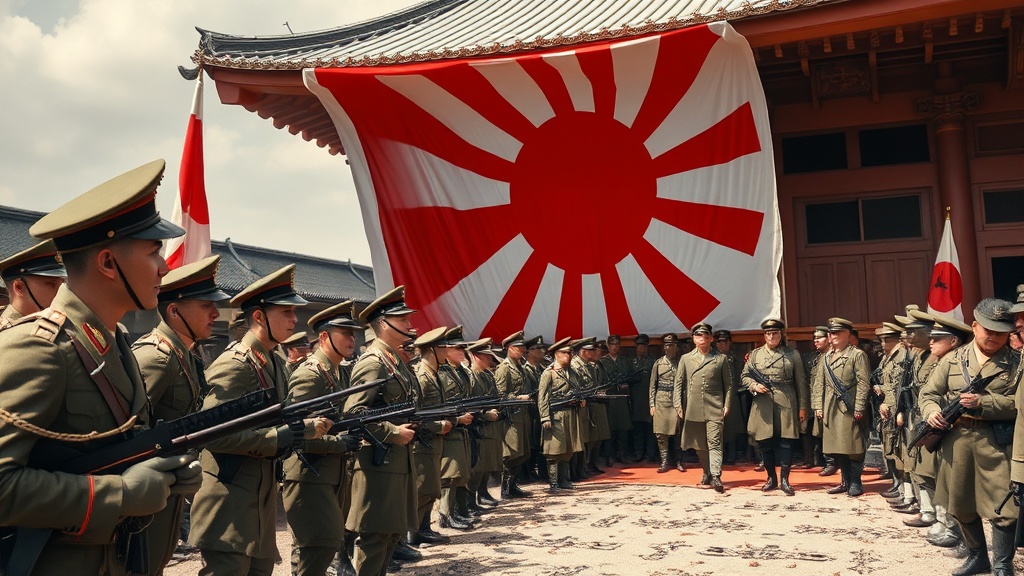
In August 1945, Japanese officers attempted a coup to stop Japan's surrender. Here's why it collapsed within hours — and what it reveals about power, honour, and defeat.
In This Article
The Night Japan Almost Refused to Surrender
On the night of 14th August 1945, a group of Japanese army officers crept through the blacked-out corridors of the Imperial Palace in Tokyo, searching for a recording. Not a weapon. Not a hostage. A gramophone record — one that, if broadcast the following morning, would tell the Japanese people something their military had spent years insisting was impossible: that their emperor was surrendering.
They never found it. The recording was hidden in a bomb shelter beneath the palace, tucked away by officials who had anticipated exactly this kind of desperate move. By noon on 15th August, Emperor Hirohito's voice crackled across radios the length and breadth of Japan, announcing unconditional surrender to the Allied powers. The coup was over almost before most of the country knew it had begun.
But the fact that it happened at all — that senior military officers were willing to seize the Imperial Palace, murder loyalists, and depose a god-emperor rather than accept defeat — tells us something profound about the psychological and political machinery of Imperial Japan in its final, agonising hours. Understanding why the 1945 Japanese army coup failed requires understanding why it was attempted in the first place.
A Nation That Had Never Learned to Lose
To grasp the coup plotters' mindset, you have to understand what surrender meant in the Japanese military culture of the time. This wasn't simply the pragmatic acknowledgement that a war had been lost. It was, for many officers, the moral extinction of everything Japan stood for.
One of the most mythologised moments in Japanese history was the repelling of the Mongol invasions under Kublai Khan in the 13th century — a moment attributed in large part to the kamikaze, or 'divine winds,' that destroyed the Mongol fleet. This wasn't just a historical footnote. It was a founding myth of national invincibility. To surrender before the Americans had even set foot on the home islands felt, to hardliners, like a betrayal of two and a half thousand years of imperial tradition.
The 1930s had already shown how volatile this culture could become. Ultranationalist factions within the army and navy had launched multiple coup attempts during that turbulent decade — against civilian governments, against moderate ministers, against anyone seen as insufficiently committed to imperial expansion. Critically, these conspirators were rarely punished with severity. When their motives — hyper-nationalist, emperor-worshipping militarism — became public, there was often quiet sympathy from large sections of the population. The army, by repeatedly positioning itself as the defender of the emperor against weak civilians, had gradually consolidated enormous political power. The lesson many officers took from the 1930s was not that coups were wrong, but that they simply needed to be better executed.
The Paralysis at the Heart of Japan's Government
By July 1945, Japan's leadership was locked in a paralysis of pride and pragmatism. The Philippines had fallen. The navy was a ghost of its former self. American B-29s were firebombing Japanese cities almost at will. Everyone in the room knew the war was lost. The argument was about the terms of losing it.
When the Allied powers issued the Potsdam Declaration in late July, demanding unconditional surrender from Japan, it landed like a grenade in an already fractured cabinet. Prime Minister Kantaro Suzuki was pushing hard for peace, believing that Japan still held enough military capacity — and the Allies enough war-weariness — to negotiate from a position of minimal dignity. Foreign Minister Shigenori Togo believed the Allies would soften their terms once Japan formally capitulated. But War Minister Korechika Anami represented the military's uncompromising line: surrender was unconscionable, occupation was humiliation, and Germany's total annihilation was the warning they needed to heed.
The government's public response to Potsdam — mokusatsu, often translated as 'no comment' or 'treat with silent contempt' — became one of history's most consequential diplomatic misreadings. Japan intended it as 'we are deliberating.' The Allies read it as dismissal. Within days, Hiroshima was reduced to ash. Three days later, Nagasaki followed. Then the Soviet Union, citing Japan's failure to pursue peace, declared war and poured troops into Manchuria.
Even then, the hardliners weren't finished. Some within the military genuinely argued that the Americans probably had no further atomic bombs, and that the Potsdam demands were a bluff designed to mask Allied weakness. It is one of the most extraordinary examples of motivated reasoning in modern military history.
The Coup's Fatal Miscalculations
The plan drawn up by Major Kenji Hatanaka and his fellow conspirators had a certain brutal logic to it, if you accepted their premises. Seize the Imperial Palace. Capture the emperor — or, if necessary, declare him mentally unfit and elevate his more malleable young son. Kill the prime minister and his peace faction. Then wait for the rest of the army, inspired by the coup's audacity, to fall into line.
The whole edifice rested on assumptions that turned out to be catastrophically wrong.
First, they assumed War Minister Anami would join them. When Hatanaka approached him, Anami said nothing — neither endorsing the plot nor denouncing it. The conspirators took his silence as tacit approval. It wasn't. Anami was a man of profound internal conflict, deeply opposed to surrender but equally aware that the coup was likely to fail and would dishonour the army he had devoted his life to. His response to the coup's collapse was to take his own life — an act that spoke more clearly than anything he had said to Hatanaka.
Second, and most fatally, they assumed the broader army would back them once the deed was done. This was the same mistake coup-plotters in the 1930s had made. The Japanese military was not a monolithic bloc of die-hard resisters. Many senior commanders had quietly, reluctantly, made their peace with the idea that the war was over. When news of the coup spread through Tokyo's military hierarchy, high-ranking officers moved swiftly to suppress it — not out of pacifism, but out of institutional discipline and an understanding that the coup would lead only to further catastrophe.
Third, they couldn't find the recording. With Tokyo under blackout conditions due to the constant threat of American air raids, the palace was dark and disorienting. Emperor Hirohito and his recorded speech were both secured in a reinforced underground shelter. The Imperial Guard, without their murdered commander Takeshi Mori to lead them, was confused by the forged orders Hatanaka produced in Mori's name — but confusion is not the same as compliance. The palace was occupied, but the prize was never within reach.
Why Hirohito's Personal Intervention Was Decisive
The role of Emperor Hirohito himself is often sanitised into a simple narrative: the god-emperor graciously intervened to spare his people further suffering. The reality is more complicated and, in some ways, more interesting.
Hirohito was not the passive, ceremonial figurehead he was sometimes portrayed as during the war years. He had followed the conflict's progression with close attention, and his council appearances — characterised in popular accounts as rare and extraordinary — were actually fairly regular occurrences. He knew perfectly well that the Supreme War Council was deadlocked and that no one in the room had the political standing or personal will to break the impasse.
His decision to personally endorse unconditional surrender at the imperial conference on 14th August was therefore a calculated political act as much as a moral one. He also understood — perhaps better than his generals — that the Allies' treatment of Japan post-surrender would be shaped in large part by how Japan surrendered. A negotiated peace, achieved with dignity, offered better prospects than a negotiated peace achieved after millions more deaths on both sides.
In the end, he was right. Japan was disarmed, yes — but war crimes prosecutions were notably more lenient than those in Germany. The zaibatsu were broken up, land reform was enacted, a democratic constitution was written. And crucially, the emperor himself remained on the throne. The very guarantee Japan's hardliners had insisted they could never obtain without fighting for it was quietly granted by an Allied command that had decided Hirohito was more useful as a symbol of continuity than as a defendant at a war crimes tribunal.
As one of the coup's own ideological premises — that the emperor must be protected at all costs — was ironically fulfilled by the surrender they had tried to prevent.
The Aftermath: Honour, Silence, and a New Japan
When the coup collapsed in the early hours of 15th August, its leaders faced a reckoning of a very particular kind. They were not arrested in the conventional sense, nor immediately tried. Instead, they were — in the understated language of the transcript that inspired this piece — 'told they were free to go and do what was expected of soldiers who had acted dishonourably.' Most of them did exactly that.
Hatanaka himself walked out onto the Imperial Palace grounds in the morning light and shot himself, reportedly having scattered leaflets explaining his actions from horseback through Tokyo's streets in the coup's final hours. It was a death that combined the theatrical and the tragic in equal measure — a man who had staked everything on a vision of Japan that had already ceased to exist.
The broadcast went out at noon. For most Japanese citizens, it was the first time they had ever heard their emperor's voice — a thin, formal recording in the elaborate court Japanese that many ordinary people struggled to fully understand. What they grasped was enough. The war was over.
What followed was, by the standards of 20th-century military occupations, a remarkably functional transformation. Japan's postwar recovery, the constitutional reforms imposed by MacArthur's administration, the economic miracle of the 1950s and 60s — all of it became possible precisely because surrender happened when it did, in the way that it did. The coup's failure wasn't merely a footnote. It was, in a very real sense, the moment modern Japan began.
Free Weekly Newsletter
Enjoying this guide?
Get the best articles like this one delivered to your inbox every week. No spam.
Conclusion: What the Failed Coup Tells Us About Power and Defeat
The 1945 Japanese army coup failed for reasons that were, in hindsight, almost predictable: poor planning, catastrophic miscalculation of support, and the inability to secure the one asset — the emperor's recorded voice — that would have given them any hope of controlling the narrative. But the deeper lesson is about the nature of institutional power in moments of civilisational crisis.
The coup's leaders were not madmen. They were products of a military culture that had spent decades rewarding exactly this kind of zealotry, and that had never seriously punished those who substituted ideological conviction for strategic reality. They had learned, from the 1930s, that boldness could substitute for legitimacy. What they had not learned — what perhaps no amount of experience could have taught them — was that by August 1945, the institutional will to fight on had quietly dissolved around them, even if the rhetoric of resistance had not.
Surrender, in the end, came not because Japan's military was forced into it by external pressure alone, but because enough of the people who mattered — including, decisively, the emperor himself — chose survival over the purity of defeat.
It is one of history's more quietly instructive ironies that the thing the coup sought to prevent — foreign occupation — ultimately preserved the very institution the coup sought to protect.
Frequently Asked Questions
Who led the 1945 Japanese army coup attempt?
The coup was led primarily by Major Kenji Hatanaka, a mid-ranking army officer who was deeply opposed to Japan's surrender. He and a small group of like-minded officers moved troops into Tokyo and attempted to seize the Imperial Palace on the night of 14th August 1945. Hatanaka took his own life after the coup collapsed the following morning.
Why did the Japanese military oppose surrender so strongly in 1945?
For many Japanese military officers, surrender before an enemy invasion of the home islands was seen as a profound betrayal of national honour and imperial tradition. Japan's cultural mythology — including the legendary repelling of the Mongol fleet in the 13th century — reinforced the idea that the home islands were inviolable. Surrender also raised the spectre of occupation, war crimes trials, and the potential end of the imperial dynasty, all of which were considered unacceptable.
What was mokusatsu and why did it matter?
Mokusatsu was the Japanese government's public response to the Potsdam Declaration in July 1945. The word can be translated as 'to treat with silent contempt' or simply 'no comment.' Japan intended it to signal that the government was still deliberating — essentially a diplomatic 'wait.' The Allied powers, particularly the United States, interpreted it as outright rejection. This misunderstanding accelerated the decision to deploy atomic weapons against Hiroshima and Nagasaki.
Did the Allied powers keep their promises to Japan after surrender?
In a significant sense, yes — though not in the way Japan's hardliners had demanded. Japan was disarmed and occupied, as the Potsdam Declaration specified. However, war crimes prosecutions were considerably more lenient in Japan than in Germany, and Emperor Hirohito was not only spared prosecution but was allowed to remain on the throne — the very guarantee Japan's government had sought throughout the summer of 1945. The postwar Allied administration, under General Douglas MacArthur, ultimately judged that retaining the emperor as a symbolic figurehead would make Japan's reconstruction more stable and manageable.
Why didn't War Minister Anami support the coup if he opposed surrender?
Anami was caught in a profound personal and institutional conflict. He opposed the terms of surrender and had argued forcefully against them in cabinet. But he also understood that the coup lacked sufficient military support to succeed, and that a failed coup would further dishonour the army at its most vulnerable moment. His silence when approached by Hatanaka was not endorsement — it was a man paralysed between two impossible choices. After the coup failed, Anami performed ritual suicide on the morning of 15th August, reportedly writing a death poem that expressed his apologies to the emperor.
Frequently Asked Questions
The Night Japan Almost Refused to Surrender
On the night of 14th August 1945, a group of Japanese army officers crept through the blacked-out corridors of the Imperial Palace in Tokyo, searching for a recording. Not a weapon. Not a hostage. A gramophone record — one that, if broadcast the following morning, would tell the Japanese people something their military had spent years insisting was impossible: that their emperor was surrendering.
They never found it. The recording was hidden in a bomb shelter beneath the palace, tucked away by officials who had anticipated exactly this kind of desperate move. By noon on 15th August, Emperor Hirohito's voice crackled across radios the length and breadth of Japan, announcing unconditional surrender to the Allied powers. The coup was over almost before most of the country knew it had begun.
But the fact that it happened at all — that senior military officers were willing to seize the Imperial Palace, murder loyalists, and depose a god-emperor rather than accept defeat — tells us something profound about the psychological and political machinery of Imperial Japan in its final, agonising hours. Understanding why the 1945 Japanese army coup failed requires understanding why it was attempted in the first place.
A Nation That Had Never Learned to Lose
To grasp the coup plotters' mindset, you have to understand what surrender meant in the Japanese military culture of the time. This wasn't simply the pragmatic acknowledgement that a war had been lost. It was, for many officers, the moral extinction of everything Japan stood for.
One of the most mythologised moments in Japanese history was the repelling of the Mongol invasions under Kublai Khan in the 13th century — a moment attributed in large part to the kamikaze, or 'divine winds,' that destroyed the Mongol fleet. This wasn't just a historical footnote. It was a founding myth of national invincibility. To surrender before the Americans had even set foot on the home islands felt, to hardliners, like a betrayal of two and a half thousand years of imperial tradition.
The 1930s had already shown how volatile this culture could become. Ultranationalist factions within the army and navy had launched multiple coup attempts during that turbulent decade — against civilian governments, against moderate ministers, against anyone seen as insufficiently committed to imperial expansion. Critically, these conspirators were rarely punished with severity. When their motives — hyper-nationalist, emperor-worshipping militarism — became public, there was often quiet sympathy from large sections of the population. The army, by repeatedly positioning itself as the defender of the emperor against weak civilians, had gradually consolidated enormous political power. The lesson many officers took from the 1930s was not that coups were wrong, but that they simply needed to be better executed.
The Paralysis at the Heart of Japan's Government
By July 1945, Japan's leadership was locked in a paralysis of pride and pragmatism. The Philippines had fallen. The navy was a ghost of its former self. American B-29s were firebombing Japanese cities almost at will. Everyone in the room knew the war was lost. The argument was about the terms of losing it.
When the Allied powers issued the Potsdam Declaration in late July, demanding unconditional surrender from Japan, it landed like a grenade in an already fractured cabinet. Prime Minister Kantaro Suzuki was pushing hard for peace, believing that Japan still held enough military capacity — and the Allies enough war-weariness — to negotiate from a position of minimal dignity. Foreign Minister Shigenori Togo believed the Allies would soften their terms once Japan formally capitulated. But War Minister Korechika Anami represented the military's uncompromising line: surrender was unconscionable, occupation was humiliation, and Germany's total annihilation was the warning they needed to heed.
The government's public response to Potsdam — mokusatsu, often translated as 'no comment' or 'treat with silent contempt' — became one of history's most consequential diplomatic misreadings. Japan intended it as 'we are deliberating.' The Allies read it as dismissal. Within days, Hiroshima was reduced to ash. Three days later, Nagasaki followed. Then the Soviet Union, citing Japan's failure to pursue peace, declared war and poured troops into Manchuria.
Even then, the hardliners weren't finished. Some within the military genuinely argued that the Americans probably had no further atomic bombs, and that the Potsdam demands were a bluff designed to mask Allied weakness. It is one of the most extraordinary examples of motivated reasoning in modern military history.
The Coup's Fatal Miscalculations
The plan drawn up by Major Kenji Hatanaka and his fellow conspirators had a certain brutal logic to it, if you accepted their premises. Seize the Imperial Palace. Capture the emperor — or, if necessary, declare him mentally unfit and elevate his more malleable young son. Kill the prime minister and his peace faction. Then wait for the rest of the army, inspired by the coup's audacity, to fall into line.
The whole edifice rested on assumptions that turned out to be catastrophically wrong.
First, they assumed War Minister Anami would join them. When Hatanaka approached him, Anami said nothing — neither endorsing the plot nor denouncing it. The conspirators took his silence as tacit approval. It wasn't. Anami was a man of profound internal conflict, deeply opposed to surrender but equally aware that the coup was likely to fail and would dishonour the army he had devoted his life to. His response to the coup's collapse was to take his own life — an act that spoke more clearly than anything he had said to Hatanaka.
Second, and most fatally, they assumed the broader army would back them once the deed was done. This was the same mistake coup-plotters in the 1930s had made. The Japanese military was not a monolithic bloc of die-hard resisters. Many senior commanders had quietly, reluctantly, made their peace with the idea that the war was over. When news of the coup spread through Tokyo's military hierarchy, high-ranking officers moved swiftly to suppress it — not out of pacifism, but out of institutional discipline and an understanding that the coup would lead only to further catastrophe.
Third, they couldn't find the recording. With Tokyo under blackout conditions due to the constant threat of American air raids, the palace was dark and disorienting. Emperor Hirohito and his recorded speech were both secured in a reinforced underground shelter. The Imperial Guard, without their murdered commander Takeshi Mori to lead them, was confused by the forged orders Hatanaka produced in Mori's name — but confusion is not the same as compliance. The palace was occupied, but the prize was never within reach.
Why Hirohito's Personal Intervention Was Decisive
The role of Emperor Hirohito himself is often sanitised into a simple narrative: the god-emperor graciously intervened to spare his people further suffering. The reality is more complicated and, in some ways, more interesting.
Hirohito was not the passive, ceremonial figurehead he was sometimes portrayed as during the war years. He had followed the conflict's progression with close attention, and his council appearances — characterised in popular accounts as rare and extraordinary — were actually fairly regular occurrences. He knew perfectly well that the Supreme War Council was deadlocked and that no one in the room had the political standing or personal will to break the impasse.
His decision to personally endorse unconditional surrender at the imperial conference on 14th August was therefore a calculated political act as much as a moral one. He also understood — perhaps better than his generals — that the Allies' treatment of Japan post-surrender would be shaped in large part by how Japan surrendered. A negotiated peace, achieved with dignity, offered better prospects than a negotiated peace achieved after millions more deaths on both sides.
In the end, he was right. Japan was disarmed, yes — but war crimes prosecutions were notably more lenient than those in Germany. The zaibatsu were broken up, land reform was enacted, a democratic constitution was written. And crucially, the emperor himself remained on the throne. The very guarantee Japan's hardliners had insisted they could never obtain without fighting for it was quietly granted by an Allied command that had decided Hirohito was more useful as a symbol of continuity than as a defendant at a war crimes tribunal.
As one of the coup's own ideological premises — that the emperor must be protected at all costs — was ironically fulfilled by the surrender they had tried to prevent.
The Aftermath: Honour, Silence, and a New Japan
When the coup collapsed in the early hours of 15th August, its leaders faced a reckoning of a very particular kind. They were not arrested in the conventional sense, nor immediately tried. Instead, they were — in the understated language of the transcript that inspired this piece — 'told they were free to go and do what was expected of soldiers who had acted dishonourably.' Most of them did exactly that.
Hatanaka himself walked out onto the Imperial Palace grounds in the morning light and shot himself, reportedly having scattered leaflets explaining his actions from horseback through Tokyo's streets in the coup's final hours. It was a death that combined the theatrical and the tragic in equal measure — a man who had staked everything on a vision of Japan that had already ceased to exist.
The broadcast went out at noon. For most Japanese citizens, it was the first time they had ever heard their emperor's voice — a thin, formal recording in the elaborate court Japanese that many ordinary people struggled to fully understand. What they grasped was enough. The war was over.
What followed was, by the standards of 20th-century military occupations, a remarkably functional transformation. Japan's postwar recovery, the constitutional reforms imposed by MacArthur's administration, the economic miracle of the 1950s and 60s — all of it became possible precisely because surrender happened when it did, in the way that it did. The coup's failure wasn't merely a footnote. It was, in a very real sense, the moment modern Japan began.
Conclusion: What the Failed Coup Tells Us About Power and Defeat
The 1945 Japanese army coup failed for reasons that were, in hindsight, almost predictable: poor planning, catastrophic miscalculation of support, and the inability to secure the one asset — the emperor's recorded voice — that would have given them any hope of controlling the narrative. But the deeper lesson is about the nature of institutional power in moments of civilisational crisis.
The coup's leaders were not madmen. They were products of a military culture that had spent decades rewarding exactly this kind of zealotry, and that had never seriously punished those who substituted ideological conviction for strategic reality. They had learned, from the 1930s, that boldness could substitute for legitimacy. What they had not learned — what perhaps no amount of experience could have taught them — was that by August 1945, the institutional will to fight on had quietly dissolved around them, even if the rhetoric of resistance had not.
Surrender, in the end, came not because Japan's military was forced into it by external pressure alone, but because enough of the people who mattered — including, decisively, the emperor himself — chose survival over the purity of defeat.
It is one of history's more quietly instructive ironies that the thing the coup sought to prevent — foreign occupation — ultimately preserved the very institution the coup sought to protect.
Frequently Asked Questions
Who led the 1945 Japanese army coup attempt?
The coup was led primarily by Major Kenji Hatanaka, a mid-ranking army officer who was deeply opposed to Japan's surrender. He and a small group of like-minded officers moved troops into Tokyo and attempted to seize the Imperial Palace on the night of 14th August 1945. Hatanaka took his own life after the coup collapsed the following morning.
Why did the Japanese military oppose surrender so strongly in 1945?
For many Japanese military officers, surrender before an enemy invasion of the home islands was seen as a profound betrayal of national honour and imperial tradition. Japan's cultural mythology — including the legendary repelling of the Mongol fleet in the 13th century — reinforced the idea that the home islands were inviolable. Surrender also raised the spectre of occupation, war crimes trials, and the potential end of the imperial dynasty, all of which were considered unacceptable.
What was mokusatsu and why did it matter?
Mokusatsu was the Japanese government's public response to the Potsdam Declaration in July 1945. The word can be translated as 'to treat with silent contempt' or simply 'no comment.' Japan intended it to signal that the government was still deliberating — essentially a diplomatic 'wait.' The Allied powers, particularly the United States, interpreted it as outright rejection. This misunderstanding accelerated the decision to deploy atomic weapons against Hiroshima and Nagasaki.
Did the Allied powers keep their promises to Japan after surrender?
In a significant sense, yes — though not in the way Japan's hardliners had demanded. Japan was disarmed and occupied, as the Potsdam Declaration specified. However, war crimes prosecutions were considerably more lenient in Japan than in Germany, and Emperor Hirohito was not only spared prosecution but was allowed to remain on the throne — the very guarantee Japan's government had sought throughout the summer of 1945. The postwar Allied administration, under General Douglas MacArthur, ultimately judged that retaining the emperor as a symbolic figurehead would make Japan's reconstruction more stable and manageable.
Why didn't War Minister Anami support the coup if he opposed surrender?
Anami was caught in a profound personal and institutional conflict. He opposed the terms of surrender and had argued forcefully against them in cabinet. But he also understood that the coup lacked sufficient military support to succeed, and that a failed coup would further dishonour the army at its most vulnerable moment. His silence when approached by Hatanaka was not endorsement — it was a man paralysed between two impossible choices. After the coup failed, Anami performed ritual suicide on the morning of 15th August, reportedly writing a death poem that expressed his apologies to the emperor.
About Zeebrain Editorial
Zeebrain publishes independent analysis of markets, investing, personal finance, and business. We disclose affiliate relationships, never accept payment for coverage, and fact-check all claims against primary sources. Read our editorial policy →
How this article was produced: Zeebrain articles are created with AI assistance from primary sources (including cited videos and market data) and reviewed under our editorial standards before publication. Spot an error? Tell us and we will correct it.
More from History & Mysteries


Related Guides
Keep exploring this topic
Why Taiwan Wasn't Returned to Japan After World War II
History & Mysteries · Taiwan · World War II
Foo Fighters: The WWII Mystery Behind the Name
Curiosities · Foo Fighters · UFO history
The Samurai Who Became a Roman Citizen in 1615
Entertainment · Japanese History · Samurai
Why the Mongols Could Never Conquer Japan
History & Mysteries · Mongol Empire · Japanese History
Explore More Categories
Keep browsing by topic and build depth around the subjects you care about most.