Samsung Galaxy S26 Ultra: Is It Worth $1,300?
Quick Summary
The Samsung Galaxy S26 Ultra has one genuinely clever new feature — but it comes with trade-offs. Here's an honest, no-nonsense breakdown before you spend $1,300.
Samsung Galaxy S26 Ultra
Check current price and availability on Amazon
In This Article
The Samsung Galaxy S26 Ultra Is a Very Good Phone With a Very High Price
Spending $1,300 on a smartphone in 2025 is not a casual decision. At that price, you are not just buying a phone — you are buying a statement of intent. You want the best camera, the sharpest display, the fastest chip, and features that justify the premium over the perfectly capable $700 alternatives sitting right next to it on the shelf. The Samsung Galaxy S26 Ultra arrives with one genuinely innovative hardware feature, a handful of iterative improvements, and a price tag that demands serious scrutiny. After digging into the full picture — specs, trade-offs, competitive landscape, and real-world use — here is the honest verdict that budget-conscious buyers actually need.
Related Post

The Privacy Display: Clever Innovation With a Hidden Cost
The headline feature of the Samsung Galaxy S26 Ultra is the Privacy Display, and credit where it is due — this is a real, meaningful hardware innovation in a smartphone era largely defined by incremental software updates. Toggle it on and the screen becomes visible only to the person directly in front of it. Viewing angles collapse dramatically in both horizontal and vertical planes, meaning the person sitting next to you on the train cannot read your banking app, your messages, or anything else you would rather keep private.
On paper, this sounds like a feature that should have existed years ago. Clip-on privacy screen protectors have existed for decades, but they come with compromises: they are always on, they reduce brightness permanently, and they do nothing for selective content. Samsung's solution lets you apply the privacy filter to specific apps only — just your banking app, just your messaging app, just incoming notifications — while the rest of the screen behaves normally. That level of granularity is genuinely impressive.
But here is where the trade-off conversation begins. To achieve this effect, Samsung built two distinct types of pixels into the display: wide-angle pixels visible from any direction, and narrow-angle pixels with a focusing lens that restricts viewing to straight-on only. When Privacy Display is activated, the wide-angle pixels switch off, leaving only the narrow-angle pixels active. The result is that your effective resolution is cut roughly in half the moment you enable the feature. Text becomes visibly blockier. Fine detail softens. Peak brightness dips slightly, though Samsung compensates by boosting the output of remaining pixels — a workaround that only holds up to a point.
More critically, the presence of those narrow-angle pixels affects the display even when Privacy Display is switched off. Half of your pixels permanently carry a focusing lens, which means the panel's baseline viewing angles are slightly worse than a conventional OLED at the same spec. The anti-reflective coating — widely praised on the S25 Ultra — also appears to have been revised here, and not for the better. Add the fact that this is still an 8-bit display simulating 10-bit colour rather than a native 10-bit panel, and the S26 Ultra's display story becomes a complicated one. It is a very good screen. It is not the best screen you can buy for $1,300 in 2025, which is a strange position for Samsung's flagship to occupy given that Samsung itself manufactures some of the finest OLED panels in the world.
For most users, none of this will matter day-to-day. Samsung ships the phone at 1080p by default precisely because they understand their audience. But if display quality is your primary purchase driver, go in with open eyes.
Performance and Battery: Solid, Not Spectacular
The Snapdragon 8 Elite Gen 5 for Galaxy inside the S26 Ultra is predictably excellent. Benchmark scores come in slightly above competing devices running the standard Snapdragon 8 Elite Gen 5, the year-on-year CPU uplift lands in the expected 20–30% range, and day-to-day performance is seamless. Animations are smooth, heavy multitasking is handled without complaint, and sustained gaming sessions do not produce the thermal throttling that plagued some earlier Samsung flagships. A redesigned vapour chamber manages heat effectively despite the thinner chassis.
Battery life sees a modest improvement over the S25 Ultra despite carrying the same 5,000mAh cell. Chip efficiency and software optimisation account for the gains, and the result is a genuinely solid all-day battery. Charging peaks at 60W, a small but welcome step up.
However, two glaring omissions undermine what could have been a more compelling battery story. First, there are no Qi2 magnets. In 2025, when ecosystem accessories built around MagSafe-style alignment are everywhere, this feels like a deliberate choice to push Samsung's own case accessories rather than a principled engineering decision. Second, Samsung has still not adopted silicon-carbon battery technology, which competitors have used to pack meaningfully more capacity into similar chassis sizes. Independent battery tests show the S26 Ultra performing well — but being clearly outpaced in endurance by silicon-carbon phones from the previous generation. For a $1,300 flagship that sells on being the ultimate version of a Samsung phone, playing it safe on battery technology in 2025 is a legitimate criticism.
Cameras: Mostly Familiar, Meaningfully Better in Low Light
The camera system on the Samsung Galaxy S26 Ultra is not dramatically new, but calling it unchanged would understate the improvements. The main camera and the 5X telephoto both receive larger apertures, meaning more light reaches the sensor in both cases. The practical benefits are real: better low-light performance, slightly shallower depth of field on close subjects, and a more natural bokeh rendering that photographers will appreciate. The 3X telephoto remains largely the same as last year.
The trade-off — and yes, there is always one — is that the main camera's minimum focus distance has increased, making extreme close-up shots slightly less capable without switching to macro mode. It is not a disaster, but users who frequently shoot flat lay photography or detailed product shots will notice the regression.
On the software side, the additions are more substantial. Apple ProRes-style APV log codec support lands for videographers who want professional colour grading flexibility straight from their phone. Horizon Lock, a gyroscopic stabilisation mode that crops into the 200-megapixel sensor to deliver locked-off, shake-free video at up to 60fps in Quad HD, is one of the better implementations of this feature seen on any smartphone. For content creators shooting handheld, it is a genuinely useful tool.
The AI Features: Take Them or Leave Them
Samsung has leaned hard into AI branding for the S26 Ultra, and the Galaxy AI suite is extensive. Call screening for unknown numbers works well and solves a real problem. Audio Eraser, which reduces background noise in recorded video, produces impressively natural results. These are features with clear, everyday utility.
Beyond those highlights, the picture gets murkier. Photo Assist can generate entirely fabricated scenes from real photos — a feature that will appeal to some users and concern others in equal measure. Various agentic AI tools promise to automate tasks across the phone, though real-world performance appears inconsistent. Safeguards prevent the most egregious misuse of generative tools, which is responsible engineering, but it also limits the creative ceiling of these features.
The more pointed issue is that most of these AI capabilities are software-based and could theoretically be delivered to older Samsung devices through updates. When a feature could run on a two-year-old phone, it is not a reason to buy the new one. If Samsung genuinely wants Galaxy AI to be a differentiator for the S26 Ultra specifically, the features that matter need to be tied to hardware that only the S26 Ultra can provide.
Design Changes: Minor Improvements, Minor Annoyances
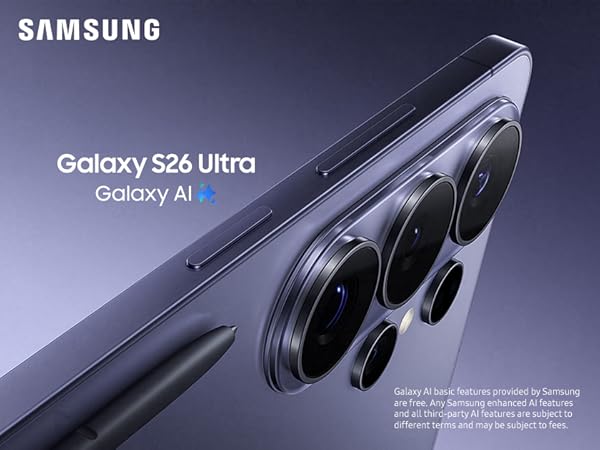
The S26 Ultra is thinner, lighter, and has softer rounded corners than its predecessor, bringing it more in line with Samsung's broader flagship aesthetic. The shift from titanium to aluminium sides is largely inconsequential in real-world use, though it removes a talking point that Samsung itself made much of in previous years.
The rounded corners create a subtle but genuine annoyance: the S Pen silo now has a curved cap, meaning the stylus must be inserted in a specific orientation to seat correctly. The flat-ended design of last year's S Pen silo was more forgiving. Small issue in isolation, but worth noting for heavy S Pen users who reach for the stylus frequently.
The camera module has also grown into a larger plateau design with rings, which combined with the thinner body produces a phone that rocks noticeably on flat surfaces. Using it without a case on a desk while typing is an exercise in frustration. A case solves this immediately, but it should not be necessary to make a $1,300 phone sit flat.
Bottom Line: Who Should Actually Buy the Samsung Galaxy S26 Ultra?
The Samsung Galaxy S26 Ultra is a very capable flagship with one genuinely inventive hardware feature. If the Privacy Display solves a real problem in your life — you work in open offices, you travel frequently, you handle sensitive information on your phone in public spaces — then it is a feature worth paying for, and no other phone currently offers it. The cameras are excellent, performance is flawless, and the software experience is polished.
Free Weekly Newsletter
Enjoying this guide?
Get the best articles like this one delivered to your inbox every week. No spam.
But at $1,300, "very capable" needs to be weighed carefully. There is no silicon-carbon battery. There are no Qi2 magnets. The display, for all its innovation, carries visible trade-offs that competing panels — including Samsung's own — do not. And the base S26 and S26 Plus, starting at $900 for largely unchanged hardware with an Exynos chip in many markets, are difficult to recommend at any price.
If you are upgrading from an S23 Ultra or earlier, the generational leap is real enough to consider. If you are coming from an S24 Ultra or S25 Ultra, the honest answer is that the Privacy Display alone probably does not justify the cost of switching. Wait for a sale, or spend that $1,300 somewhere it will make a bigger difference to your actual daily experience.
Frequently Asked Questions
Does the Privacy Display on the Samsung Galaxy S26 Ultra affect everyday display quality?
Yes, in measurable ways. Because half of the display's pixels are narrow-angle by design, baseline viewing angles are slightly worse than a standard OLED panel even when Privacy Display is switched off. At normal viewing distances, most users will not notice, but side-by-side comparisons with competing flagship displays reveal the difference. The anti-reflective coating also appears slightly less effective than the S25 Ultra's, which was considered best-in-class.
Is the Samsung Galaxy S26 Ultra worth upgrading to from the S25 Ultra?
For most users, no. The core improvements — slightly larger camera apertures, modest battery life gains, a faster chip, and marginally quicker charging — are iterative rather than transformative. The Privacy Display is the only genuinely new hardware feature, and whether it justifies an upgrade depends entirely on how much value you place on on-device privacy. If you are on an S24 Ultra or newer, holding off is the more financially sensible decision.
Why doesn't the Samsung Galaxy S26 Ultra have Qi2 or a silicon-carbon battery?
Samsung has not officially explained either omission. The absence of Qi2 magnets is widely interpreted as a commercial decision to protect Samsung's own case accessory sales. The decision to skip silicon-carbon battery technology appears more conservative — Samsung has faced high-profile battery safety issues in the past and has been cautious about new cell chemistries. Neither explanation fully satisfies at a $1,300 price point, where competitors are delivering both features.
Are the AI features on the Samsung Galaxy S26 Ultra exclusive to the phone?
Most of them are not hardware-dependent, which means Samsung could — and likely will — push many Galaxy AI features to older devices via software updates. Call screening and Audio Eraser are the most practically useful additions, but neither requires the processing capability of the Snapdragon 8 Elite Gen 5 exclusively. If AI features are the primary reason you are considering an upgrade, it is worth waiting to see how much of the suite arrives on your current device before committing to the purchase.
Samsung Galaxy S26 Ultra
Considering it? See where the price stands today
Frequently Asked Questions
The Samsung Galaxy S26 Ultra Is a Very Good Phone With a Very High Price
Spending $1,300 on a smartphone in 2025 is not a casual decision. At that price, you are not just buying a phone — you are buying a statement of intent. You want the best camera, the sharpest display, the fastest chip, and features that justify the premium over the perfectly capable $700 alternatives sitting right next to it on the shelf. The Samsung Galaxy S26 Ultra arrives with one genuinely innovative hardware feature, a handful of iterative improvements, and a price tag that demands serious scrutiny. After digging into the full picture — specs, trade-offs, competitive landscape, and real-world use — here is the honest verdict that budget-conscious buyers actually need.
The Privacy Display: Clever Innovation With a Hidden Cost
The headline feature of the Samsung Galaxy S26 Ultra is the Privacy Display, and credit where it is due — this is a real, meaningful hardware innovation in a smartphone era largely defined by incremental software updates. Toggle it on and the screen becomes visible only to the person directly in front of it. Viewing angles collapse dramatically in both horizontal and vertical planes, meaning the person sitting next to you on the train cannot read your banking app, your messages, or anything else you would rather keep private.
On paper, this sounds like a feature that should have existed years ago. Clip-on privacy screen protectors have existed for decades, but they come with compromises: they are always on, they reduce brightness permanently, and they do nothing for selective content. Samsung's solution lets you apply the privacy filter to specific apps only — just your banking app, just your messaging app, just incoming notifications — while the rest of the screen behaves normally. That level of granularity is genuinely impressive.
But here is where the trade-off conversation begins. To achieve this effect, Samsung built two distinct types of pixels into the display: wide-angle pixels visible from any direction, and narrow-angle pixels with a focusing lens that restricts viewing to straight-on only. When Privacy Display is activated, the wide-angle pixels switch off, leaving only the narrow-angle pixels active. The result is that your effective resolution is cut roughly in half the moment you enable the feature. Text becomes visibly blockier. Fine detail softens. Peak brightness dips slightly, though Samsung compensates by boosting the output of remaining pixels — a workaround that only holds up to a point.
More critically, the presence of those narrow-angle pixels affects the display even when Privacy Display is switched off. Half of your pixels permanently carry a focusing lens, which means the panel's baseline viewing angles are slightly worse than a conventional OLED at the same spec. The anti-reflective coating — widely praised on the S25 Ultra — also appears to have been revised here, and not for the better. Add the fact that this is still an 8-bit display simulating 10-bit colour rather than a native 10-bit panel, and the S26 Ultra's display story becomes a complicated one. It is a very good screen. It is not the best screen you can buy for $1,300 in 2025, which is a strange position for Samsung's flagship to occupy given that Samsung itself manufactures some of the finest OLED panels in the world.
For most users, none of this will matter day-to-day. Samsung ships the phone at 1080p by default precisely because they understand their audience. But if display quality is your primary purchase driver, go in with open eyes.
Performance and Battery: Solid, Not Spectacular
The Snapdragon 8 Elite Gen 5 for Galaxy inside the S26 Ultra is predictably excellent. Benchmark scores come in slightly above competing devices running the standard Snapdragon 8 Elite Gen 5, the year-on-year CPU uplift lands in the expected 20–30% range, and day-to-day performance is seamless. Animations are smooth, heavy multitasking is handled without complaint, and sustained gaming sessions do not produce the thermal throttling that plagued some earlier Samsung flagships. A redesigned vapour chamber manages heat effectively despite the thinner chassis.
Battery life sees a modest improvement over the S25 Ultra despite carrying the same 5,000mAh cell. Chip efficiency and software optimisation account for the gains, and the result is a genuinely solid all-day battery. Charging peaks at 60W, a small but welcome step up.
However, two glaring omissions undermine what could have been a more compelling battery story. First, there are no Qi2 magnets. In 2025, when ecosystem accessories built around MagSafe-style alignment are everywhere, this feels like a deliberate choice to push Samsung's own case accessories rather than a principled engineering decision. Second, Samsung has still not adopted silicon-carbon battery technology, which competitors have used to pack meaningfully more capacity into similar chassis sizes. Independent battery tests show the S26 Ultra performing well — but being clearly outpaced in endurance by silicon-carbon phones from the previous generation. For a $1,300 flagship that sells on being the ultimate version of a Samsung phone, playing it safe on battery technology in 2025 is a legitimate criticism.
Cameras: Mostly Familiar, Meaningfully Better in Low Light
The camera system on the Samsung Galaxy S26 Ultra is not dramatically new, but calling it unchanged would understate the improvements. The main camera and the 5X telephoto both receive larger apertures, meaning more light reaches the sensor in both cases. The practical benefits are real: better low-light performance, slightly shallower depth of field on close subjects, and a more natural bokeh rendering that photographers will appreciate. The 3X telephoto remains largely the same as last year.
The trade-off — and yes, there is always one — is that the main camera's minimum focus distance has increased, making extreme close-up shots slightly less capable without switching to macro mode. It is not a disaster, but users who frequently shoot flat lay photography or detailed product shots will notice the regression.
On the software side, the additions are more substantial. Apple ProRes-style APV log codec support lands for videographers who want professional colour grading flexibility straight from their phone. Horizon Lock, a gyroscopic stabilisation mode that crops into the 200-megapixel sensor to deliver locked-off, shake-free video at up to 60fps in Quad HD, is one of the better implementations of this feature seen on any smartphone. For content creators shooting handheld, it is a genuinely useful tool.
The AI Features: Take Them or Leave Them
Samsung has leaned hard into AI branding for the S26 Ultra, and the Galaxy AI suite is extensive. Call screening for unknown numbers works well and solves a real problem. Audio Eraser, which reduces background noise in recorded video, produces impressively natural results. These are features with clear, everyday utility.
Beyond those highlights, the picture gets murkier. Photo Assist can generate entirely fabricated scenes from real photos — a feature that will appeal to some users and concern others in equal measure. Various agentic AI tools promise to automate tasks across the phone, though real-world performance appears inconsistent. Safeguards prevent the most egregious misuse of generative tools, which is responsible engineering, but it also limits the creative ceiling of these features.
The more pointed issue is that most of these AI capabilities are software-based and could theoretically be delivered to older Samsung devices through updates. When a feature could run on a two-year-old phone, it is not a reason to buy the new one. If Samsung genuinely wants Galaxy AI to be a differentiator for the S26 Ultra specifically, the features that matter need to be tied to hardware that only the S26 Ultra can provide.
Design Changes: Minor Improvements, Minor Annoyances
The S26 Ultra is thinner, lighter, and has softer rounded corners than its predecessor, bringing it more in line with Samsung's broader flagship aesthetic. The shift from titanium to aluminium sides is largely inconsequential in real-world use, though it removes a talking point that Samsung itself made much of in previous years.
The rounded corners create a subtle but genuine annoyance: the S Pen silo now has a curved cap, meaning the stylus must be inserted in a specific orientation to seat correctly. The flat-ended design of last year's S Pen silo was more forgiving. Small issue in isolation, but worth noting for heavy S Pen users who reach for the stylus frequently.
The camera module has also grown into a larger plateau design with rings, which combined with the thinner body produces a phone that rocks noticeably on flat surfaces. Using it without a case on a desk while typing is an exercise in frustration. A case solves this immediately, but it should not be necessary to make a $1,300 phone sit flat.
Bottom Line: Who Should Actually Buy the Samsung Galaxy S26 Ultra?
The Samsung Galaxy S26 Ultra is a very capable flagship with one genuinely inventive hardware feature. If the Privacy Display solves a real problem in your life — you work in open offices, you travel frequently, you handle sensitive information on your phone in public spaces — then it is a feature worth paying for, and no other phone currently offers it. The cameras are excellent, performance is flawless, and the software experience is polished.
But at $1,300, "very capable" needs to be weighed carefully. There is no silicon-carbon battery. There are no Qi2 magnets. The display, for all its innovation, carries visible trade-offs that competing panels — including Samsung's own — do not. And the base S26 and S26 Plus, starting at $900 for largely unchanged hardware with an Exynos chip in many markets, are difficult to recommend at any price.
If you are upgrading from an S23 Ultra or earlier, the generational leap is real enough to consider. If you are coming from an S24 Ultra or S25 Ultra, the honest answer is that the Privacy Display alone probably does not justify the cost of switching. Wait for a sale, or spend that $1,300 somewhere it will make a bigger difference to your actual daily experience.
Frequently Asked Questions
Does the Privacy Display on the Samsung Galaxy S26 Ultra affect everyday display quality?
Yes, in measurable ways. Because half of the display's pixels are narrow-angle by design, baseline viewing angles are slightly worse than a standard OLED panel even when Privacy Display is switched off. At normal viewing distances, most users will not notice, but side-by-side comparisons with competing flagship displays reveal the difference. The anti-reflective coating also appears slightly less effective than the S25 Ultra's, which was considered best-in-class.
Is the Samsung Galaxy S26 Ultra worth upgrading to from the S25 Ultra?
For most users, no. The core improvements — slightly larger camera apertures, modest battery life gains, a faster chip, and marginally quicker charging — are iterative rather than transformative. The Privacy Display is the only genuinely new hardware feature, and whether it justifies an upgrade depends entirely on how much value you place on on-device privacy. If you are on an S24 Ultra or newer, holding off is the more financially sensible decision.
Why doesn't the Samsung Galaxy S26 Ultra have Qi2 or a silicon-carbon battery?
Samsung has not officially explained either omission. The absence of Qi2 magnets is widely interpreted as a commercial decision to protect Samsung's own case accessory sales. The decision to skip silicon-carbon battery technology appears more conservative — Samsung has faced high-profile battery safety issues in the past and has been cautious about new cell chemistries. Neither explanation fully satisfies at a $1,300 price point, where competitors are delivering both features.
Are the AI features on the Samsung Galaxy S26 Ultra exclusive to the phone?
Most of them are not hardware-dependent, which means Samsung could — and likely will — push many Galaxy AI features to older devices via software updates. Call screening and Audio Eraser are the most practically useful additions, but neither requires the processing capability of the Snapdragon 8 Elite Gen 5 exclusively. If AI features are the primary reason you are considering an upgrade, it is worth waiting to see how much of the suite arrives on your current device before committing to the purchase.
Samsung Galaxy S26 Ultra
Ready to decide? Compare the current price before you buy
About Zeebrain Editorial
Zeebrain publishes independent analysis of markets, investing, personal finance, and business. We disclose affiliate relationships, never accept payment for coverage, and fact-check all claims against primary sources. Read our editorial policy →
How this article was produced: Zeebrain articles are created with AI assistance from primary sources (including cited videos and market data) and reviewed under our editorial standards before publication. Spot an error? Tell us and we will correct it.
Disclaimer: Content on Zeebrain is for informational and educational purposes only and does not constitute financial advice or a recommendation to buy or sell any security. Always conduct your own research and consult a qualified financial adviser before making investment decisions. Past performance is not indicative of future results.
More from Reviews



Related Guides
Keep exploring this topic
Samsung Galaxy S26 Ultra Review: The Privacy Screen Explained
Reviews · Samsung Galaxy S26 Ultra · Samsung privacy screen
iPhone Foldable vs Pro Models: Which Apple Phone Offers Best Value?
Reviews · iPhone Pro · Apple smartphone
Oppo Find N6 Review: The Foldable That Solved the Crease
Reviews · Oppo Find N6 · foldable phones
Top 10 Healthy Foods That Boost Energy and Focus
Reviews
Explore More on Zeebrain
Keep browsing by topic, or put the numbers to work with our free tools.