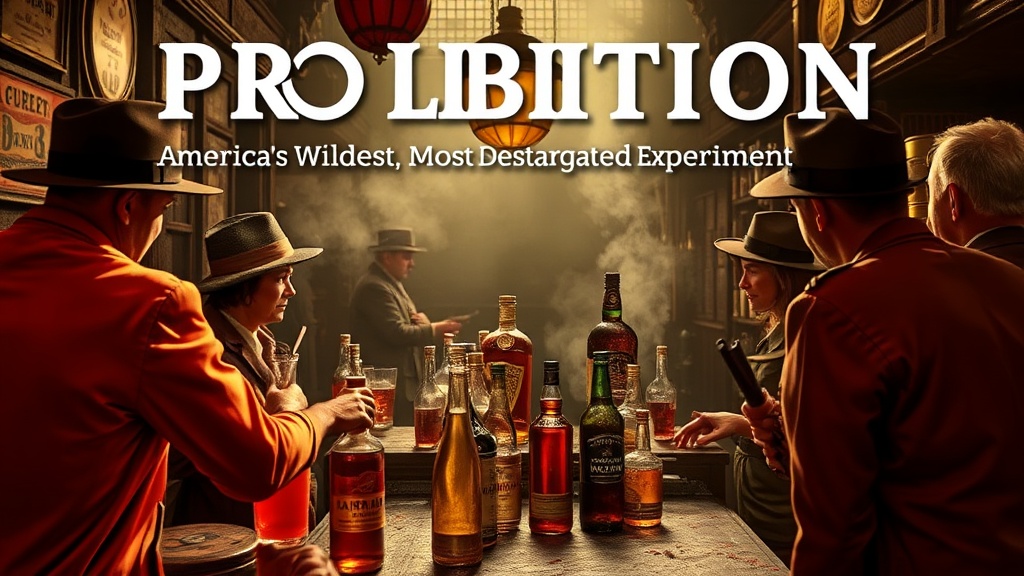
Prohibition: America's Wildest, Most Disastrous Experiment
Quick Summary
How Prohibition went from a moral crusade to organised crime's golden age. The full story of America's most spectacularly backfired constitutional amendment.
In This Article
When America Tried to Ban Itself From Drinking
Imagine a nation so thoroughly soaked in alcohol that doctors prescribed whiskey like aspirin, workers drank on the job as a matter of course, and a president's inauguration party left the White House in a state that would make a modern-day frat house blush. That was the United States before 1920 — and understanding just how saturated American culture was with drink is the only way to truly grasp the audacity, the ambition, and the catastrophic miscalculation of Prohibition.
On 17 January 1920, the Eighteenth Amendment to the United States Constitution came into force, making the manufacture, sale, and transportation of intoxicating liquors illegal across the entire country. It was the culmination of decades of moral campaigning, political pressure, and wartime fear. It was also, as history would gleefully record, one of the most spectacular own goals in legislative history. But before we get to the chaos, we need to understand the world that made Prohibition not just possible, but — for a brief, heady moment — genuinely popular.
A Nation That Drank Like It Was Dying of Thirst
The story of Prohibition begins not in Washington's marble halls but in the everyday reality of 19th-century American life. By modern standards, the drinking habits of the average American in the 1800s were staggering — quite literally. Historians estimate that Americans of that era consumed roughly three times the alcohol per capita that their 21st-century descendants do. Whiskey flowed at breakfast tables. Beer was considered safer than water in many communities, largely because it often was. Hard cider was children's fare in rural households.
This was not merely cultural permissiveness. It was structural. Alcohol taxes at one point accounted for nearly 40% of the federal government's entire annual revenue. Saloons were the social infrastructure of working-class communities — the place where immigrant labourers cashed their pay cheques, heard the news, found work, and occasionally settled disputes with their fists. To understand why Prohibition was so hard to enforce, you first have to understand how deeply alcohol was woven into the fabric of American daily life.
But fabric, no matter how deeply dyed, can fray. And by the mid-19th century, the human cost of that drinking culture was becoming impossible to ignore.
The Women Who Started a Revolution With Hymns and Hatchets
The temperance movement did not begin in Congress. It began in the streets of Ohio, led by women who had run out of patience and, frankly, options. In an era when women could not vote, could not own property in many states, and were expected to endure whatever domestic circumstances their husbands created, the saloon represented something visceral and personal: the place where the family wage disappeared, where men became violent strangers, where ambition drowned nightly in cheap whiskey.
Beginning in the early 1870s, women began staging protests outside saloons — kneeling in the mud, singing hymns, blocking doorways. The sheer novelty of it was destabilising. In some towns, schools closed when the women marched. Fire hoses were turned on them. In one extraordinary incident, a beer garden owner allegedly wheeled a cannon to his door and threatened to use it. None of it stopped them.
The Woman's Christian Temperance Union, founded in 1874, channelled this energy into organised political pressure. They lobbied for legislation, produced educational materials for schools, and built a national network of activists at a time when women organising for anything was considered radical. Their propaganda could be heavy-handed — temperance textbooks apparently suggested that a single sip of whiskey might cause a child to spontaneously combust — but the underlying message landed.
Then there was Carrie Nation. If the WCTU was the organised face of the temperance movement, Nation was its id. Armed with a hatchet and an absolute absence of fear, she travelled across Kansas — a nominally dry state where saloons operated openly and authorities looked the other way — and simply destroyed them. She was arrested repeatedly. Each time, she was released with a polite request to stop. Each time, she ignored it entirely. Her tactics alarmed even her allies, but her fame was undeniable, and her central point was devastatingly simple: the law meant nothing if no one enforced it.
The Political Genius Who Weaponised Moral Panic
The women's crusades created the cultural conditions for Prohibition, but the man who actually forced it into law was Wayne Wheeler, director of the Anti-Saloon League and one of the most effective political operators in American history. Wheeler understood something that modern political strategists recognise immediately: you do not need a majority of the people to be passionate about your cause. You need a motivated, organised minority willing to punish its opponents at the ballot box.
The Anti-Saloon League became a single-issue machine of terrifying efficiency. Wheeler had no interest in broader social reform. He cared about one thing — eliminating alcohol — and he built a political apparatus entirely around that goal. He mobilised constituencies that had nothing else in common. Progressive reformers worried about immigrant communities were told alcohol was exploiting the vulnerable. Factory owners were told drunk workers were costing them money. Racists were handed their own version of the argument, ugly and effective in equal measure. Workers were warned alcohol was a capitalist tool of oppression.
In Ohio alone, Wheeler orchestrated the defeat of 70 state representatives and a sitting governor. After that, no politician in America was willing to risk his attention. Even committed drinkers began publicly championing the temperance cause with the studied sincerity of men who knew what happened to those who didn't.
The First World War delivered the final push. The major American brewing companies were predominantly German-owned, and in the fever pitch of anti-German sentiment that gripped the country after 1917, Wheeler framed beer consumption as borderline treason. Sauerkraut had already been renamed Liberty Cabbage. Now drinking a stein of lager could mark you as a sympathiser. The Eighteenth Amendment passed the House 282 votes to 128. By 1919, enough states had ratified it to make it constitutional law.
It was a masterclass in pressure politics — and a template that campaigners on every point of the political spectrum have studied ever since.
The Law That Everyone Agreed To Break
Here is the thing about moral legislation: it works best when the behaviour it targets is already considered shameful. Prohibition's fatal flaw was that millions of Americans did not consider drinking shameful at all. They considered it Tuesday.
The Volstead Act, the legislation that gave Prohibition its teeth, contained more holes than a speakeasy wall. Drinking alcohol was not actually illegal — only its sale and manufacture were. If you had stockpiled alcohol before the law came into effect, you could drink it legally. Whiskey prescribed for medicinal purposes was still permitted, and doctors responded to this loophole with the kind of enthusiasm usually reserved for a gold rush. Prescriptions for medicinal whiskey surged overnight. Sacramental wine was exempt, and communion wine orders from churches and synagogues multiplied by millions of gallons almost immediately. An entirely new class of suspiciously recent rabbis appeared in cities across the country.
Entrepreneurs found subtler routes. Vine-Glo sold compressed bricks of dehydrated grape juice — legal, harmless, innocent — accompanied by packaging that contained a conspicuously specific warning: do not dissolve this brick in water and leave it in a cupboard for twenty days, as doing so would produce wine. The instruction was clear to everyone who read it. Its purpose was transparent. It sold in enormous quantities.
And then there was the moonshine, the bathtub gin, the basement stills that prohibition agents discovered everywhere from Appalachian hollows to the homes of politicians who had voted for the amendment. The Bureau of Prohibition employed 1,500 agents to police a country of 106 million people spread across 12,000 miles of coastline. The maths were not encouraging.
Prohibition's Darkest Legacy: The Age of Organised Crime
If Prohibition had merely failed, it would be a footnote. What made it genuinely catastrophic was what it created in the space where legal alcohol had been. By transforming a popular commodity into a forbidden one, the Eighteenth Amendment handed organised crime the most lucrative business opportunity in American history.
Alcohol distribution networks that had operated legally for generations simply went underground. The vacuum was filled by figures like Al Capone in Chicago, who built a criminal empire estimated to generate $60 million a year — roughly equivalent to $1 billion today — largely from bootlegged alcohol. Speakeasies proliferated in every major city. Corruption became endemic as police, judges, and local politicians were bought wholesale by bootleggers who could afford to pay handsomely.
The violence that accompanied this criminal consolidation was extraordinary. The St. Valentine's Day Massacre of 1929, in which seven members of a rival gang were executed in a Chicago garage, was the most infamous expression of a gangland war that played out in cities across the country. Prohibition had not eliminated alcohol. It had simply transferred control of it from legitimate businessmen to men willing to kill for market share.
The economic consequences were equally severe. Tens of thousands of jobs in brewing, distilling, and hospitality vanished. Tax revenues from alcohol — that near-40% of federal income — disappeared. The Great Depression, arriving in 1929, made the question of lost revenue feel considerably less abstract.
Franklin D. Roosevelt ran for president in 1932 partly on a platform of repealing Prohibition. He won in a landslide. The Twenty-First Amendment, repealing the Eighteenth, was ratified in 1933. Prohibition had lasted thirteen years, and left behind it a transformed criminal landscape, a generation of Americans who had learned that breaking the law was easy, and a lingering lesson about the limits of legislating private moral choices.
What Prohibition Actually Taught Us
The story of Prohibition is often told as a simple morality tale about puritanism run amok. But that framing undersells its complexity. The people who fought for temperance were responding to a genuine social crisis. Alcohol abuse in 19th-century America was devastating communities and families in measurable, documented ways. The women who knelt in the mud outside saloons were not cranks — they were people with entirely legitimate grievances about the consequences of unchecked drinking.
What Prohibition actually demonstrates is something more nuanced and more instructive: the difference between identifying a real problem and choosing an effective solution. The temperance movement correctly diagnosed a social ill. But the cure it prescribed — total prohibition enforced by an underfunded federal bureaucracy — ignored the economic incentives, cultural realities, and human instincts that would ensure its failure.
Free Weekly Newsletter
Enjoying this guide?
Get the best articles like this one delivered to your inbox every week. No spam.
It also demonstrated, with uncomfortable clarity, how a determined minority can impose its will on a majority through disciplined political organisation — and how the unintended consequences of that imposition can outlast the original cause by decades. The criminal networks built during Prohibition did not dissolve when the law was repealed. The corruption they had seeded in American institutions persisted long after the speakeasies closed.
Prohibition was not simply an experiment that failed. It was an experiment that failed while creating problems significantly worse than the one it set out to solve. As history's cautionary tales go, it remains one of the most instructive ever recorded.
Frequently Asked Questions
What exactly did Prohibition ban in the United States?
Prohibition, enacted through the Eighteenth Amendment and implemented by the Volstead Act in 1920, banned the manufacture, sale, and transportation of intoxicating liquors — defined as any beverage containing more than 0.5% alcohol by volume. Crucially, it did not make the act of drinking alcohol illegal, which created one of its most significant loopholes from the very beginning.
Why did Prohibition fail so dramatically?
Prohibition failed for several interconnected reasons. The law contained significant loopholes that allowed medicinal, sacramental, and privately stockpiled alcohol to remain legal. The enforcement agency was dramatically underfunded, with only around 1,500 agents for the entire country. Public demand for alcohol did not disappear simply because it had been made illegal, and organised crime rapidly filled the supply gap. Widespread corruption among law enforcement further undermined any serious attempt at enforcement.
Who was Wayne Wheeler and why does he matter?
Wayne Wheeler was the director of the Anti-Saloon League and the principal political architect of Prohibition. He perfected a model of single-issue pressure politics — targeting politicians who opposed his cause regardless of party affiliation — that proved devastatingly effective. He helped draft the Volstead Act, mobilised support across wildly different constituencies, and arguably did more than any other individual to make Prohibition a constitutional reality. His methods remain a studied template for political advocacy movements to this day.
When did Prohibition end and why?
Prohibition was repealed on 5 December 1933, when the Twenty-First Amendment was ratified — the only constitutional amendment ever passed specifically to repeal a previous one. By the early 1930s, a combination of factors had made repeal inevitable: the manifest failure of enforcement, the explosion of organised crime, the economic devastation of the Great Depression (which made lost tax revenue feel catastrophic), and the election of Franklin D. Roosevelt, who had campaigned partly on repeal. Prohibition had lasted thirteen years.
Did Prohibition have any lasting positive effects?
Prohibition's legacy is not entirely negative. Alcohol consumption did drop significantly in its early years, and some public health indicators temporarily improved. The movement also accelerated women's participation in political life at a critical moment — many of the organisational and lobbying skills developed during the temperance campaign fed directly into the suffrage movement. However, historians generally conclude that these benefits were substantially outweighed by the rise of organised crime, institutional corruption, and the broader cultural damage caused by thirteen years of normalised lawbreaking.
Frequently Asked Questions
When America Tried to Ban Itself From Drinking
Imagine a nation so thoroughly soaked in alcohol that doctors prescribed whiskey like aspirin, workers drank on the job as a matter of course, and a president's inauguration party left the White House in a state that would make a modern-day frat house blush. That was the United States before 1920 — and understanding just how saturated American culture was with drink is the only way to truly grasp the audacity, the ambition, and the catastrophic miscalculation of Prohibition.
On 17 January 1920, the Eighteenth Amendment to the United States Constitution came into force, making the manufacture, sale, and transportation of intoxicating liquors illegal across the entire country. It was the culmination of decades of moral campaigning, political pressure, and wartime fear. It was also, as history would gleefully record, one of the most spectacular own goals in legislative history. But before we get to the chaos, we need to understand the world that made Prohibition not just possible, but — for a brief, heady moment — genuinely popular.
A Nation That Drank Like It Was Dying of Thirst
The story of Prohibition begins not in Washington's marble halls but in the everyday reality of 19th-century American life. By modern standards, the drinking habits of the average American in the 1800s were staggering — quite literally. Historians estimate that Americans of that era consumed roughly three times the alcohol per capita that their 21st-century descendants do. Whiskey flowed at breakfast tables. Beer was considered safer than water in many communities, largely because it often was. Hard cider was children's fare in rural households.
This was not merely cultural permissiveness. It was structural. Alcohol taxes at one point accounted for nearly 40% of the federal government's entire annual revenue. Saloons were the social infrastructure of working-class communities — the place where immigrant labourers cashed their pay cheques, heard the news, found work, and occasionally settled disputes with their fists. To understand why Prohibition was so hard to enforce, you first have to understand how deeply alcohol was woven into the fabric of American daily life.
But fabric, no matter how deeply dyed, can fray. And by the mid-19th century, the human cost of that drinking culture was becoming impossible to ignore.
The Women Who Started a Revolution With Hymns and Hatchets
The temperance movement did not begin in Congress. It began in the streets of Ohio, led by women who had run out of patience and, frankly, options. In an era when women could not vote, could not own property in many states, and were expected to endure whatever domestic circumstances their husbands created, the saloon represented something visceral and personal: the place where the family wage disappeared, where men became violent strangers, where ambition drowned nightly in cheap whiskey.
Beginning in the early 1870s, women began staging protests outside saloons — kneeling in the mud, singing hymns, blocking doorways. The sheer novelty of it was destabilising. In some towns, schools closed when the women marched. Fire hoses were turned on them. In one extraordinary incident, a beer garden owner allegedly wheeled a cannon to his door and threatened to use it. None of it stopped them.
The Woman's Christian Temperance Union, founded in 1874, channelled this energy into organised political pressure. They lobbied for legislation, produced educational materials for schools, and built a national network of activists at a time when women organising for anything was considered radical. Their propaganda could be heavy-handed — temperance textbooks apparently suggested that a single sip of whiskey might cause a child to spontaneously combust — but the underlying message landed.
Then there was Carrie Nation. If the WCTU was the organised face of the temperance movement, Nation was its id. Armed with a hatchet and an absolute absence of fear, she travelled across Kansas — a nominally dry state where saloons operated openly and authorities looked the other way — and simply destroyed them. She was arrested repeatedly. Each time, she was released with a polite request to stop. Each time, she ignored it entirely. Her tactics alarmed even her allies, but her fame was undeniable, and her central point was devastatingly simple: the law meant nothing if no one enforced it.
The Political Genius Who Weaponised Moral Panic
The women's crusades created the cultural conditions for Prohibition, but the man who actually forced it into law was Wayne Wheeler, director of the Anti-Saloon League and one of the most effective political operators in American history. Wheeler understood something that modern political strategists recognise immediately: you do not need a majority of the people to be passionate about your cause. You need a motivated, organised minority willing to punish its opponents at the ballot box.
The Anti-Saloon League became a single-issue machine of terrifying efficiency. Wheeler had no interest in broader social reform. He cared about one thing — eliminating alcohol — and he built a political apparatus entirely around that goal. He mobilised constituencies that had nothing else in common. Progressive reformers worried about immigrant communities were told alcohol was exploiting the vulnerable. Factory owners were told drunk workers were costing them money. Racists were handed their own version of the argument, ugly and effective in equal measure. Workers were warned alcohol was a capitalist tool of oppression.
In Ohio alone, Wheeler orchestrated the defeat of 70 state representatives and a sitting governor. After that, no politician in America was willing to risk his attention. Even committed drinkers began publicly championing the temperance cause with the studied sincerity of men who knew what happened to those who didn't.
The First World War delivered the final push. The major American brewing companies were predominantly German-owned, and in the fever pitch of anti-German sentiment that gripped the country after 1917, Wheeler framed beer consumption as borderline treason. Sauerkraut had already been renamed Liberty Cabbage. Now drinking a stein of lager could mark you as a sympathiser. The Eighteenth Amendment passed the House 282 votes to 128. By 1919, enough states had ratified it to make it constitutional law.
It was a masterclass in pressure politics — and a template that campaigners on every point of the political spectrum have studied ever since.
The Law That Everyone Agreed To Break
Here is the thing about moral legislation: it works best when the behaviour it targets is already considered shameful. Prohibition's fatal flaw was that millions of Americans did not consider drinking shameful at all. They considered it Tuesday.
The Volstead Act, the legislation that gave Prohibition its teeth, contained more holes than a speakeasy wall. Drinking alcohol was not actually illegal — only its sale and manufacture were. If you had stockpiled alcohol before the law came into effect, you could drink it legally. Whiskey prescribed for medicinal purposes was still permitted, and doctors responded to this loophole with the kind of enthusiasm usually reserved for a gold rush. Prescriptions for medicinal whiskey surged overnight. Sacramental wine was exempt, and communion wine orders from churches and synagogues multiplied by millions of gallons almost immediately. An entirely new class of suspiciously recent rabbis appeared in cities across the country.
Entrepreneurs found subtler routes. Vine-Glo sold compressed bricks of dehydrated grape juice — legal, harmless, innocent — accompanied by packaging that contained a conspicuously specific warning: do not dissolve this brick in water and leave it in a cupboard for twenty days, as doing so would produce wine. The instruction was clear to everyone who read it. Its purpose was transparent. It sold in enormous quantities.
And then there was the moonshine, the bathtub gin, the basement stills that prohibition agents discovered everywhere from Appalachian hollows to the homes of politicians who had voted for the amendment. The Bureau of Prohibition employed 1,500 agents to police a country of 106 million people spread across 12,000 miles of coastline. The maths were not encouraging.
Prohibition's Darkest Legacy: The Age of Organised Crime
If Prohibition had merely failed, it would be a footnote. What made it genuinely catastrophic was what it created in the space where legal alcohol had been. By transforming a popular commodity into a forbidden one, the Eighteenth Amendment handed organised crime the most lucrative business opportunity in American history.
Alcohol distribution networks that had operated legally for generations simply went underground. The vacuum was filled by figures like Al Capone in Chicago, who built a criminal empire estimated to generate $60 million a year — roughly equivalent to $1 billion today — largely from bootlegged alcohol. Speakeasies proliferated in every major city. Corruption became endemic as police, judges, and local politicians were bought wholesale by bootleggers who could afford to pay handsomely.
The violence that accompanied this criminal consolidation was extraordinary. The St. Valentine's Day Massacre of 1929, in which seven members of a rival gang were executed in a Chicago garage, was the most infamous expression of a gangland war that played out in cities across the country. Prohibition had not eliminated alcohol. It had simply transferred control of it from legitimate businessmen to men willing to kill for market share.
The economic consequences were equally severe. Tens of thousands of jobs in brewing, distilling, and hospitality vanished. Tax revenues from alcohol — that near-40% of federal income — disappeared. The Great Depression, arriving in 1929, made the question of lost revenue feel considerably less abstract.
Franklin D. Roosevelt ran for president in 1932 partly on a platform of repealing Prohibition. He won in a landslide. The Twenty-First Amendment, repealing the Eighteenth, was ratified in 1933. Prohibition had lasted thirteen years, and left behind it a transformed criminal landscape, a generation of Americans who had learned that breaking the law was easy, and a lingering lesson about the limits of legislating private moral choices.
What Prohibition Actually Taught Us
The story of Prohibition is often told as a simple morality tale about puritanism run amok. But that framing undersells its complexity. The people who fought for temperance were responding to a genuine social crisis. Alcohol abuse in 19th-century America was devastating communities and families in measurable, documented ways. The women who knelt in the mud outside saloons were not cranks — they were people with entirely legitimate grievances about the consequences of unchecked drinking.
What Prohibition actually demonstrates is something more nuanced and more instructive: the difference between identifying a real problem and choosing an effective solution. The temperance movement correctly diagnosed a social ill. But the cure it prescribed — total prohibition enforced by an underfunded federal bureaucracy — ignored the economic incentives, cultural realities, and human instincts that would ensure its failure.
It also demonstrated, with uncomfortable clarity, how a determined minority can impose its will on a majority through disciplined political organisation — and how the unintended consequences of that imposition can outlast the original cause by decades. The criminal networks built during Prohibition did not dissolve when the law was repealed. The corruption they had seeded in American institutions persisted long after the speakeasies closed.
Prohibition was not simply an experiment that failed. It was an experiment that failed while creating problems significantly worse than the one it set out to solve. As history's cautionary tales go, it remains one of the most instructive ever recorded.
Frequently Asked Questions
What exactly did Prohibition ban in the United States?
Prohibition, enacted through the Eighteenth Amendment and implemented by the Volstead Act in 1920, banned the manufacture, sale, and transportation of intoxicating liquors — defined as any beverage containing more than 0.5% alcohol by volume. Crucially, it did not make the act of drinking alcohol illegal, which created one of its most significant loopholes from the very beginning.
Why did Prohibition fail so dramatically?
Prohibition failed for several interconnected reasons. The law contained significant loopholes that allowed medicinal, sacramental, and privately stockpiled alcohol to remain legal. The enforcement agency was dramatically underfunded, with only around 1,500 agents for the entire country. Public demand for alcohol did not disappear simply because it had been made illegal, and organised crime rapidly filled the supply gap. Widespread corruption among law enforcement further undermined any serious attempt at enforcement.
Who was Wayne Wheeler and why does he matter?
Wayne Wheeler was the director of the Anti-Saloon League and the principal political architect of Prohibition. He perfected a model of single-issue pressure politics — targeting politicians who opposed his cause regardless of party affiliation — that proved devastatingly effective. He helped draft the Volstead Act, mobilised support across wildly different constituencies, and arguably did more than any other individual to make Prohibition a constitutional reality. His methods remain a studied template for political advocacy movements to this day.
When did Prohibition end and why?
Prohibition was repealed on 5 December 1933, when the Twenty-First Amendment was ratified — the only constitutional amendment ever passed specifically to repeal a previous one. By the early 1930s, a combination of factors had made repeal inevitable: the manifest failure of enforcement, the explosion of organised crime, the economic devastation of the Great Depression (which made lost tax revenue feel catastrophic), and the election of Franklin D. Roosevelt, who had campaigned partly on repeal. Prohibition had lasted thirteen years.
Did Prohibition have any lasting positive effects?
Prohibition's legacy is not entirely negative. Alcohol consumption did drop significantly in its early years, and some public health indicators temporarily improved. The movement also accelerated women's participation in political life at a critical moment — many of the organisational and lobbying skills developed during the temperance campaign fed directly into the suffrage movement. However, historians generally conclude that these benefits were substantially outweighed by the rise of organised crime, institutional corruption, and the broader cultural damage caused by thirteen years of normalised lawbreaking.
About Zeebrain Editorial
Zeebrain publishes independent analysis of markets, investing, personal finance, and business. We disclose affiliate relationships, never accept payment for coverage, and fact-check all claims against primary sources. Read our editorial policy →
How this article was produced: Zeebrain articles are created with AI assistance from primary sources (including cited videos and market data) and reviewed under our editorial standards before publication. Spot an error? Tell us and we will correct it.
More from History & Mysteries

Related Guides
Keep exploring this topic
Why Teddy Roosevelt Never Got to Fight in World War One
History & Mysteries · Theodore Roosevelt · World War One
Why Mao Won the Chinese Civil War: The Full Story
History & Mysteries
Why Only Germany Paid WWI Reparations: The Full Story
History & Mysteries
Why Taiwan Wasn't Returned to Japan After World War II
History & Mysteries
Explore More Categories
Keep browsing by topic and build depth around the subjects you care about most.