The Artist Who Painted Insects Like Jewels and Changed Science
Quick Summary
Joris Hoefnagel painted insects with breathtaking precision a century before entomology existed. Here's how one artist quietly changed science forever.
In This Article
When an Artist Saw What Scientists Hadn't Yet Thought to Look For
For most of human history, insects were something to be crushed underfoot, not studied. They carried plague, spoiled food, and crawled into places they weren't welcome. Evolutionarily, psychologically, and culturally, we were primed to recoil from them. So it is a remarkable thing that the first serious, sustained, visually precise record of insect life in European history was not the work of a scientist. It was the work of a painter — a Flemish polymath named Joris Hoefnagel, working in the second half of the sixteenth century, decades before entomology existed as a discipline, and nearly a century before the microscope entered common scientific use. His masterwork, a series of roughly 300 watercolour miniatures known as The Four Elements, stands as one of the most quietly consequential achievements in the history of both art and natural science. This is the story of how one man's obsessive attention to beauty changed the way the world looked at its smallest creatures.

Antwerp: The City That Made Polymaths Possible
To understand Hoefnagel, you have to understand the world that produced him. In the mid-sixteenth century, Antwerp was arguably the most dynamic city in Europe. Its port served as the beating heart of global trade, channelling goods, people, and ideas from the Americas, Africa, and Asia into the continent. It was Europe's financial capital, a hotbed of humanist scholarship, and — unusually for a territory under Habsburg Catholic rule — a city with a genuine tradition of religious tolerance. That combination of wealth, openness, and intellectual ambition created the conditions for extraordinary cultural production.
Hoefnagel was born directly into this milieu, the son of a wealthy merchant family at the height of Antwerp's golden years. His education was comprehensively humanist: he spoke multiple languages, wrote poetry, played musical instruments, and took a keen interest in geography, trade, and natural history. But painting and illustration were his true north. As a young man, he travelled through France, England, and Spain, sketching obsessively. He was particularly struck by the exotic plants and animals arriving into the port of Seville from the New World — organisms that European eyes had never seen, that no existing taxonomy could account for. That encounter with the genuinely unknown seems to have lodged itself permanently in his imagination.
Scholar Brian Ogilvie has identified three converging forces that drove the Renaissance explosion of interest in natural history: a practical desire to understand medicinal plants, a scholarly impulse to revisit and verify what ancient writers like Aristotle had described, and a fashionable appetite for curiosities and wonders from distant corners of the globe. All three were alive in Hoefnagel. But there was a fourth force, too — a specifically Protestant theological conviction that nature was God's second book, a text as worthy of reverent study as scripture itself. To look closely at a beetle's wing casing was, in this framework, an act of worship.
Standing on Dürer's Shoulders — and Going Much Further
Hoefnagel never met Albrecht Dürer, but he inherited his aesthetic philosophy completely. Dürer had pioneered the realistic depiction of nature in the early sixteenth century — his Young Hare and Great Piece of Turf remain landmark achievements in the history of observational art. They demonstrated that the natural world, rendered with fidelity and care, could be as worthy a subject as religious iconography or portraiture. Hoefnagel took that baton and sprinted.
The difference between Dürer's famous stag beetle and Hoefnagel's version tells you everything. Where Dürer's composition leaves gaps between the head, prothorax, and forewing, Hoefnagel fills them in with anatomical precision. His wing cases carry visible texture. His colour palette is broader, capturing the metallic iridescence of the beetle's surface. And crucially, his shadow is not flat — it is calibrated to the light source, giving the creature a three-dimensional presence that makes it feel almost alive on the page. This is not the work of an artist decorating a manuscript. This is the work of someone who studied his subject with the focused intensity of a scientist.
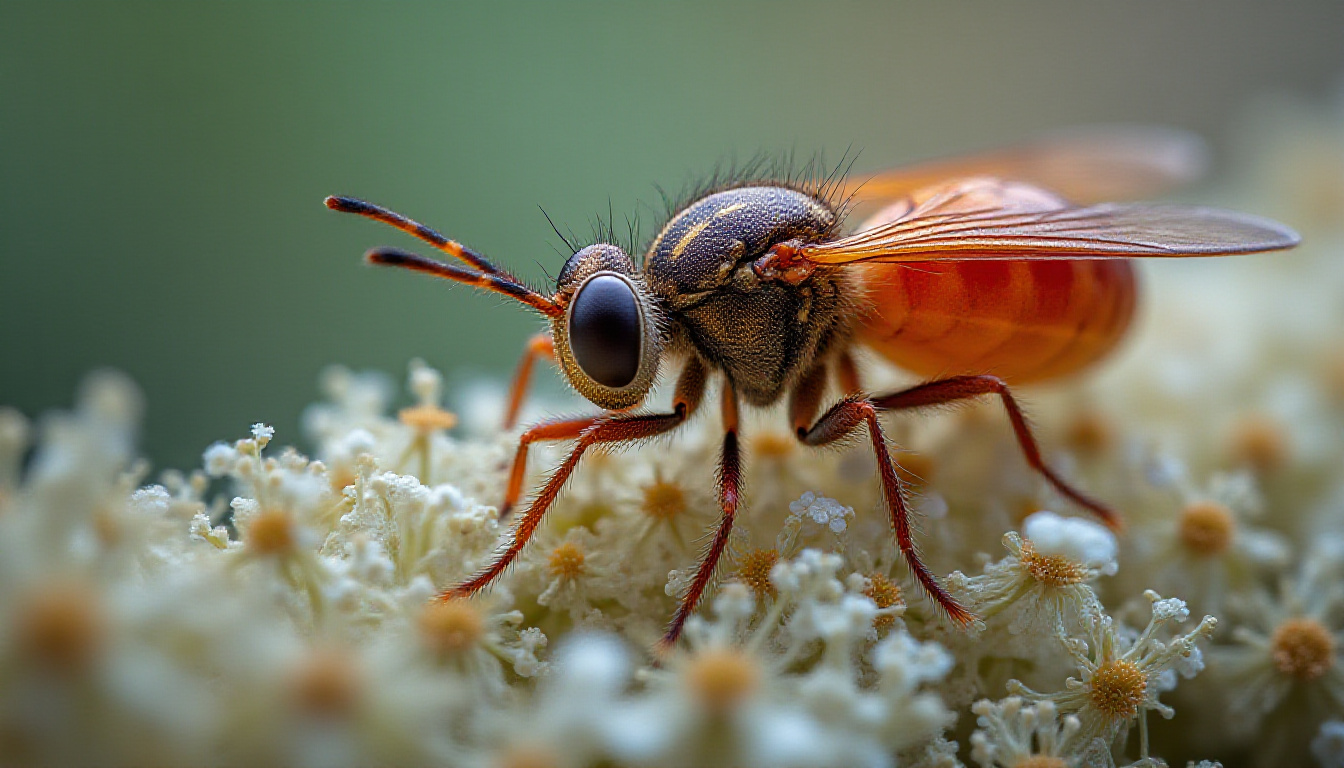
His southern hawker dragonfly makes the point even more forcefully. Each spot on the abdomen contains a subtly different mixture of green and yellow pigments. The wing venation — each individual cell, or areola — is separately shaped. His brushwork on the wings varies in weight to show how light passes through the membrane rather than simply reflecting off it. At a time when no one had yet thought to classify, name, or systematically describe insects as a group, Hoefnagel was rendering them with a precision that field entomologists would not routinely achieve for another hundred years.
The Fire Volume: Why Insects Belong Alongside Flames
The Four Elements is structured, as the name suggests, around the classical elements: water, earth, air, and fire. Sea creatures fill the water volume, birds the air volume, land animals the earth volume. Insects occupy fire — and that placement is intriguing enough to deserve a moment's thought.
We don't have Hoefnagel's own explanation. But the association is not arbitrary. Fire, in classical and Renaissance thought, was the element of transformation — the force that changes matter from one state to another. And insects are, biologically, transformation incarnate. The caterpillar becomes a butterfly. The larva becomes a beetle. The nymph becomes a dragonfly. Metamorphosis was considered one of nature's deepest mysteries well before anyone had the conceptual tools to explain it scientifically. Placing insects alongside fire was a symbolic choice, but it was also a philosophically precise one.
What makes the fire volume particularly significant is how Hoefnagel produced it. Many of the creatures in the other three volumes were copied or adapted from earlier artistic sources — a common and accepted practice in this period. The insects were almost certainly drawn from life, because in the 1560s and 1570s there were no other sources to copy from. The Four Elements was not building on a tradition of insect illustration. It was creating one. In some miniatures, Hoefnagel went so far as to include part of the actual insect specimen in the drawing — a pin, a piece of wing. The work crosses the boundary between art object and scientific specimen.
From Private Obsession to Public Influence
For most of his lifetime, The Four Elements remained a private project. It was created over decades for a small circle of wealthy patrons and close friends — royalty and aristocrats who could commission such work and appreciate it. The series was never intended, in its original form, for a general audience. Which means that one of the most important natural history documents of the sixteenth century was, for years, effectively invisible to the scientists and artists who might have learned the most from it.
Hoefnagel's solution was elegant. He collaborated with his teenage son Jacob — himself a gifted artist — to produce Archetypa Studiaque Patris, a series of 48 engraved prints that distilled the spirit and imagery of The Four Elements into a widely reproducible format. These prints grouped animals into emblematic compositions, mixing species from different volumes, surrounding them with plants and mottoes in the Renaissance tradition of the emblem book. They were circulated across Europe, landing in the hands of collectors, artists, and natural historians.
The influence was significant and traceable. Naturalists incorporated Hoefnagel's imagery into their treatises. Artists used his compositions as models. More broadly, the prints helped establish the convention that insects were subjects worthy of careful visual attention — a convention that fed directly into the work of later figures like Maria Sibylla Merian, whose late-seventeenth-century studies of insect metamorphosis are rightly celebrated as foundational texts of entomology. Merian's achievement would have been harder to imagine without Hoefnagel's precedent.
What Hoefnagel Teaches Us About the Space Between Art and Science
There is a temptation, with hindsight, to classify Hoefnagel as either an artist who happened to be interested in science, or a proto-scientist who expressed himself through art. But both framings miss the point. The very distinction between art and science — as separate, even competing modes of inquiry — is largely a product of the nineteenth century. In the sixteenth century, looking carefully was thinking carefully. Rendering a dragonfly's wing with precision was an epistemic act, a way of knowing the world.
Hoefnagel brought a natural historian's instinct for categorisation, investigation, and discovery to painting. He brought a painter's devotion to colour, form, and material reality to natural history. And running beneath both was a spiritual conviction that close attention to the smallest, most overlooked creatures was a form of reverence — that God's craftsmanship was not diminished in a beetle but fully present in it.
That synthesis is rare in any era. It requires a willingness to resist the pressure to specialise, to maintain genuine curiosity across multiple domains, and to believe that beauty and knowledge are not in tension. Hoefnagel lived that belief across a lifetime of work, and the world — its art, its science, its collective sense of what is worth looking at — is measurably different for it.
Free Weekly Newsletter
Enjoying this guide?
Get the best articles like this one delivered to your inbox every week. No spam.
Conclusion: The Universe at Our Feet
Insects represent the vast majority of animal species on Earth. They underpin almost every terrestrial ecosystem. And yet for most of human history, they were beneath notice — literally and figuratively. It took an artist, working from curiosity and faith and an almost unreasonable attention to detail, to make us look. Joris Hoefnagel did not discover insects. But he made them visible in a new way, with a seriousness and a beauty that demanded a response. The scientists who came after him — and eventually built entomology into a rigorous discipline — were, in a meaningful sense, following the path he cleared.
There is a lesson in that for anyone who thinks art and science occupy separate territories. The most productive moments in the history of human knowledge often happen exactly where those territories overlap — where someone refuses to choose between precision and beauty, between description and meaning. Hoefnagel refused that choice. What he left behind is proof that he was right to.
Frequently Asked Questions
Who was Joris Hoefnagel and why is he significant?
Joris Hoefnagel (1542–1600) was a Flemish artist, miniaturist, and natural historian born in Antwerp. He is significant for creating The Four Elements, a series of approximately 300 watercolour miniatures that represents the first dedicated visual record of insect life in European history. His work predated the formal discipline of entomology by more than a century and influenced generations of artists and naturalists.
What is The Four Elements and what does it contain?
The Four Elements is Hoefnagel's magnum opus — a set of four illuminated manuscript volumes organised around the classical elements: water (sea creatures), earth (land animals), air (birds), and fire (insects). The fire volume is considered particularly remarkable because the insects depicted were almost certainly drawn from life, making it a unique scientific and artistic document for its era.
Why did Hoefnagel place insects in the 'fire' volume?
Hoefnagel never wrote explicitly about this decision, but the most persuasive interpretation is symbolic: fire was classically associated with transformation, and insects — which undergo metamorphosis — are among nature's most dramatic examples of physical transformation. The association suggests that Hoefnagel was thinking conceptually as well as decoratively when he organised the series.
How did Hoefnagel's insect illustrations influence the history of science?
Through his Archetypa prints, produced with his son Jacob, Hoefnagel's imagery circulated widely across Europe, entering the collections of naturalists and artists alike. His approach — treating insects as subjects worthy of precise, sustained visual attention — helped establish the conditions in which entomology could eventually emerge as a formal science. Later figures such as Maria Sibylla Merian built on traditions of insect illustration that Hoefnagel had helped create.
How does Hoefnagel's work compare to Albrecht Dürer's nature studies?
Dürer was Hoefnagel's most important predecessor in the realistic depiction of nature. Hoefnagel explicitly updated and improved upon Dürer's famous stag beetle, adding anatomical detail, more accurate shadow work, and a richer colour range. Where Dürer established the principle that nature was a worthy subject for serious artistic attention, Hoefnagel extended that principle with a level of observational precision that crossed into scientific territory.
Frequently Asked Questions
When an Artist Saw What Scientists Hadn't Yet Thought to Look For
For most of human history, insects were something to be crushed underfoot, not studied. They carried plague, spoiled food, and crawled into places they weren't welcome. Evolutionarily, psychologically, and culturally, we were primed to recoil from them. So it is a remarkable thing that the first serious, sustained, visually precise record of insect life in European history was not the work of a scientist. It was the work of a painter — a Flemish polymath named Joris Hoefnagel, working in the second half of the sixteenth century, decades before entomology existed as a discipline, and nearly a century before the microscope entered common scientific use. His masterwork, a series of roughly 300 watercolour miniatures known as The Four Elements, stands as one of the most quietly consequential achievements in the history of both art and natural science. This is the story of how one man's obsessive attention to beauty changed the way the world looked at its smallest creatures.
Antwerp: The City That Made Polymaths Possible
To understand Hoefnagel, you have to understand the world that produced him. In the mid-sixteenth century, Antwerp was arguably the most dynamic city in Europe. Its port served as the beating heart of global trade, channelling goods, people, and ideas from the Americas, Africa, and Asia into the continent. It was Europe's financial capital, a hotbed of humanist scholarship, and — unusually for a territory under Habsburg Catholic rule — a city with a genuine tradition of religious tolerance. That combination of wealth, openness, and intellectual ambition created the conditions for extraordinary cultural production.
Hoefnagel was born directly into this milieu, the son of a wealthy merchant family at the height of Antwerp's golden years. His education was comprehensively humanist: he spoke multiple languages, wrote poetry, played musical instruments, and took a keen interest in geography, trade, and natural history. But painting and illustration were his true north. As a young man, he travelled through France, England, and Spain, sketching obsessively. He was particularly struck by the exotic plants and animals arriving into the port of Seville from the New World — organisms that European eyes had never seen, that no existing taxonomy could account for. That encounter with the genuinely unknown seems to have lodged itself permanently in his imagination.
Scholar Brian Ogilvie has identified three converging forces that drove the Renaissance explosion of interest in natural history: a practical desire to understand medicinal plants, a scholarly impulse to revisit and verify what ancient writers like Aristotle had described, and a fashionable appetite for curiosities and wonders from distant corners of the globe. All three were alive in Hoefnagel. But there was a fourth force, too — a specifically Protestant theological conviction that nature was God's second book, a text as worthy of reverent study as scripture itself. To look closely at a beetle's wing casing was, in this framework, an act of worship.
Standing on Dürer's Shoulders — and Going Much Further
Hoefnagel never met Albrecht Dürer, but he inherited his aesthetic philosophy completely. Dürer had pioneered the realistic depiction of nature in the early sixteenth century — his Young Hare and Great Piece of Turf remain landmark achievements in the history of observational art. They demonstrated that the natural world, rendered with fidelity and care, could be as worthy a subject as religious iconography or portraiture. Hoefnagel took that baton and sprinted.
The difference between Dürer's famous stag beetle and Hoefnagel's version tells you everything. Where Dürer's composition leaves gaps between the head, prothorax, and forewing, Hoefnagel fills them in with anatomical precision. His wing cases carry visible texture. His colour palette is broader, capturing the metallic iridescence of the beetle's surface. And crucially, his shadow is not flat — it is calibrated to the light source, giving the creature a three-dimensional presence that makes it feel almost alive on the page. This is not the work of an artist decorating a manuscript. This is the work of someone who studied his subject with the focused intensity of a scientist.
His southern hawker dragonfly makes the point even more forcefully. Each spot on the abdomen contains a subtly different mixture of green and yellow pigments. The wing venation — each individual cell, or areola — is separately shaped. His brushwork on the wings varies in weight to show how light passes through the membrane rather than simply reflecting off it. At a time when no one had yet thought to classify, name, or systematically describe insects as a group, Hoefnagel was rendering them with a precision that field entomologists would not routinely achieve for another hundred years.
The Fire Volume: Why Insects Belong Alongside Flames
The Four Elements is structured, as the name suggests, around the classical elements: water, earth, air, and fire. Sea creatures fill the water volume, birds the air volume, land animals the earth volume. Insects occupy fire — and that placement is intriguing enough to deserve a moment's thought.
We don't have Hoefnagel's own explanation. But the association is not arbitrary. Fire, in classical and Renaissance thought, was the element of transformation — the force that changes matter from one state to another. And insects are, biologically, transformation incarnate. The caterpillar becomes a butterfly. The larva becomes a beetle. The nymph becomes a dragonfly. Metamorphosis was considered one of nature's deepest mysteries well before anyone had the conceptual tools to explain it scientifically. Placing insects alongside fire was a symbolic choice, but it was also a philosophically precise one.
What makes the fire volume particularly significant is how Hoefnagel produced it. Many of the creatures in the other three volumes were copied or adapted from earlier artistic sources — a common and accepted practice in this period. The insects were almost certainly drawn from life, because in the 1560s and 1570s there were no other sources to copy from. The Four Elements was not building on a tradition of insect illustration. It was creating one. In some miniatures, Hoefnagel went so far as to include part of the actual insect specimen in the drawing — a pin, a piece of wing. The work crosses the boundary between art object and scientific specimen.
From Private Obsession to Public Influence
For most of his lifetime, The Four Elements remained a private project. It was created over decades for a small circle of wealthy patrons and close friends — royalty and aristocrats who could commission such work and appreciate it. The series was never intended, in its original form, for a general audience. Which means that one of the most important natural history documents of the sixteenth century was, for years, effectively invisible to the scientists and artists who might have learned the most from it.
Hoefnagel's solution was elegant. He collaborated with his teenage son Jacob — himself a gifted artist — to produce Archetypa Studiaque Patris, a series of 48 engraved prints that distilled the spirit and imagery of The Four Elements into a widely reproducible format. These prints grouped animals into emblematic compositions, mixing species from different volumes, surrounding them with plants and mottoes in the Renaissance tradition of the emblem book. They were circulated across Europe, landing in the hands of collectors, artists, and natural historians.
The influence was significant and traceable. Naturalists incorporated Hoefnagel's imagery into their treatises. Artists used his compositions as models. More broadly, the prints helped establish the convention that insects were subjects worthy of careful visual attention — a convention that fed directly into the work of later figures like Maria Sibylla Merian, whose late-seventeenth-century studies of insect metamorphosis are rightly celebrated as foundational texts of entomology. Merian's achievement would have been harder to imagine without Hoefnagel's precedent.
What Hoefnagel Teaches Us About the Space Between Art and Science
There is a temptation, with hindsight, to classify Hoefnagel as either an artist who happened to be interested in science, or a proto-scientist who expressed himself through art. But both framings miss the point. The very distinction between art and science — as separate, even competing modes of inquiry — is largely a product of the nineteenth century. In the sixteenth century, looking carefully was thinking carefully. Rendering a dragonfly's wing with precision was an epistemic act, a way of knowing the world.
Hoefnagel brought a natural historian's instinct for categorisation, investigation, and discovery to painting. He brought a painter's devotion to colour, form, and material reality to natural history. And running beneath both was a spiritual conviction that close attention to the smallest, most overlooked creatures was a form of reverence — that God's craftsmanship was not diminished in a beetle but fully present in it.
That synthesis is rare in any era. It requires a willingness to resist the pressure to specialise, to maintain genuine curiosity across multiple domains, and to believe that beauty and knowledge are not in tension. Hoefnagel lived that belief across a lifetime of work, and the world — its art, its science, its collective sense of what is worth looking at — is measurably different for it.
Conclusion: The Universe at Our Feet
Insects represent the vast majority of animal species on Earth. They underpin almost every terrestrial ecosystem. And yet for most of human history, they were beneath notice — literally and figuratively. It took an artist, working from curiosity and faith and an almost unreasonable attention to detail, to make us look. Joris Hoefnagel did not discover insects. But he made them visible in a new way, with a seriousness and a beauty that demanded a response. The scientists who came after him — and eventually built entomology into a rigorous discipline — were, in a meaningful sense, following the path he cleared.
There is a lesson in that for anyone who thinks art and science occupy separate territories. The most productive moments in the history of human knowledge often happen exactly where those territories overlap — where someone refuses to choose between precision and beauty, between description and meaning. Hoefnagel refused that choice. What he left behind is proof that he was right to.
Frequently Asked Questions
Who was Joris Hoefnagel and why is he significant?
Joris Hoefnagel (1542–1600) was a Flemish artist, miniaturist, and natural historian born in Antwerp. He is significant for creating The Four Elements, a series of approximately 300 watercolour miniatures that represents the first dedicated visual record of insect life in European history. His work predated the formal discipline of entomology by more than a century and influenced generations of artists and naturalists.
What is The Four Elements and what does it contain?
The Four Elements is Hoefnagel's magnum opus — a set of four illuminated manuscript volumes organised around the classical elements: water (sea creatures), earth (land animals), air (birds), and fire (insects). The fire volume is considered particularly remarkable because the insects depicted were almost certainly drawn from life, making it a unique scientific and artistic document for its era.
Why did Hoefnagel place insects in the 'fire' volume?
Hoefnagel never wrote explicitly about this decision, but the most persuasive interpretation is symbolic: fire was classically associated with transformation, and insects — which undergo metamorphosis — are among nature's most dramatic examples of physical transformation. The association suggests that Hoefnagel was thinking conceptually as well as decoratively when he organised the series.
How did Hoefnagel's insect illustrations influence the history of science?
Through his Archetypa prints, produced with his son Jacob, Hoefnagel's imagery circulated widely across Europe, entering the collections of naturalists and artists alike. His approach — treating insects as subjects worthy of precise, sustained visual attention — helped establish the conditions in which entomology could eventually emerge as a formal science. Later figures such as Maria Sibylla Merian built on traditions of insect illustration that Hoefnagel had helped create.
How does Hoefnagel's work compare to Albrecht Dürer's nature studies?
Dürer was Hoefnagel's most important predecessor in the realistic depiction of nature. Hoefnagel explicitly updated and improved upon Dürer's famous stag beetle, adding anatomical detail, more accurate shadow work, and a richer colour range. Where Dürer established the principle that nature was a worthy subject for serious artistic attention, Hoefnagel extended that principle with a level of observational precision that crossed into scientific territory.
About Zeebrain Editorial
Zeebrain publishes independent analysis of markets, investing, personal finance, and business. We disclose affiliate relationships, never accept payment for coverage, and fact-check all claims against primary sources. Read our editorial policy →
How this article was produced: Zeebrain articles are created with AI assistance from primary sources (including cited videos and market data) and reviewed under our editorial standards before publication. Spot an error? Tell us and we will correct it.
More from Entertainment


Related Guides
Keep exploring this topic
The Rise of the Machines… and Entertainers: AI-Generated Content Reshapes the Entertainment Landscap...
Entertainment
The Math Behind Why Movie Franchises Keep Failing
Entertainment
The Age of Innocence: How Scorsese Mastered Adaptation
Entertainment
Trapped on an Island: What It Really Takes to Build a Boat
Entertainment
Explore More Categories
Keep browsing by topic and build depth around the subjects you care about most.