Evolution vs Christianity: The Real History You Weren't Taught
Quick Summary
The evolution vs Christianity debate isn't as old as you think. Discover the surprising truth behind the Scopes Trial, Darwin's reception, and a mistranslated rib.
In This Article
The Conflict That Wasn't Always a Conflict
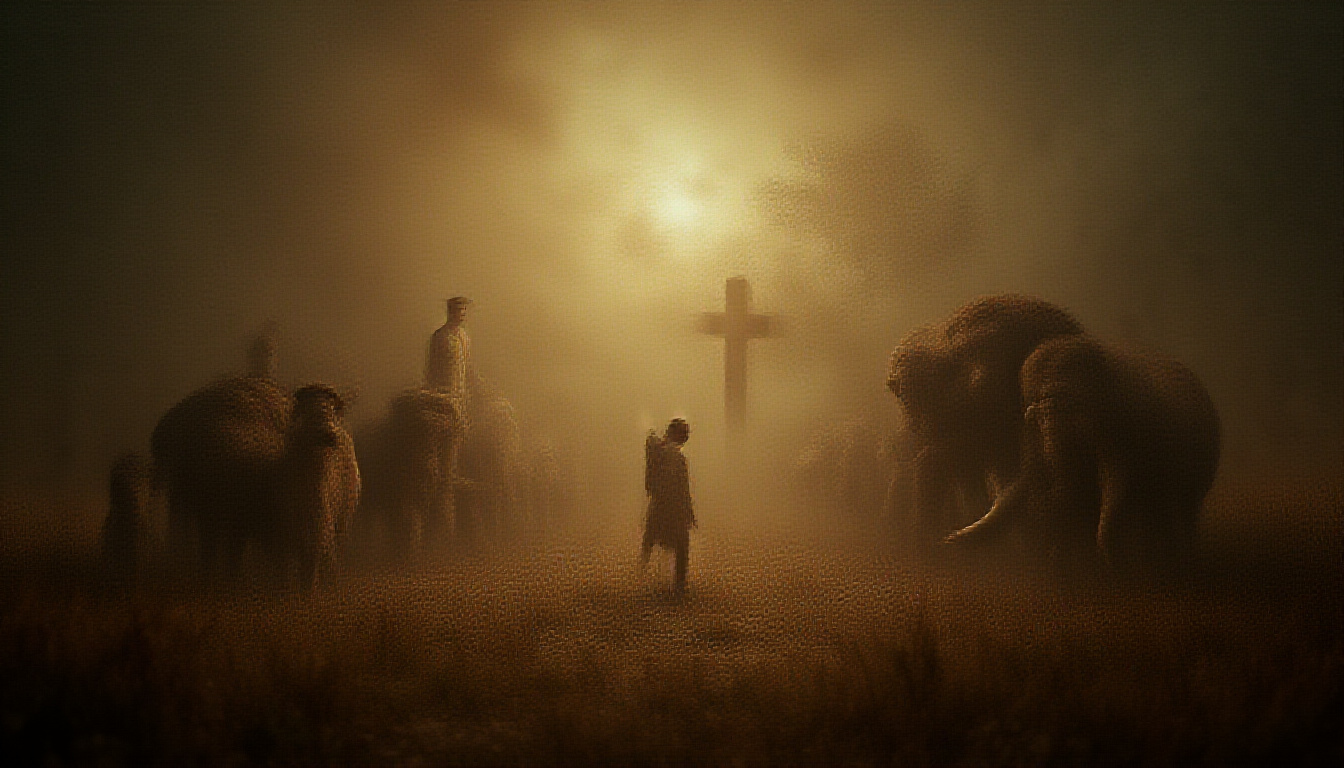
Ask most people when the war between evolution and Christianity began, and they'll point to the moment Charles Darwin published On the Origin of Species in 1859. The story goes: Darwin dropped his bombshell, the Church erupted, and science and religion have been at each other's throats ever since. Neat, simple, and largely wrong.

The actual history of evolution versus Christianity is far messier, more interesting, and considerably more nuanced than the culture-war narrative we've inherited. The loudest battles came much later than most people assume, the Church's early responses were far more varied than a blanket rejection, and some of the most iconic moments in the debate — including the legendary Scopes Trial of 1925 — were as much political theatre as genuine ideological warfare.
Understanding that history doesn't just make for good trivia. It changes how we think about science, faith, and the stories societies tell about themselves when they feel threatened.
Darwin Didn't Declare War on Christianity — Others Did That Later
Darwin's central claim was not, as popular shorthand still insists, that humans descended from monkeys. His actual argument was that humans and other primates share a common ancestor — a crucial distinction that changes the entire framing of the debate. Darwin himself was deeply anxious about the social and theological implications of his work, which is partly why he delayed publication for over two decades.
When On the Origin of Species finally appeared, the response from religious communities was neither uniform nor uniformly hostile. Yes, there were prominent voices in the Church of England who objected, but their primary concern was often the timeline: Darwin's theory required millions of years of gradual change, which sat uneasily with a literal reading of Genesis that placed creation at under 6,000 years ago. That is a specific, concrete disagreement — not the same as a wholesale rejection of naturalistic inquiry.
Many clergy found no fundamental conflict between evolutionary theory and their faith. The Catholic Church never banned Darwin's work — a striking fact given its historical willingness to suppress ideas it found threatening. Several major Protestant denominations simply declined to issue any official position at all, treating it as a matter for scientists to settle. By the early 20th century, a large number of urban American churches had actively reconciled evolutionary theory with scripture, reading Genesis as allegorical or poetic rather than literally historical.
The sweeping, us-versus-them framing of evolution versus Christianity as an ancient, inevitable clash is itself a modern invention — and a fairly recent one at that.
The Big Bang Was Proposed by a Catholic Priest, and Scientists Hated It
If you want a striking illustration of how distorted our assumptions about science and religion can be, consider the origin of the Big Bang theory. The foundational ideas behind it were developed by Georges Lemaître, a Belgian Catholic priest and physicist who proposed in 1927 that the universe was expanding outward from an initial, singular point of immense density — what he called the "hypothesis of the primeval atom."
The scientific establishment's reaction was not applause. It was suspicion. Many prominent scientists, including Albert Einstein initially, rejected Lemaître's model — not because the mathematics were weak, but because the idea of a definitive beginning to the universe seemed uncomfortably close to the Christian doctrine of creation ex nihilo. Fred Hoyle, who coined the term "Big Bang" as a dismissive label, preferred the Steady State model precisely because it avoided a moment of origin.
In other words, a scientific theory was resisted by scientists partly because it seemed too religious, while being proposed by a man of faith whose conclusions were driven entirely by evidence. The irony is almost too neat. It should make anyone pause before assuming they know which side of the science-religion divide produces clearer thinking.
The Scopes Trial: Spectacle, Strategy, and What Actually Happened
The 1925 Scopes Trial — officially The State of Tennessee v. John Thomas Scopes — is the cultural touchstone for the evolution versus Christianity debate in America. It has been dramatised, mythologised, and misrepresented so many times that the actual events are worth recovering in some detail.
The Butler Act, passed by the Tennessee legislature in March 1925, made it unlawful to teach Darwin's theory of evolution in any state-funded school. The law was widely regarded as largely symbolic — unlikely to be enforced in practice. The irony is that one of the approved biology textbooks teachers were actually required to use, Hunter's Civic Biology, contained a substantial chapter on evolutionary theory. In effect, the law created a situation where teachers were legally obligated to break the law.
The American Civil Liberties Union advertised publicly that it would fund the defence of any teacher willing to challenge the Butler Act in court. John Scopes, a young teacher in Dayton, Tennessee, volunteered — though he later admitted he was not entirely certain he had ever actually taught evolution directly, having only substituted for the biology class. This uncertainty was one reason his own defence team kept him off the witness stand.
What followed was less a legal proceeding than a national media event. Dayton filled with travelling preachers, curious crowds, vendors selling toy monkeys and Bibles side by side, and journalists from across the country. The trial was the first in American history to be broadcast live on national radio.
The two attorneys were the real protagonists. Clarence Darrow, the celebrated Chicago defence lawyer, faced off against William Jennings Bryan, three-time presidential candidate and committed biblical literalist. Both men, in a strange twist, actually wanted Scopes found guilty — Darrow so that he could appeal to a higher court and challenge the law's constitutionality, Bryan so that the law's deterrent effect would be confirmed.
Judge John Raulston effectively neutralised Darrow's core strategy by refusing to admit expert testimony on evolutionary science, ruling that the only relevant question was whether Scopes had taught evolution, not whether evolution was true or compatible with scripture. Darrow pivoted brilliantly, calling Bryan himself to the stand as an expert on the Bible — a move that produced some of the most memorable courtroom exchanges in American legal history.
Bryan's testimony revealed the limits of strict biblical literalism when pressed by rigorous cross-examination. When asked about the date of the biblical flood, Bryan cited a figure of 4,273 years ago sourced from a Bible concordance. Darrow noted that Chinese civilisation predated that figure by thousands of years. Bryan, when cornered on questions he hadn't considered, offered the remarkable answer: "I do not think about things I don't think about." It was a line that generated laughter in the courtroom and scorn in the press.
Scopes was found guilty and fined $100. But the Tennessee Supreme Court later overturned the verdict on a technicality: the judge had set the fine himself, which under Tennessee law at the time he was not permitted to do for amounts over $50. Scopes walked free, but the Butler Act remained on the books.
From Dayton to the Supreme Court: The Long Road to Legal Resolution
The Scopes Trial settled nothing constitutionally. The Butler Act remained Tennessee law for another four decades. It was finally repealed in 1967, triggered when a teacher named Gary Scott was actually fired for violating it — a sign that, by the 1960s, enforcement had become viable in a way it hadn't been in 1925.
The definitive legal resolution came in 1968, when zoology teacher Susan Epperson challenged Arkansas's equivalent ban on teaching human evolution. The case reached the United States Supreme Court, which ruled unanimously that such laws violated the Establishment Clause of the First Amendment. The state could not prohibit the teaching of a scientific theory simply because it conflicted with a particular religious interpretation of human origins.
It had taken more than a century from the publication of On the Origin of Species for American law to formally settle the question — and even then, the cultural debate continued in new forms, through battles over "creation science" and later "intelligent design" in school curricula.
The Rib That Wasn't a Rib: On Mistranslation and Its Consequences
One of the most fascinating footnotes in the evolution versus Christianity debate concerns a much older misunderstanding — the story of Eve being created from Adam's rib.
The relevant Hebrew word in Genesis is tsela, from the root tsalah, meaning curve or side. In every other context in the Hebrew Bible where tsela appears, it is translated as side — referring to the side of a building, a hill, or a tabernacle. There is a completely different Hebrew word for rib. The single instance where tsela came to be translated as rib appears to be a mistranslation that became entrenched through tradition.
Hebrew priestly texts dating back more than 2,000 years consistently use the word side rather than rib. The implication of the original is arguably that God took one half — one side — of Adam to form Eve, then closed up the remaining flesh. Some contemporary religious scholars have gone further, suggesting that a tsela meaning curve is an evocative metaphor for the double helix structure of DNA — though this reading is speculative and contested.
What's significant here isn't which interpretation is correct. It's what the mistranslation demonstrates: that the biblical texts at the centre of the creation debate have been filtered through layers of translation, tradition, and cultural assumption. Fighting over a literal rib is, in a very real sense, fighting over a translator's error.
What the History Actually Tells Us
Free Weekly Newsletter
Enjoying this guide?
Get the best articles like this one delivered to your inbox every week. No spam.
The evolution versus Christianity narrative, as it is commonly told, is a story about an inevitable collision between modern science and ancient faith. But the actual history suggests something more complicated and, frankly, more interesting.
The conflict intensified not when Darwin published his theory, but decades later, in specific cultural and political contexts — particularly in the American South of the early 20th century, where rapid social change made biblical literalism feel like a bulwark against an encroaching modern world. The legal battles that followed were as much about identity and community as they were about the age of the Earth.
Science and religion have a long, tangled history of cross-pollination — a Catholic priest at the origin of Big Bang cosmology, Darwin himself wrestling privately with faith, religious scholars contributing to our understanding of ancient texts. Reducing that history to a simple war between reason and superstition doesn't illuminate anything. It just makes better television.
The more honest question is not whether science and Christianity are inherently at war, but under what conditions specific groups have decided to treat them that way — and what was at stake when they did.
Frequently Asked Questions
Did the Catholic Church officially oppose Darwin's theory of evolution?
No. The Catholic Church never banned On the Origin of Species and never issued an official condemnation of evolutionary theory. While individual Catholic thinkers debated its implications, the Church's official position has been broadly open to evolutionary science, provided the spiritual dimension of human existence is not reduced to purely material processes. Pope John Paul II stated in 1996 that evolution was "more than a hypothesis," and the Church's current position allows for theistic evolution — the view that God works through natural processes.
What actually happened to John Scopes after the trial?
Scopes' conviction was overturned on a technicality in 1927 by the Tennessee Supreme Court, which recommended the case not be retried. He went on to study geology at the University of Chicago, then worked for decades as a petroleum engineer. He wrote a memoir, Center of the Storm, published in 1967 — the same year the Butler Act was finally repealed. He died in 1970 and remained philosophical about his role in the trial throughout his life.
Is it true that the Big Bang theory was developed by a Catholic priest?
Yes. Georges Lemaître, a Belgian Catholic priest and professor of physics, first proposed the expanding universe model in 1927 and developed the concept of the "primeval atom" in 1931 — the idea that became the foundation of Big Bang cosmology. His work was initially met with scepticism from scientists including Einstein, partly because it seemed to imply a moment of creation. The theory was later confirmed by observational evidence, and Lemaître is now widely recognised as one of the great cosmologists of the 20th century.
Why is Eve's rib mentioned in the Bible if it's a mistranslation?
The word used in the original Hebrew text of Genesis is tsela, which consistently means side or curve throughout the Hebrew Bible and is never used elsewhere to mean rib. The translation of tsela as rib appears to have become embedded through early translations — possibly the Latin Vulgate — and was then perpetuated through subsequent versions including the King James Bible. Hebrew texts and commentaries from over 2,000 years ago used the word side. The mistranslation is now widely acknowledged by biblical scholars, though the "rib" reading remains deeply rooted in popular culture.
Frequently Asked Questions
The Conflict That Wasn't Always a Conflict
Ask most people when the war between evolution and Christianity began, and they'll point to the moment Charles Darwin published On the Origin of Species in 1859. The story goes: Darwin dropped his bombshell, the Church erupted, and science and religion have been at each other's throats ever since. Neat, simple, and largely wrong.
The actual history of evolution versus Christianity is far messier, more interesting, and considerably more nuanced than the culture-war narrative we've inherited. The loudest battles came much later than most people assume, the Church's early responses were far more varied than a blanket rejection, and some of the most iconic moments in the debate — including the legendary Scopes Trial of 1925 — were as much political theatre as genuine ideological warfare.
Understanding that history doesn't just make for good trivia. It changes how we think about science, faith, and the stories societies tell about themselves when they feel threatened.
Darwin Didn't Declare War on Christianity — Others Did That Later
Darwin's central claim was not, as popular shorthand still insists, that humans descended from monkeys. His actual argument was that humans and other primates share a common ancestor — a crucial distinction that changes the entire framing of the debate. Darwin himself was deeply anxious about the social and theological implications of his work, which is partly why he delayed publication for over two decades.
When On the Origin of Species finally appeared, the response from religious communities was neither uniform nor uniformly hostile. Yes, there were prominent voices in the Church of England who objected, but their primary concern was often the timeline: Darwin's theory required millions of years of gradual change, which sat uneasily with a literal reading of Genesis that placed creation at under 6,000 years ago. That is a specific, concrete disagreement — not the same as a wholesale rejection of naturalistic inquiry.
Many clergy found no fundamental conflict between evolutionary theory and their faith. The Catholic Church never banned Darwin's work — a striking fact given its historical willingness to suppress ideas it found threatening. Several major Protestant denominations simply declined to issue any official position at all, treating it as a matter for scientists to settle. By the early 20th century, a large number of urban American churches had actively reconciled evolutionary theory with scripture, reading Genesis as allegorical or poetic rather than literally historical.
The sweeping, us-versus-them framing of evolution versus Christianity as an ancient, inevitable clash is itself a modern invention — and a fairly recent one at that.
The Big Bang Was Proposed by a Catholic Priest, and Scientists Hated It
If you want a striking illustration of how distorted our assumptions about science and religion can be, consider the origin of the Big Bang theory. The foundational ideas behind it were developed by Georges Lemaître, a Belgian Catholic priest and physicist who proposed in 1927 that the universe was expanding outward from an initial, singular point of immense density — what he called the "hypothesis of the primeval atom."
The scientific establishment's reaction was not applause. It was suspicion. Many prominent scientists, including Albert Einstein initially, rejected Lemaître's model — not because the mathematics were weak, but because the idea of a definitive beginning to the universe seemed uncomfortably close to the Christian doctrine of creation ex nihilo. Fred Hoyle, who coined the term "Big Bang" as a dismissive label, preferred the Steady State model precisely because it avoided a moment of origin.
In other words, a scientific theory was resisted by scientists partly because it seemed too religious, while being proposed by a man of faith whose conclusions were driven entirely by evidence. The irony is almost too neat. It should make anyone pause before assuming they know which side of the science-religion divide produces clearer thinking.
The Scopes Trial: Spectacle, Strategy, and What Actually Happened
The 1925 Scopes Trial — officially The State of Tennessee v. John Thomas Scopes — is the cultural touchstone for the evolution versus Christianity debate in America. It has been dramatised, mythologised, and misrepresented so many times that the actual events are worth recovering in some detail.
The Butler Act, passed by the Tennessee legislature in March 1925, made it unlawful to teach Darwin's theory of evolution in any state-funded school. The law was widely regarded as largely symbolic — unlikely to be enforced in practice. The irony is that one of the approved biology textbooks teachers were actually required to use, Hunter's Civic Biology, contained a substantial chapter on evolutionary theory. In effect, the law created a situation where teachers were legally obligated to break the law.
The American Civil Liberties Union advertised publicly that it would fund the defence of any teacher willing to challenge the Butler Act in court. John Scopes, a young teacher in Dayton, Tennessee, volunteered — though he later admitted he was not entirely certain he had ever actually taught evolution directly, having only substituted for the biology class. This uncertainty was one reason his own defence team kept him off the witness stand.
What followed was less a legal proceeding than a national media event. Dayton filled with travelling preachers, curious crowds, vendors selling toy monkeys and Bibles side by side, and journalists from across the country. The trial was the first in American history to be broadcast live on national radio.
The two attorneys were the real protagonists. Clarence Darrow, the celebrated Chicago defence lawyer, faced off against William Jennings Bryan, three-time presidential candidate and committed biblical literalist. Both men, in a strange twist, actually wanted Scopes found guilty — Darrow so that he could appeal to a higher court and challenge the law's constitutionality, Bryan so that the law's deterrent effect would be confirmed.
Judge John Raulston effectively neutralised Darrow's core strategy by refusing to admit expert testimony on evolutionary science, ruling that the only relevant question was whether Scopes had taught evolution, not whether evolution was true or compatible with scripture. Darrow pivoted brilliantly, calling Bryan himself to the stand as an expert on the Bible — a move that produced some of the most memorable courtroom exchanges in American legal history.
Bryan's testimony revealed the limits of strict biblical literalism when pressed by rigorous cross-examination. When asked about the date of the biblical flood, Bryan cited a figure of 4,273 years ago sourced from a Bible concordance. Darrow noted that Chinese civilisation predated that figure by thousands of years. Bryan, when cornered on questions he hadn't considered, offered the remarkable answer: "I do not think about things I don't think about." It was a line that generated laughter in the courtroom and scorn in the press.
Scopes was found guilty and fined $100. But the Tennessee Supreme Court later overturned the verdict on a technicality: the judge had set the fine himself, which under Tennessee law at the time he was not permitted to do for amounts over $50. Scopes walked free, but the Butler Act remained on the books.
From Dayton to the Supreme Court: The Long Road to Legal Resolution
The Scopes Trial settled nothing constitutionally. The Butler Act remained Tennessee law for another four decades. It was finally repealed in 1967, triggered when a teacher named Gary Scott was actually fired for violating it — a sign that, by the 1960s, enforcement had become viable in a way it hadn't been in 1925.
The definitive legal resolution came in 1968, when zoology teacher Susan Epperson challenged Arkansas's equivalent ban on teaching human evolution. The case reached the United States Supreme Court, which ruled unanimously that such laws violated the Establishment Clause of the First Amendment. The state could not prohibit the teaching of a scientific theory simply because it conflicted with a particular religious interpretation of human origins.
It had taken more than a century from the publication of On the Origin of Species for American law to formally settle the question — and even then, the cultural debate continued in new forms, through battles over "creation science" and later "intelligent design" in school curricula.
The Rib That Wasn't a Rib: On Mistranslation and Its Consequences
One of the most fascinating footnotes in the evolution versus Christianity debate concerns a much older misunderstanding — the story of Eve being created from Adam's rib.
The relevant Hebrew word in Genesis is tsela, from the root tsalah, meaning curve or side. In every other context in the Hebrew Bible where tsela appears, it is translated as side — referring to the side of a building, a hill, or a tabernacle. There is a completely different Hebrew word for rib. The single instance where tsela came to be translated as rib appears to be a mistranslation that became entrenched through tradition.
Hebrew priestly texts dating back more than 2,000 years consistently use the word side rather than rib. The implication of the original is arguably that God took one half — one side — of Adam to form Eve, then closed up the remaining flesh. Some contemporary religious scholars have gone further, suggesting that a tsela meaning curve is an evocative metaphor for the double helix structure of DNA — though this reading is speculative and contested.
What's significant here isn't which interpretation is correct. It's what the mistranslation demonstrates: that the biblical texts at the centre of the creation debate have been filtered through layers of translation, tradition, and cultural assumption. Fighting over a literal rib is, in a very real sense, fighting over a translator's error.
What the History Actually Tells Us
The evolution versus Christianity narrative, as it is commonly told, is a story about an inevitable collision between modern science and ancient faith. But the actual history suggests something more complicated and, frankly, more interesting.
The conflict intensified not when Darwin published his theory, but decades later, in specific cultural and political contexts — particularly in the American South of the early 20th century, where rapid social change made biblical literalism feel like a bulwark against an encroaching modern world. The legal battles that followed were as much about identity and community as they were about the age of the Earth.
Science and religion have a long, tangled history of cross-pollination — a Catholic priest at the origin of Big Bang cosmology, Darwin himself wrestling privately with faith, religious scholars contributing to our understanding of ancient texts. Reducing that history to a simple war between reason and superstition doesn't illuminate anything. It just makes better television.
The more honest question is not whether science and Christianity are inherently at war, but under what conditions specific groups have decided to treat them that way — and what was at stake when they did.
Frequently Asked Questions
Did the Catholic Church officially oppose Darwin's theory of evolution?
No. The Catholic Church never banned On the Origin of Species and never issued an official condemnation of evolutionary theory. While individual Catholic thinkers debated its implications, the Church's official position has been broadly open to evolutionary science, provided the spiritual dimension of human existence is not reduced to purely material processes. Pope John Paul II stated in 1996 that evolution was "more than a hypothesis," and the Church's current position allows for theistic evolution — the view that God works through natural processes.
What actually happened to John Scopes after the trial?
Scopes' conviction was overturned on a technicality in 1927 by the Tennessee Supreme Court, which recommended the case not be retried. He went on to study geology at the University of Chicago, then worked for decades as a petroleum engineer. He wrote a memoir, Center of the Storm, published in 1967 — the same year the Butler Act was finally repealed. He died in 1970 and remained philosophical about his role in the trial throughout his life.
Is it true that the Big Bang theory was developed by a Catholic priest?
Yes. Georges Lemaître, a Belgian Catholic priest and professor of physics, first proposed the expanding universe model in 1927 and developed the concept of the "primeval atom" in 1931 — the idea that became the foundation of Big Bang cosmology. His work was initially met with scepticism from scientists including Einstein, partly because it seemed to imply a moment of creation. The theory was later confirmed by observational evidence, and Lemaître is now widely recognised as one of the great cosmologists of the 20th century.
Why is Eve's rib mentioned in the Bible if it's a mistranslation?
The word used in the original Hebrew text of Genesis is tsela, which consistently means side or curve throughout the Hebrew Bible and is never used elsewhere to mean rib. The translation of tsela as rib appears to have become embedded through early translations — possibly the Latin Vulgate — and was then perpetuated through subsequent versions including the King James Bible. Hebrew texts and commentaries from over 2,000 years ago used the word side. The mistranslation is now widely acknowledged by biblical scholars, though the "rib" reading remains deeply rooted in popular culture.
About Zeebrain Editorial
Zeebrain publishes independent analysis of markets, investing, personal finance, and business. We disclose affiliate relationships, never accept payment for coverage, and fact-check all claims against primary sources. Read our editorial policy →
How this article was produced: Zeebrain articles are created with AI assistance from primary sources (including cited videos and market data) and reviewed under our editorial standards before publication. Spot an error? Tell us and we will correct it.
More from Curiosities


Related Guides
Keep exploring this topic
Explore More Categories
Keep browsing by topic and build depth around the subjects you care about most.