Cuba's Collapse: Why the Island Is Emptying Fast
Quick Summary
Cuba is losing its population at a record pace. Here's what's driving the exodus, why the economy is in freefall, and what comes next for the island nation.
In This Article
Cuba Is Facing Its Worst Crisis in Modern History
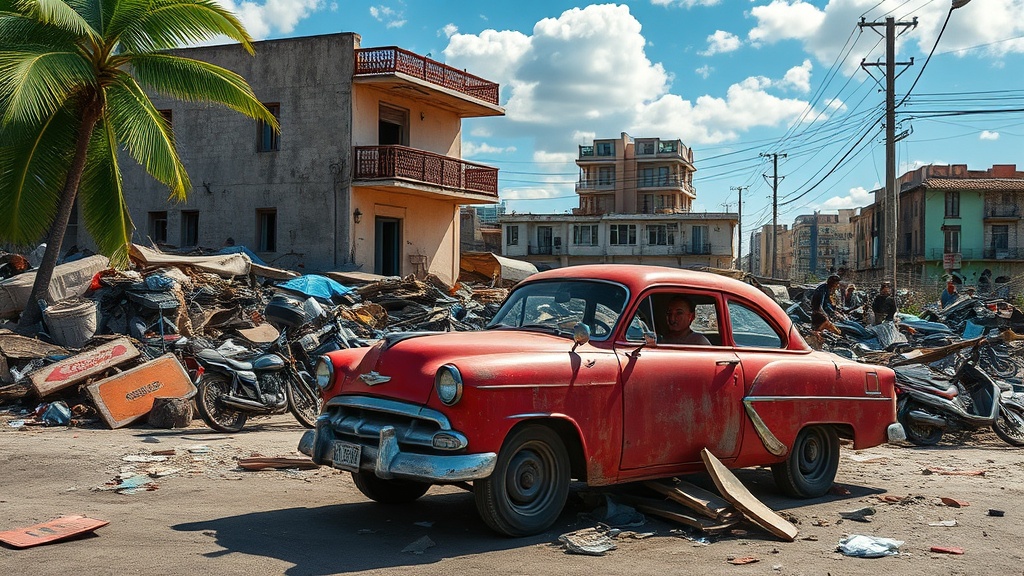
In the long, turbulent history of Cuba, no crisis has ever moved this fast. Within just five years, the island nation has lost somewhere between 14% and 25% of its entire population — figures that place it among the most dramatic demographic collapses of any peacetime country in recorded modern history. People aren't just leaving Cuba. They are fleeing it, and the scale of that flight is now so severe that it threatens to hollow out the country entirely before any political change even has a chance to arrive.

This isn't a story that has been getting the headlines it deserves. Buried beneath news cycles dominated by wars, elections, and economic turbulence elsewhere, Cuba has been quietly unravelling at a pace that demographers find genuinely alarming. To understand what is happening — and why it matters well beyond the Caribbean — you need to look at the economics, the energy crisis, the geopolitics, and the deep historical roots of a standoff that has now lasted longer than most of its participants have been alive.
A Population in Freefall: The Numbers Behind Cuba's Exodus
At the start of 2020, Cuba had a population of approximately 11.2 million people. By early 2026, the Cuban government itself — which has every incentive to downplay the figures — officially acknowledged that number had dropped to around 9.7 million. Independent demographers put the real figure closer to 8.25 million. If that lower estimate is accurate, Cuba has lost roughly one in every four residents in half a decade.
To put that into perspective: Ukraine, which has been enduring a full-scale military invasion since 2022, is the only country that has seen a faster proportional population decline this decade. Cuba is achieving a comparable rate of human loss without a single foreign soldier on its soil.
The people leaving are not a random cross-section of Cuban society. They tend to be younger, more educated, and more economically active — exactly the demographic a country needs in order to function and eventually recover. When a society loses its doctors, its engineers, its teachers, and its entrepreneurs in concentrated waves, the institutions that depend on them don't just weaken. They begin to fail structurally. Cuba is already seeing this in its healthcare system, once one of the most celebrated in the developing world, which is now critically understaffed and under-resourced.
Economic Collapse: When a Carton of Eggs Costs Half a Month's Wage
The proximate cause driving Cubans off the island is economic desperation on a scale that is difficult to fully convey with statistics alone, but the statistics are staggering nonetheless. Since 2018, Cuba's economy has contracted by at least 15% according to official government data — meaning the real figure is almost certainly worse. Inflation has been the most visceral expression of this collapse.
In 2019, the Cuban peso traded at roughly 20 to the US dollar on the informal market. By late 2025, that rate had deteriorated to 450 pesos per dollar — an implied annualised inflation rate of around 68% sustained across six consecutive years. This is the zone economists classify as verging on hyperinflation, and it has obliterated the purchasing power of ordinary Cubans almost entirely.
The official average monthly wage sits at around 6,560 pesos — equivalent to just over $14 at the informal exchange rate. Against that backdrop, a carton of 30 eggs costs 2,800 pesos, consuming nearly half of a worker's monthly income in a single purchase. A kilogram each of rice and beans — the most basic dietary staples on the island — costs the equivalent of three full days of labour. Gasoline, when it can be found at all, is rationed at 40 litres per allocation, and that allocation costs around $46, frequently several times what a Cuban earns in a month.
The Cuban Observatory for Human Rights estimates that 89% of the population now lives in extreme poverty, and that seven in ten Cubans are skipping at least one meal per day. These are not numbers from a war zone. They are numbers from an island 90 miles from the coast of Florida in 2025.
Lights Out: Cuba's Energy Crisis and Its Soviet-Era Infrastructure Problem
Layered on top of the economic collapse is an energy crisis that has become chronic and worsening. Cuba currently generates roughly 25% less electricity than it did in 2019. The reason is structural and deeply inconvenient: approximately 83% of Cuba's electricity comes from burning oil in Soviet-era diesel generators that are decades old, worn out, and increasingly unreliable. Meanwhile, the country imports around 60% of the oil it needs to run those generators, and that supply has been collapsing.
For years, Venezuela was Cuba's lifeline, providing over 100,000 barrels of oil per day at its peak in 2021 — more than enough to meet domestic demand. But as Venezuela's own economic crisis deepened, those exports fell by nearly three-quarters to just 16,000 barrels per day by 2025. The result has been rolling blackouts that are no longer occasional inconveniences but a defining feature of daily Cuban life.
During the summer of 2025, most of the island was losing power for at least four hours every day. In less populated rural provinces, outages of up to 20 hours were recorded. Without reliable electricity, refrigeration fails, medical equipment stops working, water pumps shut down, and what little economic activity remains becomes even harder to sustain. In the countryside, Cubans have returned to horse-drawn carts because there is neither the fuel to run vehicles nor the electricity to charge alternatives.
This energy crisis isn't simply a consequence of mismanagement, though mismanagement has certainly made it worse. It is also a direct consequence of Cuba's geopolitical isolation — its inability to attract foreign investment into modern renewable infrastructure, its dependence on a single ideological ally for oil, and the US embargo that limits the economic tools available to address any of it.
The US Embargo and 64 Years of Geopolitical Deadlock
The Cuba crisis cannot be properly understood without accounting for the United States embargo, which has now run continuously for 64 years — the longest sustained trade embargo of the modern era. Implemented in 1962 following a cascading series of nationalisations and retaliations, the embargo blocks virtually all trade between the two countries, with narrow exceptions for food, medicine, and humanitarian goods.
The UN General Assembly has voted 33 consecutive years in a row to call for the embargo's end. In the most recent vote in October 2025, 165 member states supported that resolution. The United States voted against it, as it has every single time.
The geopolitical backstory matters here enormously, because it explains why the Communist Party of Cuba has proven so much more durable than virtually every other Marxist-Leninist government that emerged from the Cold War era. Unlike the imposed communist governments of Eastern Europe — East Germany, Poland, Romania — which were installed by Soviet force and lacked genuine popular legitimacy, Cuba's revolution was a homegrown popular uprising against a widely despised, US-backed authoritarian in Fulgencio Batista. When the Eisenhower and Kennedy administrations then immediately attempted to crush that revolution through the Bay of Pigs invasion, they handed Fidel Castro something invaluable: the permanent moral authority of resisting imperial aggression. Every subsequent act of American pressure — the embargo, decades of covert operations, diplomatic isolation — has been folded into that founding narrative and used to sustain the regime's legitimacy at home.
This is why predictions of the Cuban government's imminent collapse have been confidently made and confidently wrong since at least 1991, when the Soviet Union dissolved and took Cuba's most important patron with it. The regime survived that. It has survived every tightening of the embargo since. The question analysts are now genuinely divided on is whether the convergence of factors in 2025 and 2026 — the population collapse, the economic freefall, the energy crisis, the loss of Venezuelan oil, and a newly aggressive US administration — finally represents something qualitatively different.
Is This Time Actually Different? What Could Come Next for Cuba
There are real reasons to think the current moment is more precarious for the Cuban government than any that came before it. The loss of a quarter of the population in five years is not a statistic a government can easily absorb politically. When people leave in those volumes, the social infrastructure that holds authoritarian systems together — the neighbourhood watch committees, the state employment networks, the informant webs — begins to thin out. And unlike previous crises, this one is happening simultaneously across multiple dimensions: economic, energetic, demographic, and geopolitical.
The Trump administration's posture toward Cuba has hardened considerably following the capture of Venezuelan President Nicolás Maduro in early 2025, with Secretary of State Marco Rubio — himself the son of Cuban exiles — making explicit threats about what might come next for Havana. The potential severance of even Cuba's remaining trickle of Venezuelan oil could push the energy crisis past a breaking point the government cannot manage.
And yet, caution is warranted. Cuba's Communist Party has demonstrated a remarkable capacity for survival under conditions that would have toppled most governments. It controls the security apparatus, the media, and the mechanisms of civil society entirely. There is no organised internal opposition of any scale. Regime change, if it comes, is more likely to emerge from an internal fracture within the party itself — possibly as younger officials recognise that the current trajectory is unsustainable — than from any external pressure campaign.
Free Weekly Newsletter
Enjoying this guide?
Get the best articles like this one delivered to your inbox every week. No spam.
What seems certain is that without significant change, Cuba cannot stabilise its population loss or its economic decline. The people most capable of rebuilding the country are precisely the ones leaving it. Every month that passes without structural reform or diplomatic opening makes the eventual reconstruction — whenever it comes — more difficult and more expensive.
Conclusion: A Crisis With No Easy Exit
Cuba in 2025 and 2026 is a country caught between a government that cannot reform itself without risking its own survival and an external environment that gives it almost no room to breathe. The population collapse is not a side effect of the crisis — it is the crisis made visible, millions of individual decisions by millions of people who have concluded that waiting is no longer a rational option.
For observers and policymakers outside Cuba, the most honest conclusion is that there are no clean solutions on offer. The US embargo has demonstrably failed to bring about regime change in 64 years while causing enormous suffering to ordinary Cubans. Lifting it without conditions would relieve that suffering but hand the regime an economic lifeline it has done nothing to deserve. The middle path — targeted reforms, conditional engagement, humanitarian carve-outs — requires political will on both sides that does not currently appear to exist.
What Cuba's crisis makes undeniable is that the human cost of this deadlock is no longer abstract. It is measured in empty towns, skipped meals, and a generation of Cubans building their lives somewhere else.
Frequently Asked Questions
How many people have left Cuba in recent years?
Estimates vary significantly depending on the source. The Cuban government acknowledges that around 14% of the population has left since 2020, reducing the total from 11.2 million to approximately 9.7 million. Independent demographers put the figure much higher, estimating the current population may be closer to 8.25 million — implying that roughly one in four Cubans has emigrated in just five years.
Why is Cuba's economy collapsing so severely?
Cuba's economic collapse stems from several compounding factors: a 15%-plus contraction in GDP since 2018, inflation running at roughly 68% annually for six years, the near-total loss of subsidised Venezuelan oil, chronic electricity blackouts, and an enduring US trade embargo that has restricted access to capital, technology, and international markets for over six decades. The peso has lost more than 95% of its informal exchange value since 2019 alone.
Why has the US embargo on Cuba lasted so long?
The embargo was implemented in 1962 following the nationalisation of American-owned assets in Cuba after the revolution, and it has persisted largely due to political dynamics within the United States — particularly the influence of Cuban exile communities concentrated in politically significant states like Florida. Despite 33 consecutive UN General Assembly resolutions calling for its end, the US has maintained the embargo as a tool of pressure on the Cuban government, though its effectiveness at achieving regime change has been widely questioned.
Why hasn't the Cuban Communist Party collapsed like other communist regimes?
Unlike the communist governments of Eastern Europe, which were imposed by Soviet military force and lacked genuine domestic legitimacy, Cuba's communist revolution emerged from a popular homegrown uprising against an unpopular US-backed dictatorship. The subsequent Bay of Pigs invasion by the United States gave Fidel Castro enormous moral authority as a symbol of resistance to imperialism — an authority that the party has continued to invoke ever since. This foundational legitimacy, combined with total control of the security services, media, and civil society, has allowed the party to survive economic and political shocks that would have toppled most governments.
What role does Venezuela play in Cuba's energy crisis?
Venezuela has historically been Cuba's primary source of imported oil, providing more than 100,000 barrels per day at its peak in 2021 under agreements made between the two governments. As Venezuela's own economic crisis deepened, those exports fell to around 16,000 barrels per day by 2025 — a reduction of nearly 75%. Since Cuba generates roughly 83% of its electricity from oil-burning diesel plants and imports around 60% of its oil needs, this supply collapse has been a primary driver of the rolling blackouts now affecting most of the island daily.
Free Investing Tools
Frequently Asked Questions
Cuba Is Facing Its Worst Crisis in Modern History
In the long, turbulent history of Cuba, no crisis has ever moved this fast. Within just five years, the island nation has lost somewhere between 14% and 25% of its entire population — figures that place it among the most dramatic demographic collapses of any peacetime country in recorded modern history. People aren't just leaving Cuba. They are fleeing it, and the scale of that flight is now so severe that it threatens to hollow out the country entirely before any political change even has a chance to arrive.
This isn't a story that has been getting the headlines it deserves. Buried beneath news cycles dominated by wars, elections, and economic turbulence elsewhere, Cuba has been quietly unravelling at a pace that demographers find genuinely alarming. To understand what is happening — and why it matters well beyond the Caribbean — you need to look at the economics, the energy crisis, the geopolitics, and the deep historical roots of a standoff that has now lasted longer than most of its participants have been alive.
A Population in Freefall: The Numbers Behind Cuba's Exodus
At the start of 2020, Cuba had a population of approximately 11.2 million people. By early 2026, the Cuban government itself — which has every incentive to downplay the figures — officially acknowledged that number had dropped to around 9.7 million. Independent demographers put the real figure closer to 8.25 million. If that lower estimate is accurate, Cuba has lost roughly one in every four residents in half a decade.
To put that into perspective: Ukraine, which has been enduring a full-scale military invasion since 2022, is the only country that has seen a faster proportional population decline this decade. Cuba is achieving a comparable rate of human loss without a single foreign soldier on its soil.
The people leaving are not a random cross-section of Cuban society. They tend to be younger, more educated, and more economically active — exactly the demographic a country needs in order to function and eventually recover. When a society loses its doctors, its engineers, its teachers, and its entrepreneurs in concentrated waves, the institutions that depend on them don't just weaken. They begin to fail structurally. Cuba is already seeing this in its healthcare system, once one of the most celebrated in the developing world, which is now critically understaffed and under-resourced.
Economic Collapse: When a Carton of Eggs Costs Half a Month's Wage
The proximate cause driving Cubans off the island is economic desperation on a scale that is difficult to fully convey with statistics alone, but the statistics are staggering nonetheless. Since 2018, Cuba's economy has contracted by at least 15% according to official government data — meaning the real figure is almost certainly worse. Inflation has been the most visceral expression of this collapse.
In 2019, the Cuban peso traded at roughly 20 to the US dollar on the informal market. By late 2025, that rate had deteriorated to 450 pesos per dollar — an implied annualised inflation rate of around 68% sustained across six consecutive years. This is the zone economists classify as verging on hyperinflation, and it has obliterated the purchasing power of ordinary Cubans almost entirely.
The official average monthly wage sits at around 6,560 pesos — equivalent to just over $14 at the informal exchange rate. Against that backdrop, a carton of 30 eggs costs 2,800 pesos, consuming nearly half of a worker's monthly income in a single purchase. A kilogram each of rice and beans — the most basic dietary staples on the island — costs the equivalent of three full days of labour. Gasoline, when it can be found at all, is rationed at 40 litres per allocation, and that allocation costs around $46, frequently several times what a Cuban earns in a month.
The Cuban Observatory for Human Rights estimates that 89% of the population now lives in extreme poverty, and that seven in ten Cubans are skipping at least one meal per day. These are not numbers from a war zone. They are numbers from an island 90 miles from the coast of Florida in 2025.
Lights Out: Cuba's Energy Crisis and Its Soviet-Era Infrastructure Problem
Layered on top of the economic collapse is an energy crisis that has become chronic and worsening. Cuba currently generates roughly 25% less electricity than it did in 2019. The reason is structural and deeply inconvenient: approximately 83% of Cuba's electricity comes from burning oil in Soviet-era diesel generators that are decades old, worn out, and increasingly unreliable. Meanwhile, the country imports around 60% of the oil it needs to run those generators, and that supply has been collapsing.
For years, Venezuela was Cuba's lifeline, providing over 100,000 barrels of oil per day at its peak in 2021 — more than enough to meet domestic demand. But as Venezuela's own economic crisis deepened, those exports fell by nearly three-quarters to just 16,000 barrels per day by 2025. The result has been rolling blackouts that are no longer occasional inconveniences but a defining feature of daily Cuban life.
During the summer of 2025, most of the island was losing power for at least four hours every day. In less populated rural provinces, outages of up to 20 hours were recorded. Without reliable electricity, refrigeration fails, medical equipment stops working, water pumps shut down, and what little economic activity remains becomes even harder to sustain. In the countryside, Cubans have returned to horse-drawn carts because there is neither the fuel to run vehicles nor the electricity to charge alternatives.
This energy crisis isn't simply a consequence of mismanagement, though mismanagement has certainly made it worse. It is also a direct consequence of Cuba's geopolitical isolation — its inability to attract foreign investment into modern renewable infrastructure, its dependence on a single ideological ally for oil, and the US embargo that limits the economic tools available to address any of it.
The US Embargo and 64 Years of Geopolitical Deadlock
The Cuba crisis cannot be properly understood without accounting for the United States embargo, which has now run continuously for 64 years — the longest sustained trade embargo of the modern era. Implemented in 1962 following a cascading series of nationalisations and retaliations, the embargo blocks virtually all trade between the two countries, with narrow exceptions for food, medicine, and humanitarian goods.
The UN General Assembly has voted 33 consecutive years in a row to call for the embargo's end. In the most recent vote in October 2025, 165 member states supported that resolution. The United States voted against it, as it has every single time.
The geopolitical backstory matters here enormously, because it explains why the Communist Party of Cuba has proven so much more durable than virtually every other Marxist-Leninist government that emerged from the Cold War era. Unlike the imposed communist governments of Eastern Europe — East Germany, Poland, Romania — which were installed by Soviet force and lacked genuine popular legitimacy, Cuba's revolution was a homegrown popular uprising against a widely despised, US-backed authoritarian in Fulgencio Batista. When the Eisenhower and Kennedy administrations then immediately attempted to crush that revolution through the Bay of Pigs invasion, they handed Fidel Castro something invaluable: the permanent moral authority of resisting imperial aggression. Every subsequent act of American pressure — the embargo, decades of covert operations, diplomatic isolation — has been folded into that founding narrative and used to sustain the regime's legitimacy at home.
This is why predictions of the Cuban government's imminent collapse have been confidently made and confidently wrong since at least 1991, when the Soviet Union dissolved and took Cuba's most important patron with it. The regime survived that. It has survived every tightening of the embargo since. The question analysts are now genuinely divided on is whether the convergence of factors in 2025 and 2026 — the population collapse, the economic freefall, the energy crisis, the loss of Venezuelan oil, and a newly aggressive US administration — finally represents something qualitatively different.
Is This Time Actually Different? What Could Come Next for Cuba
There are real reasons to think the current moment is more precarious for the Cuban government than any that came before it. The loss of a quarter of the population in five years is not a statistic a government can easily absorb politically. When people leave in those volumes, the social infrastructure that holds authoritarian systems together — the neighbourhood watch committees, the state employment networks, the informant webs — begins to thin out. And unlike previous crises, this one is happening simultaneously across multiple dimensions: economic, energetic, demographic, and geopolitical.
The Trump administration's posture toward Cuba has hardened considerably following the capture of Venezuelan President Nicolás Maduro in early 2025, with Secretary of State Marco Rubio — himself the son of Cuban exiles — making explicit threats about what might come next for Havana. The potential severance of even Cuba's remaining trickle of Venezuelan oil could push the energy crisis past a breaking point the government cannot manage.
And yet, caution is warranted. Cuba's Communist Party has demonstrated a remarkable capacity for survival under conditions that would have toppled most governments. It controls the security apparatus, the media, and the mechanisms of civil society entirely. There is no organised internal opposition of any scale. Regime change, if it comes, is more likely to emerge from an internal fracture within the party itself — possibly as younger officials recognise that the current trajectory is unsustainable — than from any external pressure campaign.
What seems certain is that without significant change, Cuba cannot stabilise its population loss or its economic decline. The people most capable of rebuilding the country are precisely the ones leaving it. Every month that passes without structural reform or diplomatic opening makes the eventual reconstruction — whenever it comes — more difficult and more expensive.
Conclusion: A Crisis With No Easy Exit
Cuba in 2025 and 2026 is a country caught between a government that cannot reform itself without risking its own survival and an external environment that gives it almost no room to breathe. The population collapse is not a side effect of the crisis — it is the crisis made visible, millions of individual decisions by millions of people who have concluded that waiting is no longer a rational option.
For observers and policymakers outside Cuba, the most honest conclusion is that there are no clean solutions on offer. The US embargo has demonstrably failed to bring about regime change in 64 years while causing enormous suffering to ordinary Cubans. Lifting it without conditions would relieve that suffering but hand the regime an economic lifeline it has done nothing to deserve. The middle path — targeted reforms, conditional engagement, humanitarian carve-outs — requires political will on both sides that does not currently appear to exist.
What Cuba's crisis makes undeniable is that the human cost of this deadlock is no longer abstract. It is measured in empty towns, skipped meals, and a generation of Cubans building their lives somewhere else.
Frequently Asked Questions
How many people have left Cuba in recent years?
Estimates vary significantly depending on the source. The Cuban government acknowledges that around 14% of the population has left since 2020, reducing the total from 11.2 million to approximately 9.7 million. Independent demographers put the figure much higher, estimating the current population may be closer to 8.25 million — implying that roughly one in four Cubans has emigrated in just five years.
Why is Cuba's economy collapsing so severely?
Cuba's economic collapse stems from several compounding factors: a 15%-plus contraction in GDP since 2018, inflation running at roughly 68% annually for six years, the near-total loss of subsidised Venezuelan oil, chronic electricity blackouts, and an enduring US trade embargo that has restricted access to capital, technology, and international markets for over six decades. The peso has lost more than 95% of its informal exchange value since 2019 alone.
Why has the US embargo on Cuba lasted so long?
The embargo was implemented in 1962 following the nationalisation of American-owned assets in Cuba after the revolution, and it has persisted largely due to political dynamics within the United States — particularly the influence of Cuban exile communities concentrated in politically significant states like Florida. Despite 33 consecutive UN General Assembly resolutions calling for its end, the US has maintained the embargo as a tool of pressure on the Cuban government, though its effectiveness at achieving regime change has been widely questioned.
Why hasn't the Cuban Communist Party collapsed like other communist regimes?
Unlike the communist governments of Eastern Europe, which were imposed by Soviet military force and lacked genuine domestic legitimacy, Cuba's communist revolution emerged from a popular homegrown uprising against an unpopular US-backed dictatorship. The subsequent Bay of Pigs invasion by the United States gave Fidel Castro enormous moral authority as a symbol of resistance to imperialism — an authority that the party has continued to invoke ever since. This foundational legitimacy, combined with total control of the security services, media, and civil society, has allowed the party to survive economic and political shocks that would have toppled most governments.
What role does Venezuela play in Cuba's energy crisis?
Venezuela has historically been Cuba's primary source of imported oil, providing more than 100,000 barrels per day at its peak in 2021 under agreements made between the two governments. As Venezuela's own economic crisis deepened, those exports fell to around 16,000 barrels per day by 2025 — a reduction of nearly 75%. Since Cuba generates roughly 83% of its electricity from oil-burning diesel plants and imports around 60% of its oil needs, this supply collapse has been a primary driver of the rolling blackouts now affecting most of the island daily.
About Zeebrain Editorial
Zeebrain publishes independent analysis of markets, investing, personal finance, and business. We disclose affiliate relationships, never accept payment for coverage, and fact-check all claims against primary sources. Read our editorial policy →
How this article was produced: Zeebrain articles are created with AI assistance from primary sources (including cited videos and market data) and reviewed under our editorial standards before publication. Spot an error? Tell us and we will correct it.
More from Curiosities



Related Guides
Keep exploring this topic
Why Castro Never Retook Guantanamo Bay from America
History & Mysteries · Guantanamo Bay · Fidel Castro
Who Is Pope Francis? Life, Legacy, and His Impact on the Modern Church
Curiosities
How Was William Wallace Captured? The Real Story
Curiosities
Daylight Saving Time Debate: The Curious Case of Our Clocks
Curiosities
Explore More Categories
Keep browsing by topic and build depth around the subjects you care about most.