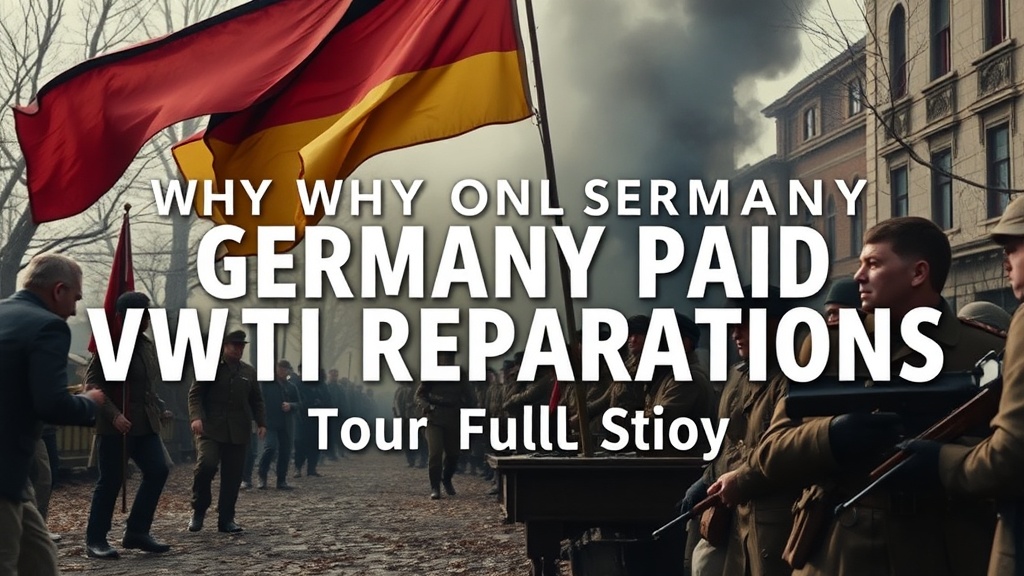
Why Only Germany Paid WWI Reparations: The Full Story
Quick Summary
Germany shouldered nearly all WWI reparations — but why? Discover the forgotten stories of Austria, Hungary, Bulgaria, and the Ottoman Empire after 1918.
In This Article
The Bill That Only One Nation Had to Pay
When the guns fell silent in November 1918, four empires lay in ruins. Germany, Austria-Hungary, Bulgaria, and the Ottoman Empire had fought together as the Central Powers through four years of industrial slaughter — and they had lost. What followed was one of the most consequential peace settlements in modern history, a series of treaties hammered out in the gilded salons of Paris that would reshape the map of the world and plant the seeds of another catastrophe just two decades later.
We know what happened to Germany. The Treaty of Versailles stripped it of territory, gutted its military, and saddled it with reparations so enormous that the final payment wasn't made until 2010. The humiliation of Versailles became a rallying cry, a wound that never fully healed, and a grievance that demagogues would exploit with devastating effect.
But Germany did not fight alone. So why, when the Allied victors sat down to settle the accounts of the First World War, did the burden of WWI reparations fall almost entirely on German shoulders? Why were the other defeated Central Powers — Austria, Hungary, Bulgaria, and the Ottomans — largely spared the financial punishment that crippled Germany for a generation? The answers lie in a tangle of collapsed empires, bankrupt treasuries, revolutionary chaos, and one extraordinary military comeback that rewrote the rules entirely.
Bulgaria: The One That Actually Paid — Briefly
Of all the defeated Central Powers, Bulgaria's situation most closely resembled Germany's, in that it remained a recognisable, functioning state after the armistice. Bulgaria had entered the war in 1915, drawn in by the promise of avenging its losses in the Second Balkan War of 1913 and reclaiming territories it considered rightfully its own. For a time, it worked. Bulgarian forces expanded the nation's borders considerably, particularly at Serbia's expense.
Then came the Allied offensive from Greece in 1918. Facing military collapse and with no realistic path to victory, Bulgaria sued for an armistice in September — the first of the Central Powers to do so. The subsequent Treaty of Neuilly-sur-Seine, signed in November 1919, imposed familiar-sounding penalties: territorial losses to Greece, Romania, and the newly expanded Kingdom of Serbs, Croats and Slovenes, strict limits on its armed forces, and financial reparations.
Those reparations, however, were a fraction of Germany's. More immediately damaging were the restitutions in kind — fixed quantities of coal, livestock, and agricultural goods delivered directly to neighbouring states as material compensation for wartime damage. When you combine those deliveries with the loss of vital Aegean ports, the mass unemployment of demobilised soldiers, and forced population transfers from surrounding countries, the economic picture was bleak. Bulgaria spiralled into poverty and political instability, radicalised by the weight of defeat in ways that would haunt the Balkans for decades.
Yet even here, the Allies recognised reality before long. Bulgaria's reparations burden was progressively reduced throughout the 1920s and eventually abandoned altogether. The pattern was becoming clear: the victors wanted payment in principle but understood, however reluctantly, that bleeding a broken economy dry was pointless.
The Impossible Arithmetic of Austria-Hungary
If Bulgaria's case was complicated, Austria-Hungary's was a cartographer's nightmare. The Dual Monarchy — technically two states sharing a Habsburg monarch, a foreign ministry, and little else — had simply ceased to exist by the time the peacemakers gathered in Paris. Assigning WWI reparations to an empire that no longer existed raised an immediate and rather fundamental question: who exactly would pay whom?
The German-speaking remnant of Austria had cobbled together an informal entity calling itself German-Austria, claiming authority over the old Cisleithanian half of the empire. In practice, its writ barely extended beyond Vienna. Hungary was in an even more precarious state — simultaneously fighting wars against Romania and the newly proclaimed Czechoslovakia, lurching through a communist revolution under Béla Kun, and then enduring a royalist counter-coup. Negotiating a peace treaty with a government that might not exist by Thursday was, to put it diplomatically, challenging.
There was also a profound moral complexity at the heart of the reparations question. When Austria-Hungary dissolved, the successor states — Czechoslovakia, Yugoslavia, Romania, Poland — absorbed enormous chunks of the former empire's industrial base. The Škoda works, the vast coal fields of Bohemia, the agricultural lands of the Pannonian plain: all of these had fed the Habsburg war machine. Was the newly independent Czech worker in a Moravian factory now liable for the war crimes of an empire he had been subject to, not a citizen of? The Allies recognised, however grudgingly, that punishing Czechoslovakia for Austria-Hungary's sins was not only unjust but politically absurd.
The Treaty of Saint-Germain-en-Laye in September 1919 formally dissolved Cisleithania into its component parts and nominated the rump Republic of Austria as the successor state — and therefore the inheritor of the blame. Austria's delegates made matters worse for themselves by provocatively invoking Woodrow Wilson's principle of national self-determination to demand territory from its newly born neighbours, and by suggesting that Austria should be permitted to unify with Germany. The Allies were not amused. Austria was forbidden from calling itself German-Austria and permanently barred from any political union with Germany — a prohibition that would remain contested and ultimately violated until 1938.
As for reparations, Austria was told it would pay. The exact amount would be decided later. It was the diplomatic equivalent of a restaurant bill left face-down on the table. Everyone in the room understood why: Austria was not merely poor but existentially precarious. One in three Austrians lived in Vienna, a vast imperial capital now serving as the head of a tiny, landlocked state with insufficient agricultural land to feed itself. The spectre of mass starvation was not rhetorical — it was a genuine planning assumption. The Allies recognised that Austria needed loans, not demands. Reparations were quietly shelved and never seriously revisited.
Hungary: Punished by Geography, Not by Invoice
Hungary's experience followed a similar arc but with its own particular brutality. The Treaty of Trianon, signed in June 1920, was devastating even by the standards of post-war settlements. Hungary lost 70 percent of its pre-war territory and 65 percent of its population — an amputation so severe that it remains a live political wound in Hungarian national consciousness more than a century later. Transylvania went to Romania. Slovakia to Czechoslovakia. Croatia and Slavonia to the new South Slav state. Hungary was left a landlocked rump, shorn of its mines, its forests, and much of its farmland.
Like Austria, Hungary was told it would pay reparations to the Allied powers. Like Austria, the exact figure was left for a later date. And like Austria, everyone involved knew the figure would never materialise. A nation that had just lost two-thirds of its economic base, suffered military occupation by Romanian forces, and endured the violent convulsions of revolution and counter-revolution simply had nothing left to give.
In place of financial reparations, Hungary's neighbours accepted their territorial gains as sufficient compensation — a settlement they were not, in fact, satisfied with, as the subsequent creation of the Little Entente alliance between Czechoslovakia, Romania, and Yugoslavia illustrated. These three states formed a defensive bloc specifically designed to prevent any Hungarian attempt to reclaim lost lands, a fear that proved entirely well-founded given the revisionist politics that consumed interwar Hungary.
The Ottoman Exception: How One Nation Fought Its Way Out of Reparations
The most extraordinary story among the defeated Central Powers is that of the Ottoman Empire — not because of what was done to it, but because of what it did in response. The Ottoman surrender in October 1918 left the empire at the mercy of the victors. The Treaty of Sèvres, signed in August 1920, was merciless: Ottoman territory was reduced to a narrow strip of northern Anatolia, its military was gutted, and the Allies carved the remaining economy into zones of foreign influence. The Dardanelles became an internationalised waterway outside Ottoman control. The idea of financial WWI reparations barely came up — the Allies calculated they would need to loan Istanbul money just to prevent complete state collapse.
But the Ottoman leadership that had signed Sèvres no longer represented the only power in the region. In Ankara, a parallel government had formed around Mustafa Kemal — later known as Atatürk — and it refused to accept the treaty's terms. What followed was the Turkish War of Independence, a grinding military campaign that, against all expectation, succeeded. The Turkish nationalist forces defeated the Greeks, pushed back the Armenians, and negotiated the departure of French forces from Cilicia. Britain, exhausted and facing open refusal from its Dominions to commit troops — with the near-sole exception of New Zealand — found itself unable to enforce Sèvres.
The result was the Treaty of Lausanne in 1923, which replaced Sèvres entirely. It was one of the very few post-WWI treaties negotiated from a position of military parity rather than defeat. Turkey emerged with borders close to those it holds today, its sovereignty intact, and — critically — with the Allies formally agreeing that Turkey bore no responsibility for the First World War. With that declaration, any question of Ottoman or Turkish reparations evaporated permanently. It remains one of history's more remarkable reversals: a defeated power that negotiated its way back to respectability through force of arms.
Why Germany Alone Bore the Weight
Understanding why WWI reparations fell almost exclusively on Germany requires holding all of these threads together simultaneously. Germany was the only defeated power that emerged from the war with its state structures broadly intact, its government — however changed in form — still recognisably continuous with its predecessor, and its industrial economy still functioning. It was, in the brutal logic of post-war finance, the only party that could theoretically pay.
The others either dissolved into successor states that could not be held collectively responsible, collapsed into poverty so profound that extraction was impossible, or — in Turkey's unique case — fought their way out of the obligation entirely. Bulgaria paid something, briefly. Hungary and Austria sent some raw materials and received some quietly forgotten invoices. The Ottomans' successors were declared blameless by treaty.
This asymmetry had consequences that rippled across the entire twentieth century. The concentration of reparations on Germany created the conditions — economic crisis, political radicalisation, nationalist resentment — that would ultimately contribute to the rise of National Socialism. John Maynard Keynes warned as much in 1919 in The Economic Consequences of the Peace, and history vindicated him with terrible thoroughness.
The irony is sharp: by trying to make one nation pay for a war that four had fought, the victorious Allies created exactly the instability they had sought to prevent.
What We Can Learn From the Reparations That Were Never Paid
There is a temptation, looking back, to read the post-WWI reparations settlement as simply a case of victor's justice applied inconsistently. That is partly true. But the fuller picture is more interesting and more instructive. The Allies were not merely being vindictive toward Germany — they were also being pragmatic about everyone else. They recognised, however slowly and reluctantly, that demanding payment from states that had already been broken by war and territorial dismemberment would destabilise the entire European order.
Free Weekly Newsletter
Enjoying this guide?
Get the best articles like this one delivered to your inbox every week. No spam.
They understood this everywhere except Germany. And therein lay the tragedy.
The lesson that post-WWII planners took from this catastrophic miscalculation was profound. The Marshall Plan, the deliberate reconstruction of defeated Germany and Japan, the architecture of European economic integration — all of these were shaped, at least in part, by the memory of what happened when victors demanded the impossible from the vanquished. The reparations that were never collected from Austria, Hungary, Bulgaria, and the Ottoman Empire turned out to matter enormously — not because they were forgiven, but because the reasons for forgiving them illuminated exactly what was being done wrong everywhere else.
Frequently Asked Questions
Did any of the other Central Powers pay any reparations at all?
Yes, but minimally. Bulgaria made some financial reparation payments and delivered quantities of coal, cattle, and other goods to neighbouring states under the Treaty of Neuilly-sur-Seine, though these payments were progressively reduced and eventually cancelled during the 1920s. Hungary made limited deliveries of natural resources to its neighbours. Austria's reparations were effectively never enforced due to the country's complete economic collapse. The Ottoman Empire's successor state, Turkey, was formally declared a blameless party in the First World War under the Treaty of Lausanne and paid nothing whatsoever.
Why was Germany treated so differently from the other defeated powers regarding reparations?
Germany was the only defeated power that remained a coherent, functioning state with an intact institutional structure and a still-operational industrial economy. The other Central Powers had either dissolved entirely, suffered catastrophic territorial losses that destroyed their economic base, or — in Turkey's case — successfully renegotiated their position through military force. Germany was, in the cold logic of post-war finance, the only party from which meaningful reparations could realistically be extracted. The victorious Allies also assigned Germany the primary moral responsibility for the war under the controversial Article 231 of the Treaty of Versailles, the so-called War Guilt Clause, which provided the legal justification for the reparations demand.
How did Turkey manage to avoid WWI reparations entirely?
Turkey is the only example of a defeated First World War power that successfully reversed its post-war settlement through armed resistance. The Treaty of Sèvres of 1920, which imposed harsh terms on the Ottoman Empire, was rejected by the nationalist government of Mustafa Kemal based in Ankara. The subsequent Turkish War of Independence (1919–1923) saw Turkish nationalist forces defeat the Greek army, push back Armenian forces, and negotiate French withdrawal. Britain, unwilling and largely unable to commit sufficient troops to enforce Sèvres, was forced to the table. The resulting Treaty of Lausanne in 1923 replaced Sèvres entirely, recognised Turkey's sovereignty and borders, and explicitly agreed that Turkey bore no war guilt — extinguishing any reparations claim in the process.
What happened to the reparations that Austria and Hungary were technically supposed to pay?
Both Austria and Hungary were notified under their respective peace treaties — the Treaty of Saint-Germain-en-Laye and the Treaty of Trianon — that they would be required to pay reparations, with the exact sums to be determined at a later date. In practice, this formula was understood by all parties to be largely nominal. Austria's economy was in freefall, with mass unemployment, food shortages, and a hyper-inflated currency making any meaningful transfer impossible. The Allies recognised they would need to extend loans to Vienna simply to prevent state collapse, making reparation demands nonsensical. Hungary had lost 70 percent of its territory and 65 percent of its population under Trianon, gutting its economic capacity. In both cases, the reparations were quietly and indefinitely deferred, then effectively abandoned. The neighbouring states that might have received payments were expected to consider their substantial territorial gains as sufficient compensation.
How did the unequal reparations burden affect Germany's political trajectory?
The concentration of WWI reparations almost entirely on Germany had profound and ultimately catastrophic consequences. The economic strain of reparations payments — combined with the hyperinflation of the early 1920s and the Great Depression of the early 1930s — created conditions of severe social stress and political radicalisation. The economist John Maynard Keynes had predicted this outcome in his 1919 work The Economic Consequences of the Peace, arguing that the reparations regime was both economically irrational and politically dangerous. His warnings proved prescient. The resentment generated by what many Germans perceived as an unjust and uniquely punitive financial burden became one of the most powerful recruiting tools available to extremist political movements, including the Nazi Party. The lesson was absorbed — imperfectly but meaningfully — by the architects of the post-Second World War order, who chose reconstruction over retribution.
Frequently Asked Questions
The Bill That Only One Nation Had to Pay
When the guns fell silent in November 1918, four empires lay in ruins. Germany, Austria-Hungary, Bulgaria, and the Ottoman Empire had fought together as the Central Powers through four years of industrial slaughter — and they had lost. What followed was one of the most consequential peace settlements in modern history, a series of treaties hammered out in the gilded salons of Paris that would reshape the map of the world and plant the seeds of another catastrophe just two decades later.
We know what happened to Germany. The Treaty of Versailles stripped it of territory, gutted its military, and saddled it with reparations so enormous that the final payment wasn't made until 2010. The humiliation of Versailles became a rallying cry, a wound that never fully healed, and a grievance that demagogues would exploit with devastating effect.
But Germany did not fight alone. So why, when the Allied victors sat down to settle the accounts of the First World War, did the burden of WWI reparations fall almost entirely on German shoulders? Why were the other defeated Central Powers — Austria, Hungary, Bulgaria, and the Ottomans — largely spared the financial punishment that crippled Germany for a generation? The answers lie in a tangle of collapsed empires, bankrupt treasuries, revolutionary chaos, and one extraordinary military comeback that rewrote the rules entirely.
Bulgaria: The One That Actually Paid — Briefly
Of all the defeated Central Powers, Bulgaria's situation most closely resembled Germany's, in that it remained a recognisable, functioning state after the armistice. Bulgaria had entered the war in 1915, drawn in by the promise of avenging its losses in the Second Balkan War of 1913 and reclaiming territories it considered rightfully its own. For a time, it worked. Bulgarian forces expanded the nation's borders considerably, particularly at Serbia's expense.
Then came the Allied offensive from Greece in 1918. Facing military collapse and with no realistic path to victory, Bulgaria sued for an armistice in September — the first of the Central Powers to do so. The subsequent Treaty of Neuilly-sur-Seine, signed in November 1919, imposed familiar-sounding penalties: territorial losses to Greece, Romania, and the newly expanded Kingdom of Serbs, Croats and Slovenes, strict limits on its armed forces, and financial reparations.
Those reparations, however, were a fraction of Germany's. More immediately damaging were the restitutions in kind — fixed quantities of coal, livestock, and agricultural goods delivered directly to neighbouring states as material compensation for wartime damage. When you combine those deliveries with the loss of vital Aegean ports, the mass unemployment of demobilised soldiers, and forced population transfers from surrounding countries, the economic picture was bleak. Bulgaria spiralled into poverty and political instability, radicalised by the weight of defeat in ways that would haunt the Balkans for decades.
Yet even here, the Allies recognised reality before long. Bulgaria's reparations burden was progressively reduced throughout the 1920s and eventually abandoned altogether. The pattern was becoming clear: the victors wanted payment in principle but understood, however reluctantly, that bleeding a broken economy dry was pointless.
The Impossible Arithmetic of Austria-Hungary
If Bulgaria's case was complicated, Austria-Hungary's was a cartographer's nightmare. The Dual Monarchy — technically two states sharing a Habsburg monarch, a foreign ministry, and little else — had simply ceased to exist by the time the peacemakers gathered in Paris. Assigning WWI reparations to an empire that no longer existed raised an immediate and rather fundamental question: who exactly would pay whom?
The German-speaking remnant of Austria had cobbled together an informal entity calling itself German-Austria, claiming authority over the old Cisleithanian half of the empire. In practice, its writ barely extended beyond Vienna. Hungary was in an even more precarious state — simultaneously fighting wars against Romania and the newly proclaimed Czechoslovakia, lurching through a communist revolution under Béla Kun, and then enduring a royalist counter-coup. Negotiating a peace treaty with a government that might not exist by Thursday was, to put it diplomatically, challenging.
There was also a profound moral complexity at the heart of the reparations question. When Austria-Hungary dissolved, the successor states — Czechoslovakia, Yugoslavia, Romania, Poland — absorbed enormous chunks of the former empire's industrial base. The Škoda works, the vast coal fields of Bohemia, the agricultural lands of the Pannonian plain: all of these had fed the Habsburg war machine. Was the newly independent Czech worker in a Moravian factory now liable for the war crimes of an empire he had been subject to, not a citizen of? The Allies recognised, however grudgingly, that punishing Czechoslovakia for Austria-Hungary's sins was not only unjust but politically absurd.
The Treaty of Saint-Germain-en-Laye in September 1919 formally dissolved Cisleithania into its component parts and nominated the rump Republic of Austria as the successor state — and therefore the inheritor of the blame. Austria's delegates made matters worse for themselves by provocatively invoking Woodrow Wilson's principle of national self-determination to demand territory from its newly born neighbours, and by suggesting that Austria should be permitted to unify with Germany. The Allies were not amused. Austria was forbidden from calling itself German-Austria and permanently barred from any political union with Germany — a prohibition that would remain contested and ultimately violated until 1938.
As for reparations, Austria was told it would pay. The exact amount would be decided later. It was the diplomatic equivalent of a restaurant bill left face-down on the table. Everyone in the room understood why: Austria was not merely poor but existentially precarious. One in three Austrians lived in Vienna, a vast imperial capital now serving as the head of a tiny, landlocked state with insufficient agricultural land to feed itself. The spectre of mass starvation was not rhetorical — it was a genuine planning assumption. The Allies recognised that Austria needed loans, not demands. Reparations were quietly shelved and never seriously revisited.
Hungary: Punished by Geography, Not by Invoice
Hungary's experience followed a similar arc but with its own particular brutality. The Treaty of Trianon, signed in June 1920, was devastating even by the standards of post-war settlements. Hungary lost 70 percent of its pre-war territory and 65 percent of its population — an amputation so severe that it remains a live political wound in Hungarian national consciousness more than a century later. Transylvania went to Romania. Slovakia to Czechoslovakia. Croatia and Slavonia to the new South Slav state. Hungary was left a landlocked rump, shorn of its mines, its forests, and much of its farmland.
Like Austria, Hungary was told it would pay reparations to the Allied powers. Like Austria, the exact figure was left for a later date. And like Austria, everyone involved knew the figure would never materialise. A nation that had just lost two-thirds of its economic base, suffered military occupation by Romanian forces, and endured the violent convulsions of revolution and counter-revolution simply had nothing left to give.
In place of financial reparations, Hungary's neighbours accepted their territorial gains as sufficient compensation — a settlement they were not, in fact, satisfied with, as the subsequent creation of the Little Entente alliance between Czechoslovakia, Romania, and Yugoslavia illustrated. These three states formed a defensive bloc specifically designed to prevent any Hungarian attempt to reclaim lost lands, a fear that proved entirely well-founded given the revisionist politics that consumed interwar Hungary.
The Ottoman Exception: How One Nation Fought Its Way Out of Reparations
The most extraordinary story among the defeated Central Powers is that of the Ottoman Empire — not because of what was done to it, but because of what it did in response. The Ottoman surrender in October 1918 left the empire at the mercy of the victors. The Treaty of Sèvres, signed in August 1920, was merciless: Ottoman territory was reduced to a narrow strip of northern Anatolia, its military was gutted, and the Allies carved the remaining economy into zones of foreign influence. The Dardanelles became an internationalised waterway outside Ottoman control. The idea of financial WWI reparations barely came up — the Allies calculated they would need to loan Istanbul money just to prevent complete state collapse.
But the Ottoman leadership that had signed Sèvres no longer represented the only power in the region. In Ankara, a parallel government had formed around Mustafa Kemal — later known as Atatürk — and it refused to accept the treaty's terms. What followed was the Turkish War of Independence, a grinding military campaign that, against all expectation, succeeded. The Turkish nationalist forces defeated the Greeks, pushed back the Armenians, and negotiated the departure of French forces from Cilicia. Britain, exhausted and facing open refusal from its Dominions to commit troops — with the near-sole exception of New Zealand — found itself unable to enforce Sèvres.
The result was the Treaty of Lausanne in 1923, which replaced Sèvres entirely. It was one of the very few post-WWI treaties negotiated from a position of military parity rather than defeat. Turkey emerged with borders close to those it holds today, its sovereignty intact, and — critically — with the Allies formally agreeing that Turkey bore no responsibility for the First World War. With that declaration, any question of Ottoman or Turkish reparations evaporated permanently. It remains one of history's more remarkable reversals: a defeated power that negotiated its way back to respectability through force of arms.
Why Germany Alone Bore the Weight
Understanding why WWI reparations fell almost exclusively on Germany requires holding all of these threads together simultaneously. Germany was the only defeated power that emerged from the war with its state structures broadly intact, its government — however changed in form — still recognisably continuous with its predecessor, and its industrial economy still functioning. It was, in the brutal logic of post-war finance, the only party that could theoretically pay.
The others either dissolved into successor states that could not be held collectively responsible, collapsed into poverty so profound that extraction was impossible, or — in Turkey's unique case — fought their way out of the obligation entirely. Bulgaria paid something, briefly. Hungary and Austria sent some raw materials and received some quietly forgotten invoices. The Ottomans' successors were declared blameless by treaty.
This asymmetry had consequences that rippled across the entire twentieth century. The concentration of reparations on Germany created the conditions — economic crisis, political radicalisation, nationalist resentment — that would ultimately contribute to the rise of National Socialism. John Maynard Keynes warned as much in 1919 in The Economic Consequences of the Peace, and history vindicated him with terrible thoroughness.
The irony is sharp: by trying to make one nation pay for a war that four had fought, the victorious Allies created exactly the instability they had sought to prevent.
What We Can Learn From the Reparations That Were Never Paid
There is a temptation, looking back, to read the post-WWI reparations settlement as simply a case of victor's justice applied inconsistently. That is partly true. But the fuller picture is more interesting and more instructive. The Allies were not merely being vindictive toward Germany — they were also being pragmatic about everyone else. They recognised, however slowly and reluctantly, that demanding payment from states that had already been broken by war and territorial dismemberment would destabilise the entire European order.
They understood this everywhere except Germany. And therein lay the tragedy.
The lesson that post-WWII planners took from this catastrophic miscalculation was profound. The Marshall Plan, the deliberate reconstruction of defeated Germany and Japan, the architecture of European economic integration — all of these were shaped, at least in part, by the memory of what happened when victors demanded the impossible from the vanquished. The reparations that were never collected from Austria, Hungary, Bulgaria, and the Ottoman Empire turned out to matter enormously — not because they were forgiven, but because the reasons for forgiving them illuminated exactly what was being done wrong everywhere else.
Frequently Asked Questions
Did any of the other Central Powers pay any reparations at all?
Yes, but minimally. Bulgaria made some financial reparation payments and delivered quantities of coal, cattle, and other goods to neighbouring states under the Treaty of Neuilly-sur-Seine, though these payments were progressively reduced and eventually cancelled during the 1920s. Hungary made limited deliveries of natural resources to its neighbours. Austria's reparations were effectively never enforced due to the country's complete economic collapse. The Ottoman Empire's successor state, Turkey, was formally declared a blameless party in the First World War under the Treaty of Lausanne and paid nothing whatsoever.
Why was Germany treated so differently from the other defeated powers regarding reparations?
Germany was the only defeated power that remained a coherent, functioning state with an intact institutional structure and a still-operational industrial economy. The other Central Powers had either dissolved entirely, suffered catastrophic territorial losses that destroyed their economic base, or — in Turkey's case — successfully renegotiated their position through military force. Germany was, in the cold logic of post-war finance, the only party from which meaningful reparations could realistically be extracted. The victorious Allies also assigned Germany the primary moral responsibility for the war under the controversial Article 231 of the Treaty of Versailles, the so-called War Guilt Clause, which provided the legal justification for the reparations demand.
How did Turkey manage to avoid WWI reparations entirely?
Turkey is the only example of a defeated First World War power that successfully reversed its post-war settlement through armed resistance. The Treaty of Sèvres of 1920, which imposed harsh terms on the Ottoman Empire, was rejected by the nationalist government of Mustafa Kemal based in Ankara. The subsequent Turkish War of Independence (1919–1923) saw Turkish nationalist forces defeat the Greek army, push back Armenian forces, and negotiate French withdrawal. Britain, unwilling and largely unable to commit sufficient troops to enforce Sèvres, was forced to the table. The resulting Treaty of Lausanne in 1923 replaced Sèvres entirely, recognised Turkey's sovereignty and borders, and explicitly agreed that Turkey bore no war guilt — extinguishing any reparations claim in the process.
What happened to the reparations that Austria and Hungary were technically supposed to pay?
Both Austria and Hungary were notified under their respective peace treaties — the Treaty of Saint-Germain-en-Laye and the Treaty of Trianon — that they would be required to pay reparations, with the exact sums to be determined at a later date. In practice, this formula was understood by all parties to be largely nominal. Austria's economy was in freefall, with mass unemployment, food shortages, and a hyper-inflated currency making any meaningful transfer impossible. The Allies recognised they would need to extend loans to Vienna simply to prevent state collapse, making reparation demands nonsensical. Hungary had lost 70 percent of its territory and 65 percent of its population under Trianon, gutting its economic capacity. In both cases, the reparations were quietly and indefinitely deferred, then effectively abandoned. The neighbouring states that might have received payments were expected to consider their substantial territorial gains as sufficient compensation.
How did the unequal reparations burden affect Germany's political trajectory?
The concentration of WWI reparations almost entirely on Germany had profound and ultimately catastrophic consequences. The economic strain of reparations payments — combined with the hyperinflation of the early 1920s and the Great Depression of the early 1930s — created conditions of severe social stress and political radicalisation. The economist John Maynard Keynes had predicted this outcome in his 1919 work The Economic Consequences of the Peace, arguing that the reparations regime was both economically irrational and politically dangerous. His warnings proved prescient. The resentment generated by what many Germans perceived as an unjust and uniquely punitive financial burden became one of the most powerful recruiting tools available to extremist political movements, including the Nazi Party. The lesson was absorbed — imperfectly but meaningfully — by the architects of the post-Second World War order, who chose reconstruction over retribution.
About Zeebrain Editorial
Zeebrain publishes independent analysis of markets, investing, personal finance, and business. We disclose affiliate relationships, never accept payment for coverage, and fact-check all claims against primary sources. Read our editorial policy →
How this article was produced: Zeebrain articles are created with AI assistance from primary sources (including cited videos and market data) and reviewed under our editorial standards before publication. Spot an error? Tell us and we will correct it.
More from History & Mysteries



Related Guides
Keep exploring this topic
Why Germany Refused to Stop Expanding Before WW2
History & Mysteries · World War Two · Nazi Germany
Why Mao Won the Chinese Civil War: The Full Story
History & Mysteries
Why Taiwan Wasn't Returned to Japan After World War II
History & Mysteries
The Unseen Architects: Decoding the Historical Roots of AI Ethics
History & Mysteries
Explore More Categories
Keep browsing by topic and build depth around the subjects you care about most.