Trapped on an Island: What It Really Takes to Build a Boat
Quick Summary
MrBeast and crew got stranded on a Pacific island and had to build a sailboat to escape. Here's what their ordeal teaches us about survival, teamwork, and human grit.
In This Article
When Survival Stops Being a Metaphor
Most of us have asked it at some point — usually while watching a survival show from a comfortable sofa — what would I actually do if I were stranded on a deserted island? MrBeast and four friends stopped asking and started finding out. Dropped onto a remote Pacific island with a box of basic supplies and a single exit condition — build a working sailboat and sail it to another island — they turned a thought experiment into something far more revealing than your average YouTube challenge.

This wasn't a stunt dressed up as survival. It was, at its core, a masterclass in what happens when human beings are stripped of convenience and forced to problem-solve under real physical and psychological pressure. The heat was genuine. The dehydration was genuine. The 60-plus insect bites on one crew member's arms were very much genuine. And the lessons that emerged from six days of jungle heat, ocean currents, and hand-tied knots are worth unpacking properly.
Building a Sailboat from Scratch: What It Actually Involves
Let's be clear about the scale of what was attempted here. A functional sailboat — even a rudimentary outrigger-style one — is not a weekend woodworking project. It requires an understanding of buoyancy, structural load, sail mechanics, tidal behaviour, and the physics of wind propulsion. None of the core group had ever built a boat before. Only one member, Hayes, had any prior experience.
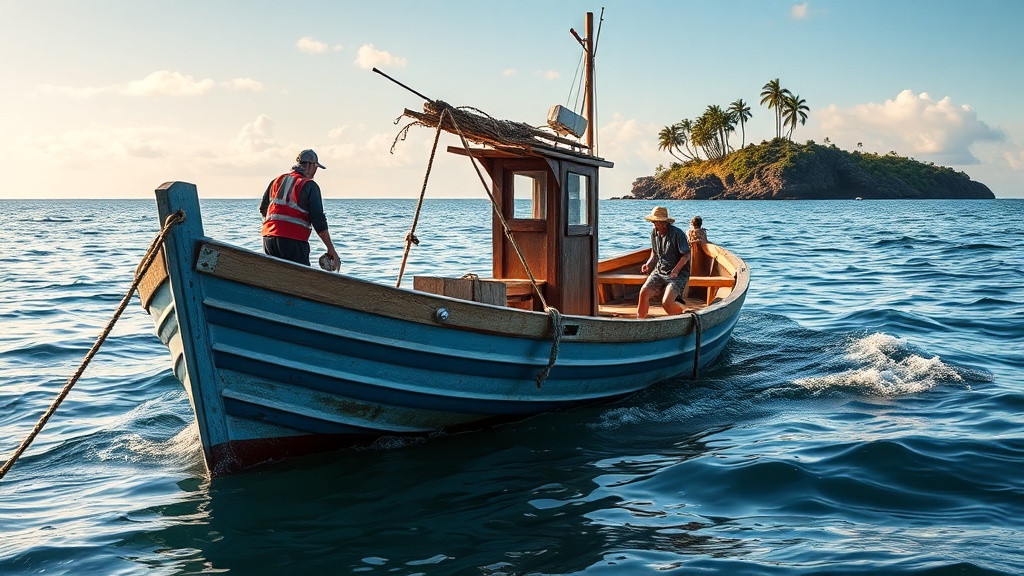
The design they settled on was inspired by traditional Polynesian outrigger canoes — a style refined over thousands of years specifically for open-ocean navigation across the Pacific. The "crab claw" sail they constructed mirrors designs used by ancient Polynesian navigators who crossed vast stretches of ocean with no GPS, no engine, and no safety net. The fact that a group of content creators landed on something this historically proven — partly by necessity, partly through Hayes's knowledge — is a quiet testament to why traditional maritime engineering still matters.
Bamboo, as any boat builder worth their salt will tell you, is a remarkable material. Lightweight, tensile, and surprisingly resistant to saltwater, it was the ideal structural choice available on the island. Combined with sealed plastic containers sourced from ocean debris washing ashore, the team effectively built a vessel using principles that would be recognisable to any naval architect: buoyancy chambers to displace water, a rigid deck platform to distribute load, and a sail system to harness wind.
The Survival Psychology Nobody Talks About
The physical challenge of island survival is well documented. The psychological dimension is less often discussed honestly. What the footage reveals — and what makes this more than entertainment — is a vivid portrait of how group dynamics fracture and reform under sustained stress.
By day four, the cracks were visible. One member attempted to swap his manual labour role for camera duty. Another pushed well past his physical limit searching for a crucial fourth buoyancy container, nearly losing consciousness in the heat. Decision fatigue was evident in the way conversations degraded late at night — nobody could remember what components were called, nobody was entirely sure what they were building next.
This is textbook survival psychology. Research consistently shows that in high-stress group scenarios, cohesion is maintained not through uniform effort but through role clarity. The moment Hayes established a clear division of labour — knot-tying, material sourcing, sail construction, structural assembly — progress accelerated. Teams that survive difficult situations are rarely the ones where everyone does everything equally. They are the ones where people stop competing for status and start playing to individual strengths.
The near-collapse moment — when one team member returned from an hours-long solo search barely able to stand, clutching the final missing container — crystallised this. His contribution wasn't physical dominance. It was persistence on a task everyone else had written off. Every survival scenario has that person. The question is whether the group recognises and values what they bring.
Tides, Currents, and the Science of Island Escape
One of the most underappreciated aspects of the whole endeavour was Hayes's reading of the tidal window. Ocean navigation — even over a relatively short distance — is not simply a matter of pointing a boat in a direction and paddling. Tidal flows create powerful currents that can either accelerate or destroy a voyage depending on timing.
The team identified a specific tidal outflow that, if caught at the right moment, would pull the vessel naturally toward the target island. Miss that window, and they risked being swept sideways into open ocean — a scenario with no easy recovery in a handmade bamboo raft with no motor and limited fresh water.
This is precisely how Pacific islanders navigated for millennia before European contact. The Polynesian wayfinding tradition — which enabled the settlement of islands across 10 million square kilometres of ocean — relied on intimate knowledge of currents, star positions, wave patterns, and wind behaviour. No instruments. Just observation, accumulated knowledge, and extraordinary courage. The group's instinct to align their departure with tidal movement wasn't accidental ingenuity. It was the same logic, rediscovered under pressure.
What Ocean Debris Tells Us About Our Coastlines
There is an uncomfortable subplot running through the entire build: almost every crucial material — the buoyancy containers that kept the boat afloat, the sheet metal used in attempting to shape paddles, various structural components — came from ocean debris washed ashore. Large vessels pass through these waters and their waste ends up on supposedly remote beaches. The island was littered with it.
On one hand, this debris provided a lifeline. On the other, its presence on a remote Pacific island tells a story about the reach of ocean plastic pollution that no statistics quite manage to convey as viscerally. The crew noted, with some irony, that they were cleaning up the beach at the same time as they were building their escape vessel. The plastic that should never have been there was the only reason they had a functional boat.
This is worth sitting with. The same globalised supply chain that creates the content creators' cameras, their sponsors' apps, and their audience's smartphones is the source of the debris that floats onto beaches most of us will never visit. Resource recovery from ocean plastic is a real and growing field — organisations like The Ocean Cleanup are turning this kind of waste into a feedstock for new products. The island makeshift boat is a quirky extreme of a legitimate circular economy principle.
The Moment the Boat Hit the Water
After nearly a week of labour, the flotation test was the emotional pivot of the entire experience. Everything that had been built — every knot tied, every bamboo pole lashed, every container wrestled through jungle — came down to whether the vessel would sit on the water or sink into it.
It floated.
The reaction from the group was not triumphant whooping. It was something quieter and more interesting — relief mixed with genuine disbelief. Because for all the commitment to the challenge, there had clearly been a background hum of doubt throughout. This might not work. That doubt is the honest companion of any genuinely difficult undertaking. When the boat floated, it wasn't just structural validation. It was the group proving to themselves that sustained effort in an unfamiliar domain, guided by one person who knew what they were doing, could produce something functional and real.
The actual crossing — navigating the tidal channel, managing the sail, fighting currents that threatened to pull them sideways into open ocean — was not the ending. It was the reward for everything that came before it. The boat was never the point. The point was learning, under genuine duress, that you can build something that works when you have no other option.
Practical Lessons Worth Taking Seriously
Stripped of the entertainment framing, this challenge surfaces a handful of insights that apply well beyond island survival.
Specialisation beats generalisation under pressure. When the group stopped trying to share every task equally and let Hayes lead on structural decisions, progress compounded rapidly. Know who in your group has the relevant expertise and let them lead in their domain.
Resources are rarely zero — they're often just displaced. The materials for a functional ocean-going vessel were already on that island. They just required reconnaissance, creativity, and persistence to identify and repurpose.
Timing is a skill. The tidal window that made the crossing possible didn't just appear. It required observation over days and a deliberate decision to align the team's readiness with a natural opportunity. Most consequential moments in any project work the same way.
Free Weekly Newsletter
Enjoying this guide?
Get the best articles like this one delivered to your inbox every week. No spam.
Physical limits are negotiable; hydration limits are not. The crew pushed through fatigue, insect bites, sore muscles, and sleep deprivation. But dehydration consistently produced the most dangerous moments. In any survival or high-output scenario, water management is the non-negotiable priority around which everything else organises.
Build something, test it, then build further. The team's decision to float-test the incomplete vessel before adding the sail and rigging prevented potentially catastrophic failure on launch day. Iterative testing under real conditions beats theoretical perfection every time.
The Boat Is Built — Now What?
There is something enduringly compelling about the image of five people who had never built a boat, on an island they had no conventional means of escaping, sailing away on something they made with their hands from jungle bamboo and ocean debris. It is ridiculous and impressive in roughly equal measure.
But the deeper current running through the whole story — past the YouTube production and the sponsorship reads and the comedic asides — is something older and more universal. Human beings are spectacularly good at solving problems when the problem is unavoidable. We improvise, we collaborate, we push past what we believed our limits to be, and occasionally we build something that actually floats.
That's not a small thing. And it's worth remembering the next time a challenge feels too large, too unfamiliar, or too far outside the scope of what you think you know how to do.
You probably don't need prior experience. You need the right people, the right timing, and no way out except forward.
Frequently Asked Questions
What type of boat did MrBeast's team build on the island?
The team built a bamboo outrigger sailboat, loosely modelled on traditional Polynesian crab-claw sail designs. It used four sealed plastic containers found as ocean debris to provide buoyancy, bamboo poles for structure, and a triangular sail system attached to a central mast. Despite being constructed from salvaged materials with no formal boat-building training (aside from one crew member), the vessel successfully floated and was used to sail to a neighbouring island.
How long did it take to build the sailboat?
The build took approximately five to six days from arrival on the island to the final launch. This included time spent gathering materials, constructing a shelter, searching the coastline for usable ocean debris, building and testing the boat's floatation system, and constructing the sail and paddles. The final sailing attempt was timed to align with a specific tidal outflow window to assist navigation.
Is bamboo actually a good material for building a boat?
Yes, bamboo is a surprisingly effective boat-building material, particularly for outrigger and raft-style vessels. It has a high strength-to-weight ratio, reasonable resistance to saltwater, and significant natural buoyancy. Bamboo rafts and canoes have been used across Southeast Asia and the Pacific for centuries. The key limitation is durability over extended periods in salt water, where bamboo can degrade, making it better suited to short-distance crossings than long ocean voyages.
What is a crab-claw sail and why did the team use it?
A crab-claw sail is a triangular sail design with two curved spars extending from a central mast, forming a shape resembling an open crab claw. It was developed by ancient Polynesian navigators and is highly efficient at capturing wind from a range of directions, making it ideal for open-ocean sailing where wind direction is variable. The team adopted this design because it is structurally simpler to build from raw materials than a conventional sail rig, and because it is historically proven for exactly the kind of inter-island Pacific crossing they were attempting.
How dangerous was the actual ocean crossing?
The crossing carried genuine risk. The team had to navigate a tidal channel where currents could have swept them sideways into open ocean rather than toward the target island. They had limited fresh water, no motor as a backup, and a vessel constructed from lashed bamboo and salvaged containers — meaning any structural failure mid-crossing would have left them stranded at sea. A safety team was present off-camera as a precaution, which is standard practice for high-risk MrBeast productions, but the physical and navigational challenge was real.
Frequently Asked Questions
When Survival Stops Being a Metaphor
Most of us have asked it at some point — usually while watching a survival show from a comfortable sofa — what would I actually do if I were stranded on a deserted island? MrBeast and four friends stopped asking and started finding out. Dropped onto a remote Pacific island with a box of basic supplies and a single exit condition — build a working sailboat and sail it to another island — they turned a thought experiment into something far more revealing than your average YouTube challenge.
This wasn't a stunt dressed up as survival. It was, at its core, a masterclass in what happens when human beings are stripped of convenience and forced to problem-solve under real physical and psychological pressure. The heat was genuine. The dehydration was genuine. The 60-plus insect bites on one crew member's arms were very much genuine. And the lessons that emerged from six days of jungle heat, ocean currents, and hand-tied knots are worth unpacking properly.
Building a Sailboat from Scratch: What It Actually Involves
Let's be clear about the scale of what was attempted here. A functional sailboat — even a rudimentary outrigger-style one — is not a weekend woodworking project. It requires an understanding of buoyancy, structural load, sail mechanics, tidal behaviour, and the physics of wind propulsion. None of the core group had ever built a boat before. Only one member, Hayes, had any prior experience.
The design they settled on was inspired by traditional Polynesian outrigger canoes — a style refined over thousands of years specifically for open-ocean navigation across the Pacific. The "crab claw" sail they constructed mirrors designs used by ancient Polynesian navigators who crossed vast stretches of ocean with no GPS, no engine, and no safety net. The fact that a group of content creators landed on something this historically proven — partly by necessity, partly through Hayes's knowledge — is a quiet testament to why traditional maritime engineering still matters.
Bamboo, as any boat builder worth their salt will tell you, is a remarkable material. Lightweight, tensile, and surprisingly resistant to saltwater, it was the ideal structural choice available on the island. Combined with sealed plastic containers sourced from ocean debris washing ashore, the team effectively built a vessel using principles that would be recognisable to any naval architect: buoyancy chambers to displace water, a rigid deck platform to distribute load, and a sail system to harness wind.
The Survival Psychology Nobody Talks About
The physical challenge of island survival is well documented. The psychological dimension is less often discussed honestly. What the footage reveals — and what makes this more than entertainment — is a vivid portrait of how group dynamics fracture and reform under sustained stress.
By day four, the cracks were visible. One member attempted to swap his manual labour role for camera duty. Another pushed well past his physical limit searching for a crucial fourth buoyancy container, nearly losing consciousness in the heat. Decision fatigue was evident in the way conversations degraded late at night — nobody could remember what components were called, nobody was entirely sure what they were building next.
This is textbook survival psychology. Research consistently shows that in high-stress group scenarios, cohesion is maintained not through uniform effort but through role clarity. The moment Hayes established a clear division of labour — knot-tying, material sourcing, sail construction, structural assembly — progress accelerated. Teams that survive difficult situations are rarely the ones where everyone does everything equally. They are the ones where people stop competing for status and start playing to individual strengths.
The near-collapse moment — when one team member returned from an hours-long solo search barely able to stand, clutching the final missing container — crystallised this. His contribution wasn't physical dominance. It was persistence on a task everyone else had written off. Every survival scenario has that person. The question is whether the group recognises and values what they bring.
Tides, Currents, and the Science of Island Escape
One of the most underappreciated aspects of the whole endeavour was Hayes's reading of the tidal window. Ocean navigation — even over a relatively short distance — is not simply a matter of pointing a boat in a direction and paddling. Tidal flows create powerful currents that can either accelerate or destroy a voyage depending on timing.
The team identified a specific tidal outflow that, if caught at the right moment, would pull the vessel naturally toward the target island. Miss that window, and they risked being swept sideways into open ocean — a scenario with no easy recovery in a handmade bamboo raft with no motor and limited fresh water.
This is precisely how Pacific islanders navigated for millennia before European contact. The Polynesian wayfinding tradition — which enabled the settlement of islands across 10 million square kilometres of ocean — relied on intimate knowledge of currents, star positions, wave patterns, and wind behaviour. No instruments. Just observation, accumulated knowledge, and extraordinary courage. The group's instinct to align their departure with tidal movement wasn't accidental ingenuity. It was the same logic, rediscovered under pressure.
What Ocean Debris Tells Us About Our Coastlines
There is an uncomfortable subplot running through the entire build: almost every crucial material — the buoyancy containers that kept the boat afloat, the sheet metal used in attempting to shape paddles, various structural components — came from ocean debris washed ashore. Large vessels pass through these waters and their waste ends up on supposedly remote beaches. The island was littered with it.
On one hand, this debris provided a lifeline. On the other, its presence on a remote Pacific island tells a story about the reach of ocean plastic pollution that no statistics quite manage to convey as viscerally. The crew noted, with some irony, that they were cleaning up the beach at the same time as they were building their escape vessel. The plastic that should never have been there was the only reason they had a functional boat.
This is worth sitting with. The same globalised supply chain that creates the content creators' cameras, their sponsors' apps, and their audience's smartphones is the source of the debris that floats onto beaches most of us will never visit. Resource recovery from ocean plastic is a real and growing field — organisations like The Ocean Cleanup are turning this kind of waste into a feedstock for new products. The island makeshift boat is a quirky extreme of a legitimate circular economy principle.
The Moment the Boat Hit the Water
After nearly a week of labour, the flotation test was the emotional pivot of the entire experience. Everything that had been built — every knot tied, every bamboo pole lashed, every container wrestled through jungle — came down to whether the vessel would sit on the water or sink into it.
It floated.
The reaction from the group was not triumphant whooping. It was something quieter and more interesting — relief mixed with genuine disbelief. Because for all the commitment to the challenge, there had clearly been a background hum of doubt throughout. This might not work. That doubt is the honest companion of any genuinely difficult undertaking. When the boat floated, it wasn't just structural validation. It was the group proving to themselves that sustained effort in an unfamiliar domain, guided by one person who knew what they were doing, could produce something functional and real.
The actual crossing — navigating the tidal channel, managing the sail, fighting currents that threatened to pull them sideways into open ocean — was not the ending. It was the reward for everything that came before it. The boat was never the point. The point was learning, under genuine duress, that you can build something that works when you have no other option.
Practical Lessons Worth Taking Seriously
Stripped of the entertainment framing, this challenge surfaces a handful of insights that apply well beyond island survival.
Specialisation beats generalisation under pressure. When the group stopped trying to share every task equally and let Hayes lead on structural decisions, progress compounded rapidly. Know who in your group has the relevant expertise and let them lead in their domain.
Resources are rarely zero — they're often just displaced. The materials for a functional ocean-going vessel were already on that island. They just required reconnaissance, creativity, and persistence to identify and repurpose.
Timing is a skill. The tidal window that made the crossing possible didn't just appear. It required observation over days and a deliberate decision to align the team's readiness with a natural opportunity. Most consequential moments in any project work the same way.
Physical limits are negotiable; hydration limits are not. The crew pushed through fatigue, insect bites, sore muscles, and sleep deprivation. But dehydration consistently produced the most dangerous moments. In any survival or high-output scenario, water management is the non-negotiable priority around which everything else organises.
Build something, test it, then build further. The team's decision to float-test the incomplete vessel before adding the sail and rigging prevented potentially catastrophic failure on launch day. Iterative testing under real conditions beats theoretical perfection every time.
The Boat Is Built — Now What?
There is something enduringly compelling about the image of five people who had never built a boat, on an island they had no conventional means of escaping, sailing away on something they made with their hands from jungle bamboo and ocean debris. It is ridiculous and impressive in roughly equal measure.
But the deeper current running through the whole story — past the YouTube production and the sponsorship reads and the comedic asides — is something older and more universal. Human beings are spectacularly good at solving problems when the problem is unavoidable. We improvise, we collaborate, we push past what we believed our limits to be, and occasionally we build something that actually floats.
That's not a small thing. And it's worth remembering the next time a challenge feels too large, too unfamiliar, or too far outside the scope of what you think you know how to do.
You probably don't need prior experience. You need the right people, the right timing, and no way out except forward.
Frequently Asked Questions
What type of boat did MrBeast's team build on the island?
The team built a bamboo outrigger sailboat, loosely modelled on traditional Polynesian crab-claw sail designs. It used four sealed plastic containers found as ocean debris to provide buoyancy, bamboo poles for structure, and a triangular sail system attached to a central mast. Despite being constructed from salvaged materials with no formal boat-building training (aside from one crew member), the vessel successfully floated and was used to sail to a neighbouring island.
How long did it take to build the sailboat?
The build took approximately five to six days from arrival on the island to the final launch. This included time spent gathering materials, constructing a shelter, searching the coastline for usable ocean debris, building and testing the boat's floatation system, and constructing the sail and paddles. The final sailing attempt was timed to align with a specific tidal outflow window to assist navigation.
Is bamboo actually a good material for building a boat?
Yes, bamboo is a surprisingly effective boat-building material, particularly for outrigger and raft-style vessels. It has a high strength-to-weight ratio, reasonable resistance to saltwater, and significant natural buoyancy. Bamboo rafts and canoes have been used across Southeast Asia and the Pacific for centuries. The key limitation is durability over extended periods in salt water, where bamboo can degrade, making it better suited to short-distance crossings than long ocean voyages.
What is a crab-claw sail and why did the team use it?
A crab-claw sail is a triangular sail design with two curved spars extending from a central mast, forming a shape resembling an open crab claw. It was developed by ancient Polynesian navigators and is highly efficient at capturing wind from a range of directions, making it ideal for open-ocean sailing where wind direction is variable. The team adopted this design because it is structurally simpler to build from raw materials than a conventional sail rig, and because it is historically proven for exactly the kind of inter-island Pacific crossing they were attempting.
How dangerous was the actual ocean crossing?
The crossing carried genuine risk. The team had to navigate a tidal channel where currents could have swept them sideways into open ocean rather than toward the target island. They had limited fresh water, no motor as a backup, and a vessel constructed from lashed bamboo and salvaged containers — meaning any structural failure mid-crossing would have left them stranded at sea. A safety team was present off-camera as a precaution, which is standard practice for high-risk MrBeast productions, but the physical and navigational challenge was real.
About Zeebrain Editorial
Zeebrain publishes independent analysis of markets, investing, personal finance, and business. We disclose affiliate relationships, never accept payment for coverage, and fact-check all claims against primary sources. Read our editorial policy →
How this article was produced: Zeebrain articles are created with AI assistance from primary sources (including cited videos and market data) and reviewed under our editorial standards before publication. Spot an error? Tell us and we will correct it.
More from Entertainment




Related Guides
Keep exploring this topic
7 Days Stranded in the Arctic: What It Really Takes
Entertainment · Arctic survival · MrBeast
Survival Experts vs Amateurs: Who Really Wins Outdoors?
Entertainment · wilderness survival · MrBeast
The Rise of the Machines… and Entertainers: AI-Generated Content Reshapes the Entertainment Landscap...
Entertainment
The Math Behind Why Movie Franchises Keep Failing
Entertainment
Explore More Categories
Keep browsing by topic and build depth around the subjects you care about most.