The Pig War: How a Pig Almost Started a World War
Quick Summary
In 1859, a British pig eating American potatoes nearly triggered a war between two nations. The Pig War is history's most absurd and fascinating border dispute.
In This Article
When a Pig Nearly Ended the Peace Between Britain and America
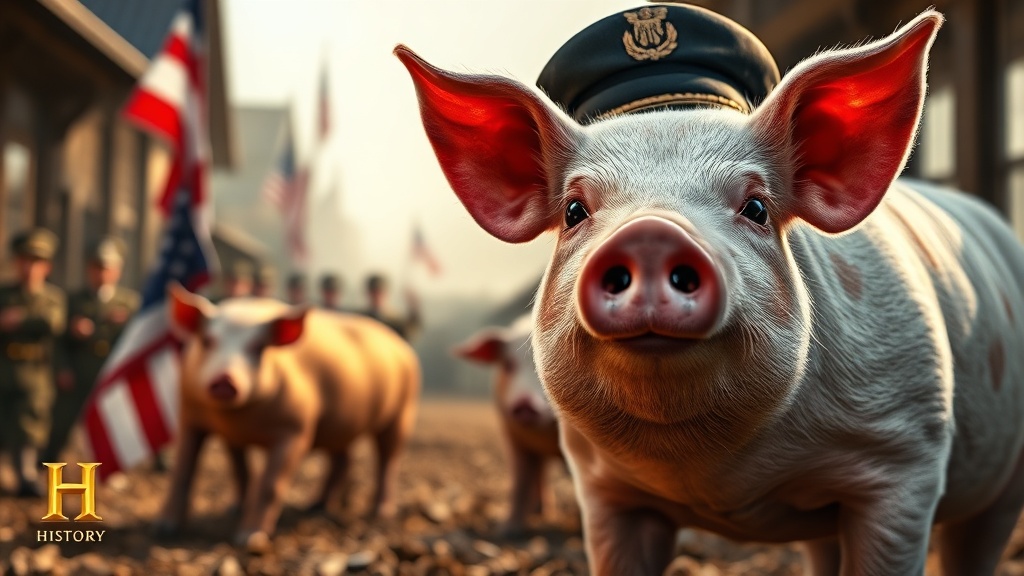
In the summer of 1859, a farmer named Lyman Cutler shot a pig. Not a particularly remarkable act in itself — except that this pig belonged to a British company, the island it rooted around on was claimed by both Britain and the United States, and the gunshot that killed it very nearly ignited a war between two of the world's most powerful nations. The Pig War, as history would come to call it, stands as one of the strangest, most gloriously absurd diplomatic crises ever recorded — and yet buried beneath its comedy is a serious story about empire, manifest destiny, territorial ambition, and the terrifying fragility of peace.
To understand how a single pig brought two nations to the brink, you have to go back much further than 1859. You have to go back to the very birth of the United States itself — and to a series of border agreements so carelessly drawn they practically begged for conflict.
A Border Built on Bad Maps and Wishful Thinking
When the United States won its independence from Britain in 1783, the two sides met in Paris to carve up the continent between them. It should have been a straightforward process. Draw a line, sign a paper, shake hands, go home. Instead, it became the first in a long series of cartographic disasters that would haunt North America for decades.
The negotiators agreed to extend the border westward from a lake — one they believed was perfectly oval in shape. It was not. They also intended the line to meet the Mississippi River at a specific point. It did not. The map they were working from, the best available at the time, was riddled with errors. The result was a border agreement that, in practice, made almost no geographical sense at all.
This wasn't incompetence so much as the inevitable consequence of legislating territory that neither side had properly explored. Vast swathes of North America in the late eighteenth century were unmapped, poorly understood, or simply misrepresented by European cartographers working from secondhand accounts. Founding fathers, for all their celebrated brilliance, were working half-blind.
The War of 1812 — that peculiar conflict in which the Americans tried to invade Canada and the British responded by burning down the White House — settled very little militarily, but it did force both sides back to the negotiating table. They agreed to extend the border along the 49th parallel westward to the Rocky Mountains. Clean, simple, sensible. But beyond the Rockies? That was a different matter entirely. Both Britain and the United States claimed the vast Oregon Territory, and neither was willing to yield.
Manifest Destiny Meets the Hudson's Bay Company
The ideological force driving American westward expansion in the nineteenth century was manifest destiny — the conviction, held with extraordinary sincerity by millions, that God had ordained the United States to stretch from the Atlantic to the Pacific. It was imperialism dressed in the language of divine providence, and it was extraordinarily effective as a motivating force. By the 1840s, tens of thousands of American settlers were flooding into the Oregon Territory along the Oregon Trail, outnumbering British subjects in the region by more than six to one.
On the British side, the primary institutional presence was the Hudson's Bay Company — a charter company of almost incomprehensible reach and influence that had spent over a century turning North American beavers into European felt hats. The Columbia River was the jugular vein of their entire Pacific operation, and ceding it to American control was unthinkable.
For years, the two nations agreed to jointly occupy the Oregon Territory — a deeply awkward arrangement that satisfied nobody but avoided outright war. American settlers kept arriving. British traders kept trapping. And both governments kept kicking the question of permanent sovereignty down the road.
In 1846, the Oregon Treaty finally drew a line: the border would continue along the 49th parallel to the Strait of Georgia, then south through the middle of the channel to the Pacific. Britain kept Vancouver Island. It seemed settled. It was not. Because nobody had thought to specify which channel the treaty meant — and in the waters between Vancouver Island and the mainland, there was more than one.
The Island at the Heart of the Dispute
San Juan Island sits in the disputed waters between what is now Washington State and British Columbia. It is small, green, and possessed of extraordinary agricultural potential — the kind of land that makes farmers weep with longing. The British were convinced the relevant border channel was the Rosario Strait, which placed the island firmly in their territory. The Americans were equally convinced it was the Haro Strait, which made it indisputably theirs.
In 1853, James Douglas — then Governor of Vancouver Island and a man of almost theatrical stubbornness — devised a characteristically blunt solution to the ambiguity. If Britain could establish a settled presence on the island before the Americans did, possession might do what diplomacy had failed to achieve. He dispatched an Irishman named Charles Griffin, accompanied by a group of Hawaiian shepherds, to establish a sheep farm on San Juan Island.
The farm flourished. By the time American settlers began drifting onto the island in the late 1850s — many of them failed gold prospectors from the Fraser Canyon rush who had decided the green pastures of San Juan were preferable to the long walk home — Griffin's operation included nearly 1,400 sheep and a collection of prized Berkshire pigs.
Among the American newcomers was Lyman Cutler, a young man whose relationship with hard work was best described as theoretical. Rather than clearing forest for his cabin, he built it in the middle of Griffin's sheep run. Rather than properly fencing his potato garden, he enclosed three sides and trusted that British livestock had absorbed enough imperial decorum to respect his property rights. They had not.
The Shot That Nearly Started a War
Griffin's Berkshire pig was, by all accounts, a magnificent and determined animal. Berkshires are known for rooting — for using their powerful snouts to dig through soil in search of food — and Cutler's half-hearted fence presented no serious obstacle to a motivated pig. Time and again, the animal pushed through and decimated Cutler's potato patch. Time and again, Cutler complained to Griffin. Time and again, Griffin reportedly told him that it was Cutler's responsibility to keep the pig out, not Griffin's responsibility to keep the pig in.
On the morning of June 15, 1859, Lyman Cutler found the pig in his garden one final time. He picked up his rifle and shot it dead.
What followed was a cascade of escalation that reads less like history and more like a particularly well-constructed farce. Griffin demanded compensation. Cutler offered ten dollars. Griffin demanded one hundred. Cutler, apparently reconsidering the entire incident, said Griffin should be grateful he wasn't going to be arrested. The Hudson's Bay Company threatened to have Cutler arrested instead. American settlers on the island, alarmed by the threat of British authority, petitioned the U.S. Army for military protection.
General William Harney, commanding American forces in the region, was only too happy to oblige. He dispatched Captain George Pickett — who would later achieve a very different and considerably more catastrophic form of fame at Gettysburg — to San Juan Island with sixty-six soldiers. Pickett landed, planted a flag, and declared the island American territory.
The British response was swift. Royal Navy vessels arrived in the harbor. By August, there were five British warships carrying over two thousand men and seventy-two guns facing down Pickett's small force on the beach. The guns on both sides were loaded. Officers on both sides were awaiting orders. The situation had, with remarkable speed, become genuinely dangerous.
How Cooler Heads Prevented a Catastrophe
What saved the day — and possibly prevented a third Anglo-American war — was a combination of institutional caution and the personal decency of the officers on the ground. Governor Douglas pushed for a show of force. Rear Admiral Robert Baynes, commanding the British naval squadron, refused to fire on American soldiers over what he called, with magnificent understatement, 'a squabble about a pig.' His restraint almost certainly preserved the peace.
When news of the standoff reached Washington and London, both governments were horrified. President Buchanan sent General Winfield Scott — the most senior officer in the U.S. Army — to defuse the situation personally. Scott negotiated a joint military occupation of the island: a small American camp on one end, a small British camp on the other, a gentlemen's agreement not to shoot each other, and apparently quite a lot of shared dinners and sporting events between the two garrisons in the years that followed.
The joint occupation lasted twelve years. In 1871, as part of the broader Treaty of Washington, both nations agreed to submit the boundary question to international arbitration. Kaiser Wilhelm I of Germany was appointed arbiter. In 1872, he ruled in favour of the United States. The Haro Strait was the correct channel. San Juan Island was American. The British soldiers packed up their camp and left, reportedly on excellent terms with their American neighbours.
Free Weekly Newsletter
Enjoying this guide?
Get the best articles like this one delivered to your inbox every week. No spam.
Not a single human life had been lost in the entire affair. The only casualty of the Pig War was the pig.
What the Pig War Reveals About Power, Borders, and Diplomacy
The Pig War is often told as a comedy, and it is genuinely funny — the hapless fencing strategy, the impromptu magistracy by wig, the sheriff who auctioned off sheep to himself. But it rewards more serious attention than it usually receives.
It illustrates, first, the profound danger of vague treaty language. The Oregon Treaty of 1846 was agreed by men who either did not know or did not care which channel divided the islands, and their carelessness created twelve years of tension and one genuinely close brush with war. Precision in diplomatic language is not pedantry — it is the difference between peace and conflict.
It also reveals the mechanics of imperial competition at its most granular. The great geopolitical struggles of the nineteenth century were not only fought in chancelleries and parliaments. They played out on sheep farms, in potato gardens, in the decisions of individual settlers, company agents, and army captains operating thousands of miles from any seat of power. History is made at every scale simultaneously.
And finally, the Pig War is a story about the wisdom of restraint. Admiral Baynes's refusal to fire on American soldiers was not weakness — it was a clear-eyed recognition that no territorial dispute, however legitimate the claim, was worth the catastrophe of war. That kind of institutional courage, the willingness to de-escalate in the face of pressure, is rarer and more valuable than it looks.
The pig, of course, had no opinion on any of this. It simply wanted the potatoes.
Frequently Asked Questions
What was the Pig War and when did it happen?
The Pig War was a bloodless military standoff between the United States and Great Britain that took place in 1859 on San Juan Island, located in the waters between what is now Washington State and British Columbia, Canada. It was triggered when an American settler named Lyman Cutler shot a pig belonging to the British Hudson's Bay Company, leading to a rapid military escalation that briefly threatened to become a full-scale war between the two nations.
Did anyone die in the Pig War?
Remarkably, no human lives were lost during the Pig War. Despite the presence of hundreds of armed soldiers and several Royal Navy warships with loaded guns, cooler heads prevailed on both sides. The only fatality in the entire conflict was the British Berkshire pig that Lyman Cutler shot in his potato garden in June 1859 — making it one of the most genuinely bloodless military standoffs in recorded history.
How was the Pig War resolved?
After a tense military standoff in the summer of 1859, both the United States and Britain agreed to a joint military occupation of San Juan Island, with American troops stationed at one end and British troops at the other. This arrangement lasted until 1872, when Kaiser Wilhelm I of Germany, acting as international arbitrator under the terms of the 1871 Treaty of Washington, ruled in favour of the United States. San Juan Island was declared American territory, and the British garrison departed peacefully.
Why was San Juan Island disputed in the first place?
San Juan Island became the subject of dispute because the 1846 Oregon Treaty, which was intended to settle the boundary between British and American territory in the Pacific Northwest, used vague language specifying that the border should run through 'the middle of the channel' between Vancouver Island and the mainland. Since there were multiple channels in the area — including the Haro Strait and the Rosario Strait — both nations interpreted the treaty differently and claimed the islands between them as their own sovereign territory.
Who was Captain George Pickett and what was his role in the Pig War?
Captain George Pickett was the U.S. Army officer dispatched to San Juan Island in 1859 to protect American settlers following the shooting of the pig and the subsequent threat of British intervention. He landed with sixty-six soldiers and declared the island American territory, directly triggering the naval standoff with the Royal Navy. Pickett would later become far more famous — and infamous — as the Confederate general who led 'Pickett's Charge' at the Battle of Gettysburg in 1863, one of the most catastrophic military assaults in American history.
Frequently Asked Questions
When a Pig Nearly Ended the Peace Between Britain and America
In the summer of 1859, a farmer named Lyman Cutler shot a pig. Not a particularly remarkable act in itself — except that this pig belonged to a British company, the island it rooted around on was claimed by both Britain and the United States, and the gunshot that killed it very nearly ignited a war between two of the world's most powerful nations. The Pig War, as history would come to call it, stands as one of the strangest, most gloriously absurd diplomatic crises ever recorded — and yet buried beneath its comedy is a serious story about empire, manifest destiny, territorial ambition, and the terrifying fragility of peace.
To understand how a single pig brought two nations to the brink, you have to go back much further than 1859. You have to go back to the very birth of the United States itself — and to a series of border agreements so carelessly drawn they practically begged for conflict.
A Border Built on Bad Maps and Wishful Thinking
When the United States won its independence from Britain in 1783, the two sides met in Paris to carve up the continent between them. It should have been a straightforward process. Draw a line, sign a paper, shake hands, go home. Instead, it became the first in a long series of cartographic disasters that would haunt North America for decades.
The negotiators agreed to extend the border westward from a lake — one they believed was perfectly oval in shape. It was not. They also intended the line to meet the Mississippi River at a specific point. It did not. The map they were working from, the best available at the time, was riddled with errors. The result was a border agreement that, in practice, made almost no geographical sense at all.
This wasn't incompetence so much as the inevitable consequence of legislating territory that neither side had properly explored. Vast swathes of North America in the late eighteenth century were unmapped, poorly understood, or simply misrepresented by European cartographers working from secondhand accounts. Founding fathers, for all their celebrated brilliance, were working half-blind.
The War of 1812 — that peculiar conflict in which the Americans tried to invade Canada and the British responded by burning down the White House — settled very little militarily, but it did force both sides back to the negotiating table. They agreed to extend the border along the 49th parallel westward to the Rocky Mountains. Clean, simple, sensible. But beyond the Rockies? That was a different matter entirely. Both Britain and the United States claimed the vast Oregon Territory, and neither was willing to yield.
Manifest Destiny Meets the Hudson's Bay Company
The ideological force driving American westward expansion in the nineteenth century was manifest destiny — the conviction, held with extraordinary sincerity by millions, that God had ordained the United States to stretch from the Atlantic to the Pacific. It was imperialism dressed in the language of divine providence, and it was extraordinarily effective as a motivating force. By the 1840s, tens of thousands of American settlers were flooding into the Oregon Territory along the Oregon Trail, outnumbering British subjects in the region by more than six to one.
On the British side, the primary institutional presence was the Hudson's Bay Company — a charter company of almost incomprehensible reach and influence that had spent over a century turning North American beavers into European felt hats. The Columbia River was the jugular vein of their entire Pacific operation, and ceding it to American control was unthinkable.
For years, the two nations agreed to jointly occupy the Oregon Territory — a deeply awkward arrangement that satisfied nobody but avoided outright war. American settlers kept arriving. British traders kept trapping. And both governments kept kicking the question of permanent sovereignty down the road.
In 1846, the Oregon Treaty finally drew a line: the border would continue along the 49th parallel to the Strait of Georgia, then south through the middle of the channel to the Pacific. Britain kept Vancouver Island. It seemed settled. It was not. Because nobody had thought to specify which channel the treaty meant — and in the waters between Vancouver Island and the mainland, there was more than one.
The Island at the Heart of the Dispute
San Juan Island sits in the disputed waters between what is now Washington State and British Columbia. It is small, green, and possessed of extraordinary agricultural potential — the kind of land that makes farmers weep with longing. The British were convinced the relevant border channel was the Rosario Strait, which placed the island firmly in their territory. The Americans were equally convinced it was the Haro Strait, which made it indisputably theirs.
In 1853, James Douglas — then Governor of Vancouver Island and a man of almost theatrical stubbornness — devised a characteristically blunt solution to the ambiguity. If Britain could establish a settled presence on the island before the Americans did, possession might do what diplomacy had failed to achieve. He dispatched an Irishman named Charles Griffin, accompanied by a group of Hawaiian shepherds, to establish a sheep farm on San Juan Island.
The farm flourished. By the time American settlers began drifting onto the island in the late 1850s — many of them failed gold prospectors from the Fraser Canyon rush who had decided the green pastures of San Juan were preferable to the long walk home — Griffin's operation included nearly 1,400 sheep and a collection of prized Berkshire pigs.
Among the American newcomers was Lyman Cutler, a young man whose relationship with hard work was best described as theoretical. Rather than clearing forest for his cabin, he built it in the middle of Griffin's sheep run. Rather than properly fencing his potato garden, he enclosed three sides and trusted that British livestock had absorbed enough imperial decorum to respect his property rights. They had not.
The Shot That Nearly Started a War
Griffin's Berkshire pig was, by all accounts, a magnificent and determined animal. Berkshires are known for rooting — for using their powerful snouts to dig through soil in search of food — and Cutler's half-hearted fence presented no serious obstacle to a motivated pig. Time and again, the animal pushed through and decimated Cutler's potato patch. Time and again, Cutler complained to Griffin. Time and again, Griffin reportedly told him that it was Cutler's responsibility to keep the pig out, not Griffin's responsibility to keep the pig in.
On the morning of June 15, 1859, Lyman Cutler found the pig in his garden one final time. He picked up his rifle and shot it dead.
What followed was a cascade of escalation that reads less like history and more like a particularly well-constructed farce. Griffin demanded compensation. Cutler offered ten dollars. Griffin demanded one hundred. Cutler, apparently reconsidering the entire incident, said Griffin should be grateful he wasn't going to be arrested. The Hudson's Bay Company threatened to have Cutler arrested instead. American settlers on the island, alarmed by the threat of British authority, petitioned the U.S. Army for military protection.
General William Harney, commanding American forces in the region, was only too happy to oblige. He dispatched Captain George Pickett — who would later achieve a very different and considerably more catastrophic form of fame at Gettysburg — to San Juan Island with sixty-six soldiers. Pickett landed, planted a flag, and declared the island American territory.
The British response was swift. Royal Navy vessels arrived in the harbor. By August, there were five British warships carrying over two thousand men and seventy-two guns facing down Pickett's small force on the beach. The guns on both sides were loaded. Officers on both sides were awaiting orders. The situation had, with remarkable speed, become genuinely dangerous.
How Cooler Heads Prevented a Catastrophe
What saved the day — and possibly prevented a third Anglo-American war — was a combination of institutional caution and the personal decency of the officers on the ground. Governor Douglas pushed for a show of force. Rear Admiral Robert Baynes, commanding the British naval squadron, refused to fire on American soldiers over what he called, with magnificent understatement, 'a squabble about a pig.' His restraint almost certainly preserved the peace.
When news of the standoff reached Washington and London, both governments were horrified. President Buchanan sent General Winfield Scott — the most senior officer in the U.S. Army — to defuse the situation personally. Scott negotiated a joint military occupation of the island: a small American camp on one end, a small British camp on the other, a gentlemen's agreement not to shoot each other, and apparently quite a lot of shared dinners and sporting events between the two garrisons in the years that followed.
The joint occupation lasted twelve years. In 1871, as part of the broader Treaty of Washington, both nations agreed to submit the boundary question to international arbitration. Kaiser Wilhelm I of Germany was appointed arbiter. In 1872, he ruled in favour of the United States. The Haro Strait was the correct channel. San Juan Island was American. The British soldiers packed up their camp and left, reportedly on excellent terms with their American neighbours.
Not a single human life had been lost in the entire affair. The only casualty of the Pig War was the pig.
What the Pig War Reveals About Power, Borders, and Diplomacy
The Pig War is often told as a comedy, and it is genuinely funny — the hapless fencing strategy, the impromptu magistracy by wig, the sheriff who auctioned off sheep to himself. But it rewards more serious attention than it usually receives.
It illustrates, first, the profound danger of vague treaty language. The Oregon Treaty of 1846 was agreed by men who either did not know or did not care which channel divided the islands, and their carelessness created twelve years of tension and one genuinely close brush with war. Precision in diplomatic language is not pedantry — it is the difference between peace and conflict.
It also reveals the mechanics of imperial competition at its most granular. The great geopolitical struggles of the nineteenth century were not only fought in chancelleries and parliaments. They played out on sheep farms, in potato gardens, in the decisions of individual settlers, company agents, and army captains operating thousands of miles from any seat of power. History is made at every scale simultaneously.
And finally, the Pig War is a story about the wisdom of restraint. Admiral Baynes's refusal to fire on American soldiers was not weakness — it was a clear-eyed recognition that no territorial dispute, however legitimate the claim, was worth the catastrophe of war. That kind of institutional courage, the willingness to de-escalate in the face of pressure, is rarer and more valuable than it looks.
The pig, of course, had no opinion on any of this. It simply wanted the potatoes.
Frequently Asked Questions
What was the Pig War and when did it happen?
The Pig War was a bloodless military standoff between the United States and Great Britain that took place in 1859 on San Juan Island, located in the waters between what is now Washington State and British Columbia, Canada. It was triggered when an American settler named Lyman Cutler shot a pig belonging to the British Hudson's Bay Company, leading to a rapid military escalation that briefly threatened to become a full-scale war between the two nations.
Did anyone die in the Pig War?
Remarkably, no human lives were lost during the Pig War. Despite the presence of hundreds of armed soldiers and several Royal Navy warships with loaded guns, cooler heads prevailed on both sides. The only fatality in the entire conflict was the British Berkshire pig that Lyman Cutler shot in his potato garden in June 1859 — making it one of the most genuinely bloodless military standoffs in recorded history.
How was the Pig War resolved?
After a tense military standoff in the summer of 1859, both the United States and Britain agreed to a joint military occupation of San Juan Island, with American troops stationed at one end and British troops at the other. This arrangement lasted until 1872, when Kaiser Wilhelm I of Germany, acting as international arbitrator under the terms of the 1871 Treaty of Washington, ruled in favour of the United States. San Juan Island was declared American territory, and the British garrison departed peacefully.
Why was San Juan Island disputed in the first place?
San Juan Island became the subject of dispute because the 1846 Oregon Treaty, which was intended to settle the boundary between British and American territory in the Pacific Northwest, used vague language specifying that the border should run through 'the middle of the channel' between Vancouver Island and the mainland. Since there were multiple channels in the area — including the Haro Strait and the Rosario Strait — both nations interpreted the treaty differently and claimed the islands between them as their own sovereign territory.
Who was Captain George Pickett and what was his role in the Pig War?
Captain George Pickett was the U.S. Army officer dispatched to San Juan Island in 1859 to protect American settlers following the shooting of the pig and the subsequent threat of British intervention. He landed with sixty-six soldiers and declared the island American territory, directly triggering the naval standoff with the Royal Navy. Pickett would later become far more famous — and infamous — as the Confederate general who led 'Pickett's Charge' at the Battle of Gettysburg in 1863, one of the most catastrophic military assaults in American history.
About Zeebrain Editorial
Zeebrain publishes independent analysis of markets, investing, personal finance, and business. We disclose affiliate relationships, never accept payment for coverage, and fact-check all claims against primary sources. Read our editorial policy →
How this article was produced: Zeebrain articles are created with AI assistance from primary sources (including cited videos and market data) and reviewed under our editorial standards before publication. Spot an error? Tell us and we will correct it.
More from History & Mysteries
Related Guides
Keep exploring this topic
Explore More Categories
Keep browsing by topic and build depth around the subjects you care about most.