The Russian Revolution: How an Empire Collapsed in Days
Quick Summary
From Rasputin's murder to Lenin's return, discover how the Russian Revolution unfolded — and why the Romanov dynasty never stood a chance.
In This Article
When Empires Fall, They Fall Fast
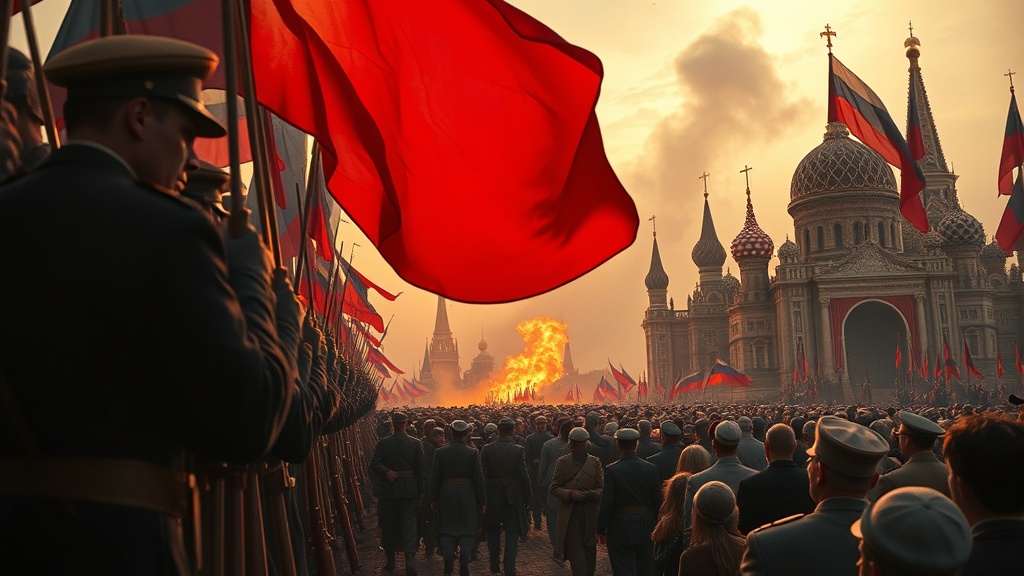
There is a peculiar cruelty in the way history chooses its turning points. Not grand, orchestrated moments, but ordinary ones — a hungry woman stepping into a Petrograd street on a February morning, a train rerouted by a telegraph worker, a palace guard laying down his rifle without a fight. The Russian Revolution did not announce itself with trumpets. It arrived like a slow crack in river ice: barely visible, then suddenly, catastrophically total.
The collapse of the Romanov dynasty and the eventual rise of Bolshevik power in 1917 is one of history's most dramatic political transformations. In a single year, a 300-year-old imperial dynasty dissolved, a provisional government rose and imploded, and a small cadre of committed revolutionaries — dismissed by most as fringe agitators — seized the largest country on Earth. Understanding how that happened requires looking not just at the revolution itself, but at the years of accumulated pressure that made it inevitable.
World War One: The Fire That Broke Russia
The Russian Revolution cannot be understood without first understanding what the First World War did to the country. When war broke out in 1914, a wave of patriotism temporarily united Russians across class lines. The capital was even renamed from St. Petersburg — deemed too German-sounding — to Petrograd. Even many revolutionaries, despite viewing the conflict as a cynical imperial land grab, rallied behind the idea that a foreign empire was worse than their own.
But the Tsarist state was structurally incapable of fighting a modern industrial war. Supply chains collapsed. Ammunition ran short. Soldiers were sometimes sent to the front without rifles, told to pick up weapons from fallen comrades. By 1917, Russia had suffered somewhere between 1.6 and 1.8 million military deaths, with millions more wounded or captured. These were not abstract statistics — they were fathers, brothers and sons from every village and city district in the empire.
Tsar Nicholas II, in a decision of almost theatrical self-destruction, declared himself Commander-in-Chief of the armed forces in 1915 and went to the front. The strategic logic was thin. The political consequences were devastating. Every military defeat could now be laid personally at his feet. Back in Petrograd, Tsarina Alexandra — German by birth, which did nothing to help public opinion during a war against Germany — was left to manage the government, increasingly under the influence of the mystic Grigori Rasputin.
Rasputin, Reputation, and the Rot at the Centre
History has treated Rasputin as something between a punchline and a supernatural villain, and both readings miss the more disturbing truth. He was a Siberian peasant-turned-faith-healer who had gained extraordinary access to the imperial family by appearing to ease the suffering of young Alexei, the haemophiliac heir to the throne. Whether through hypnosis, herbal remedies, or sheer psychological suggestion, Rasputin could calm the boy when conventional medicine failed. For a desperate mother, that made him indispensable.
The problem was perception. In the febrile atmosphere of wartime Petrograd, rumours spread that Rasputin was the hidden hand directing Russian policy — and worse. Pamphlets circulated suggesting an improper relationship between him and the Tsarina. Whether any of it was true mattered less than what it represented: an imperial family so detached from reality that they had handed influence to a wandering mystic while their country bled.
In December 1916, a group of noblemen assassinated Rasputin. The details remain disputed — accounts of poisoned cakes, multiple gunshots and eventual drowning have the quality of legend rather than reportage. What is historically clear is that the murder changed almost nothing politically, while simultaneously confirming to ordinary Russians that their ruling class had lost its mind. The Tsar's credibility, already severely damaged, effectively did not survive the scandal.
The February Revolution: Hunger as the Trigger
Revolutions are rarely ignited by ideology alone. They begin with hunger. On International Women's Day in February 1917, thousands of women in Petrograd — factory workers, wives of soldiers, ordinary citizens stretched beyond endurance by bread rationing — took to the streets. Within days, the demonstrations had swelled to roughly 250,000 people. The crowds demanded bread, an end to the war, and an end to autocracy itself.
What made this moment different from earlier unrest was the response of the military. In 1905, troops had fired on demonstrators and broken the revolutionary momentum. In 1917, entire regiments mutinied and joined the crowds instead. The soldiers were hungry too. They were tired too. And they had spent years watching men die in a war that seemed to have no purpose and no end.
With the army no longer reliable and his capital in open rebellion, Nicholas II found his options vanishing. Military commanders and liberal politicians jointly concluded that his abdication was the only path to stabilising the country. Nicholas, returning by train to Petrograd, never made it. Intercepted by generals, he abdicated on 2 March 1917. Three centuries of Romanov rule ended not in a palace coup or a bloody siege, but in a railway carriage conversation that took a matter of hours.
The Provisional Government's Fatal Mistakes
The liberal politicians who filled the power vacuum after Nicholas abdicated faced an almost impossible task — and made it considerably harder through their own decisions. The Provisional Government, which assumed official authority, shared power uneasily with the elected workers' councils known as Soviets. This dual power arrangement was inherently unstable, and everyone knew it. The question was simply who would blink first.
The Provisional Government made several genuinely progressive moves. It abolished the death penalty, disbanded the secret police, and planned free elections — reforms that would have been unthinkable under Nicholas. But it made one catastrophic error that undermined everything else: it chose to continue the war.
Alexander Kerensky, who became Prime Minister, believed that military victories would legitimise the new government in the eyes of the people. Instead, the summer 1917 offensive — later known as the Kerensky Offensive — collapsed disastrously. Russian forces advanced briefly before being driven back with enormous losses. The economy deteriorated further. Food shortages deepened. And the political space for moderate liberalism began to shrink with every passing week.
Kerensky's subsequent decision to appoint the reactionary General Kornilov as Supreme Commander backfired spectacularly when Kornilov attempted his own coup in August 1917. Kerensky, in desperation, turned to the Bolsheviks for help — releasing their imprisoned leaders and arming their militias. The Kornilov coup collapsed, largely due to the organisational brilliance of Leon Trotsky and the practical action of railway and telegraph workers who simply refused to cooperate with Kornilov's forces. But in saving himself, Kerensky had handed his most dangerous rivals both weapons and an enormous propaganda victory.
Lenin's Return and the October Seizure of Power
For much of 1917, Vladimir Lenin had been watching events from exile — first in Switzerland, then briefly in Finland after returning to Russia and being forced to flee again. His perspective was sharply out of step with mainstream opinion. While others celebrated the February Revolution as a democratic breakthrough, Lenin saw it as an incomplete half-measure. He wanted not constitutional reform but the complete dismantling of the bourgeois state.
The Germans, with characteristic strategic calculation, recognised that Lenin in Russia meant trouble for the Russian war effort. They facilitated his journey home in a sealed train — one of the stranger footnotes in modern history. When Lenin arrived at Petrograd's Finland Station in April 1917, he immediately alienated nearly everyone by denouncing both the Provisional Government and the Soviets as inadequate. His April Theses called for immediate peace, redistribution of land to peasants, and all power to the Soviets.
His slogan was disarmingly simple: Peace, Land, Bread. Three words that addressed the three things ordinary Russians cared about most. While Kerensky's government offered continuation, complexity and compromise, Lenin offered clarity. Through the summer and autumn of 1917, the Bolsheviks grew steadily more powerful — winning majorities in the Petrograd and Moscow Soviets and positioning themselves as the only political force willing to act decisively.
The October Revolution, when it came, was almost anticlimactic. On the night of 25–26 October 1917, Bolshevik forces — coordinated by Trotsky from his position as Soviet chairman — moved into key government buildings, communications centres and bridges across Petrograd. There was remarkably little fighting. The provisional government, besieged in the Winter Palace, was defended by a unit that quickly surrendered. Kerensky escaped in a borrowed car. Lenin emerged from hiding and announced Soviet power.
The most consequential revolution of the twentieth century had been accomplished, in Petrograd at least, in roughly twenty-four hours.
Free Weekly Newsletter
Enjoying this guide?
Get the best articles like this one delivered to your inbox every week. No spam.
What the Russian Revolution Actually Teaches Us
The Russian Revolution is often taught as a story of ideology — of Marxism defeating autocracy. But the closer you look, the more it reads as a story about institutional failure and the consequences of ignoring accumulated grievance.
Nicholas II was not uniquely wicked. He was a man temperamentally unsuited to his position, clinging to absolute power in an era that had already begun to move beyond it, and unwilling to make the compromises that might have saved both his dynasty and his country. His tragedy — and the much greater tragedy of the millions swept up in what followed — was that he mistook stubbornness for strength.
The Provisional Government was not corrupt. Many of its members were genuine reformers. But they fatally misjudged the mood of a population that had been promised change and received more of the same sacrifice. In politics, as in most things, promises without delivery do not merely fail — they actively destroy trust.
And Lenin's Bolsheviks did not win because Marxism is an especially persuasive philosophy. They won because they were organised, disciplined, and ruthlessly focused on power at a moment when everyone else was exhausted, distracted, or naive. Their revolution was less a popular uprising than a precise insertion into a vacuum — made possible entirely by the failures of those who came before them.
The Russian Revolution is not ancient history. It is a case study in how quickly legitimacy can dissolve when institutions fail to meet the basic needs of the people they govern, and how swiftly determined minorities can move into the space left behind.
Frequently Asked Questions
What caused the Russian Revolution of 1917?
The Russian Revolution had multiple causes that accumulated over decades. The most immediate triggers were the catastrophic human and economic costs of World War One, chronic food shortages, the deeply unpopular influence of Rasputin on the royal family, and Tsar Nicholas II's refusal to share political power. Beneath these lay longer-term tensions: rural poverty, rapid industrialisation without adequate workers' rights, and growing awareness across all classes that the autocratic system was structurally unable to govern a modern nation.
Why did the Provisional Government fail so quickly?
The Provisional Government lasted only eight months, undermined primarily by its decision to continue fighting World War One. This choice — driven by a misguided belief that military success would legitimise the new government — proved fatal. It deepened food shortages, sustained military casualties, and alienated the same workers and soldiers who had made the February Revolution possible. The government also failed to redistribute land to peasants, leaving one of the revolution's central demands unmet. When Lenin's Bolsheviks offered Peace, Land and Bread, the contrast was devastating.
What role did Rasputin actually play in the Russian Revolution?
Rasputin's direct political influence has almost certainly been exaggerated by both contemporaries and subsequent mythology. He was not secretly directing Russian policy, and the evidence that he had deep governmental influence is thin. His real importance was symbolic: his presence at the heart of the imperial family made the Romanovs look both incompetent and bizarre at precisely the moment they needed to project authority. His murder in 1916, far from stabilising the dynasty's reputation, confirmed to many Russians that the ruling class had become detached from reality.
How did Lenin manage to return to Russia in 1917?
Lenin had been living in exile in Switzerland when the February Revolution broke out. The German government, recognising that Lenin's return would destabilise Russia and potentially take it out of the war, arranged for him to travel through Germany in a sealed train — a famous episode sometimes called the 'sealed train' or 'plague bacillus' journey, the latter term coined by Winston Churchill. Lenin arrived at Petrograd's Finland Station in April 1917, where he immediately began agitating against both the Provisional Government and the existing Soviet leadership.
Was the October Revolution actually a popular uprising?
Not in the conventional sense. While the Bolsheviks had genuine and growing popular support — particularly among urban workers and soldiers — the October seizure of power was less a mass uprising than a carefully organised military operation. Trotsky, using his position as chairman of the Petrograd Soviet, coordinated the takeover of key installations across the city with minimal fighting. The Provisional Government's defenders largely stood down or surrendered without serious resistance. The revolution succeeded not because millions stormed the barricades, but because the Bolsheviks were organised and their opponents were not.
Frequently Asked Questions
When Empires Fall, They Fall Fast
There is a peculiar cruelty in the way history chooses its turning points. Not grand, orchestrated moments, but ordinary ones — a hungry woman stepping into a Petrograd street on a February morning, a train rerouted by a telegraph worker, a palace guard laying down his rifle without a fight. The Russian Revolution did not announce itself with trumpets. It arrived like a slow crack in river ice: barely visible, then suddenly, catastrophically total.
The collapse of the Romanov dynasty and the eventual rise of Bolshevik power in 1917 is one of history's most dramatic political transformations. In a single year, a 300-year-old imperial dynasty dissolved, a provisional government rose and imploded, and a small cadre of committed revolutionaries — dismissed by most as fringe agitators — seized the largest country on Earth. Understanding how that happened requires looking not just at the revolution itself, but at the years of accumulated pressure that made it inevitable.
World War One: The Fire That Broke Russia
The Russian Revolution cannot be understood without first understanding what the First World War did to the country. When war broke out in 1914, a wave of patriotism temporarily united Russians across class lines. The capital was even renamed from St. Petersburg — deemed too German-sounding — to Petrograd. Even many revolutionaries, despite viewing the conflict as a cynical imperial land grab, rallied behind the idea that a foreign empire was worse than their own.
But the Tsarist state was structurally incapable of fighting a modern industrial war. Supply chains collapsed. Ammunition ran short. Soldiers were sometimes sent to the front without rifles, told to pick up weapons from fallen comrades. By 1917, Russia had suffered somewhere between 1.6 and 1.8 million military deaths, with millions more wounded or captured. These were not abstract statistics — they were fathers, brothers and sons from every village and city district in the empire.
Tsar Nicholas II, in a decision of almost theatrical self-destruction, declared himself Commander-in-Chief of the armed forces in 1915 and went to the front. The strategic logic was thin. The political consequences were devastating. Every military defeat could now be laid personally at his feet. Back in Petrograd, Tsarina Alexandra — German by birth, which did nothing to help public opinion during a war against Germany — was left to manage the government, increasingly under the influence of the mystic Grigori Rasputin.
Rasputin, Reputation, and the Rot at the Centre
History has treated Rasputin as something between a punchline and a supernatural villain, and both readings miss the more disturbing truth. He was a Siberian peasant-turned-faith-healer who had gained extraordinary access to the imperial family by appearing to ease the suffering of young Alexei, the haemophiliac heir to the throne. Whether through hypnosis, herbal remedies, or sheer psychological suggestion, Rasputin could calm the boy when conventional medicine failed. For a desperate mother, that made him indispensable.
The problem was perception. In the febrile atmosphere of wartime Petrograd, rumours spread that Rasputin was the hidden hand directing Russian policy — and worse. Pamphlets circulated suggesting an improper relationship between him and the Tsarina. Whether any of it was true mattered less than what it represented: an imperial family so detached from reality that they had handed influence to a wandering mystic while their country bled.
In December 1916, a group of noblemen assassinated Rasputin. The details remain disputed — accounts of poisoned cakes, multiple gunshots and eventual drowning have the quality of legend rather than reportage. What is historically clear is that the murder changed almost nothing politically, while simultaneously confirming to ordinary Russians that their ruling class had lost its mind. The Tsar's credibility, already severely damaged, effectively did not survive the scandal.
The February Revolution: Hunger as the Trigger
Revolutions are rarely ignited by ideology alone. They begin with hunger. On International Women's Day in February 1917, thousands of women in Petrograd — factory workers, wives of soldiers, ordinary citizens stretched beyond endurance by bread rationing — took to the streets. Within days, the demonstrations had swelled to roughly 250,000 people. The crowds demanded bread, an end to the war, and an end to autocracy itself.
What made this moment different from earlier unrest was the response of the military. In 1905, troops had fired on demonstrators and broken the revolutionary momentum. In 1917, entire regiments mutinied and joined the crowds instead. The soldiers were hungry too. They were tired too. And they had spent years watching men die in a war that seemed to have no purpose and no end.
With the army no longer reliable and his capital in open rebellion, Nicholas II found his options vanishing. Military commanders and liberal politicians jointly concluded that his abdication was the only path to stabilising the country. Nicholas, returning by train to Petrograd, never made it. Intercepted by generals, he abdicated on 2 March 1917. Three centuries of Romanov rule ended not in a palace coup or a bloody siege, but in a railway carriage conversation that took a matter of hours.
The Provisional Government's Fatal Mistakes
The liberal politicians who filled the power vacuum after Nicholas abdicated faced an almost impossible task — and made it considerably harder through their own decisions. The Provisional Government, which assumed official authority, shared power uneasily with the elected workers' councils known as Soviets. This dual power arrangement was inherently unstable, and everyone knew it. The question was simply who would blink first.
The Provisional Government made several genuinely progressive moves. It abolished the death penalty, disbanded the secret police, and planned free elections — reforms that would have been unthinkable under Nicholas. But it made one catastrophic error that undermined everything else: it chose to continue the war.
Alexander Kerensky, who became Prime Minister, believed that military victories would legitimise the new government in the eyes of the people. Instead, the summer 1917 offensive — later known as the Kerensky Offensive — collapsed disastrously. Russian forces advanced briefly before being driven back with enormous losses. The economy deteriorated further. Food shortages deepened. And the political space for moderate liberalism began to shrink with every passing week.
Kerensky's subsequent decision to appoint the reactionary General Kornilov as Supreme Commander backfired spectacularly when Kornilov attempted his own coup in August 1917. Kerensky, in desperation, turned to the Bolsheviks for help — releasing their imprisoned leaders and arming their militias. The Kornilov coup collapsed, largely due to the organisational brilliance of Leon Trotsky and the practical action of railway and telegraph workers who simply refused to cooperate with Kornilov's forces. But in saving himself, Kerensky had handed his most dangerous rivals both weapons and an enormous propaganda victory.
Lenin's Return and the October Seizure of Power
For much of 1917, Vladimir Lenin had been watching events from exile — first in Switzerland, then briefly in Finland after returning to Russia and being forced to flee again. His perspective was sharply out of step with mainstream opinion. While others celebrated the February Revolution as a democratic breakthrough, Lenin saw it as an incomplete half-measure. He wanted not constitutional reform but the complete dismantling of the bourgeois state.
The Germans, with characteristic strategic calculation, recognised that Lenin in Russia meant trouble for the Russian war effort. They facilitated his journey home in a sealed train — one of the stranger footnotes in modern history. When Lenin arrived at Petrograd's Finland Station in April 1917, he immediately alienated nearly everyone by denouncing both the Provisional Government and the Soviets as inadequate. His April Theses called for immediate peace, redistribution of land to peasants, and all power to the Soviets.
His slogan was disarmingly simple: Peace, Land, Bread. Three words that addressed the three things ordinary Russians cared about most. While Kerensky's government offered continuation, complexity and compromise, Lenin offered clarity. Through the summer and autumn of 1917, the Bolsheviks grew steadily more powerful — winning majorities in the Petrograd and Moscow Soviets and positioning themselves as the only political force willing to act decisively.
The October Revolution, when it came, was almost anticlimactic. On the night of 25–26 October 1917, Bolshevik forces — coordinated by Trotsky from his position as Soviet chairman — moved into key government buildings, communications centres and bridges across Petrograd. There was remarkably little fighting. The provisional government, besieged in the Winter Palace, was defended by a unit that quickly surrendered. Kerensky escaped in a borrowed car. Lenin emerged from hiding and announced Soviet power.
The most consequential revolution of the twentieth century had been accomplished, in Petrograd at least, in roughly twenty-four hours.
What the Russian Revolution Actually Teaches Us
The Russian Revolution is often taught as a story of ideology — of Marxism defeating autocracy. But the closer you look, the more it reads as a story about institutional failure and the consequences of ignoring accumulated grievance.
Nicholas II was not uniquely wicked. He was a man temperamentally unsuited to his position, clinging to absolute power in an era that had already begun to move beyond it, and unwilling to make the compromises that might have saved both his dynasty and his country. His tragedy — and the much greater tragedy of the millions swept up in what followed — was that he mistook stubbornness for strength.
The Provisional Government was not corrupt. Many of its members were genuine reformers. But they fatally misjudged the mood of a population that had been promised change and received more of the same sacrifice. In politics, as in most things, promises without delivery do not merely fail — they actively destroy trust.
And Lenin's Bolsheviks did not win because Marxism is an especially persuasive philosophy. They won because they were organised, disciplined, and ruthlessly focused on power at a moment when everyone else was exhausted, distracted, or naive. Their revolution was less a popular uprising than a precise insertion into a vacuum — made possible entirely by the failures of those who came before them.
The Russian Revolution is not ancient history. It is a case study in how quickly legitimacy can dissolve when institutions fail to meet the basic needs of the people they govern, and how swiftly determined minorities can move into the space left behind.
Frequently Asked Questions
What caused the Russian Revolution of 1917?
The Russian Revolution had multiple causes that accumulated over decades. The most immediate triggers were the catastrophic human and economic costs of World War One, chronic food shortages, the deeply unpopular influence of Rasputin on the royal family, and Tsar Nicholas II's refusal to share political power. Beneath these lay longer-term tensions: rural poverty, rapid industrialisation without adequate workers' rights, and growing awareness across all classes that the autocratic system was structurally unable to govern a modern nation.
Why did the Provisional Government fail so quickly?
The Provisional Government lasted only eight months, undermined primarily by its decision to continue fighting World War One. This choice — driven by a misguided belief that military success would legitimise the new government — proved fatal. It deepened food shortages, sustained military casualties, and alienated the same workers and soldiers who had made the February Revolution possible. The government also failed to redistribute land to peasants, leaving one of the revolution's central demands unmet. When Lenin's Bolsheviks offered Peace, Land and Bread, the contrast was devastating.
What role did Rasputin actually play in the Russian Revolution?
Rasputin's direct political influence has almost certainly been exaggerated by both contemporaries and subsequent mythology. He was not secretly directing Russian policy, and the evidence that he had deep governmental influence is thin. His real importance was symbolic: his presence at the heart of the imperial family made the Romanovs look both incompetent and bizarre at precisely the moment they needed to project authority. His murder in 1916, far from stabilising the dynasty's reputation, confirmed to many Russians that the ruling class had become detached from reality.
How did Lenin manage to return to Russia in 1917?
Lenin had been living in exile in Switzerland when the February Revolution broke out. The German government, recognising that Lenin's return would destabilise Russia and potentially take it out of the war, arranged for him to travel through Germany in a sealed train — a famous episode sometimes called the 'sealed train' or 'plague bacillus' journey, the latter term coined by Winston Churchill. Lenin arrived at Petrograd's Finland Station in April 1917, where he immediately began agitating against both the Provisional Government and the existing Soviet leadership.
Was the October Revolution actually a popular uprising?
Not in the conventional sense. While the Bolsheviks had genuine and growing popular support — particularly among urban workers and soldiers — the October seizure of power was less a mass uprising than a carefully organised military operation. Trotsky, using his position as chairman of the Petrograd Soviet, coordinated the takeover of key installations across the city with minimal fighting. The Provisional Government's defenders largely stood down or surrendered without serious resistance. The revolution succeeded not because millions stormed the barricades, but because the Bolsheviks were organised and their opponents were not.
About Zeebrain Editorial
Zeebrain publishes independent analysis of markets, investing, personal finance, and business. We disclose affiliate relationships, never accept payment for coverage, and fact-check all claims against primary sources. Read our editorial policy →
How this article was produced: Zeebrain articles are created with AI assistance from primary sources (including cited videos and market data) and reviewed under our editorial standards before publication. Spot an error? Tell us and we will correct it.
More from History & Mysteries

Related Guides
Keep exploring this topic
The Russian Revolution: How a Broken Empire Fell Apart
History & Mysteries · Russian Revolution · Tsar Nicholas II
Why Mao Won the Chinese Civil War: The Full Story
History & Mysteries
Why Only Germany Paid WWI Reparations: The Full Story
History & Mysteries
Why Taiwan Wasn't Returned to Japan After World War II
History & Mysteries
Explore More Categories
Keep browsing by topic and build depth around the subjects you care about most.