RC Car Engineering: Lessons From a Real Robot Death Match
Quick Summary
What happens when top engineers build battle RC cars from scratch? Deep lessons in design, failure, and creativity from Mark Rober's Dirt Box Derby.
In This Article
When Engineers Stop Theorising and Start Building
There is a version of engineering that lives in spreadsheets, peer-reviewed papers, and carefully controlled lab conditions. Then there is the version where you have a few days, a warehouse full of dirt, and six rival teams trying to destroy everything you just built. Mark Rober's CrunchLabs Dirt Box Derby leaned hard into the second version — and in doing so, accidentally produced one of the most instructive showcases of rapid prototyping, creative constraint, and competitive design thinking you will find outside of a university robotics programme.

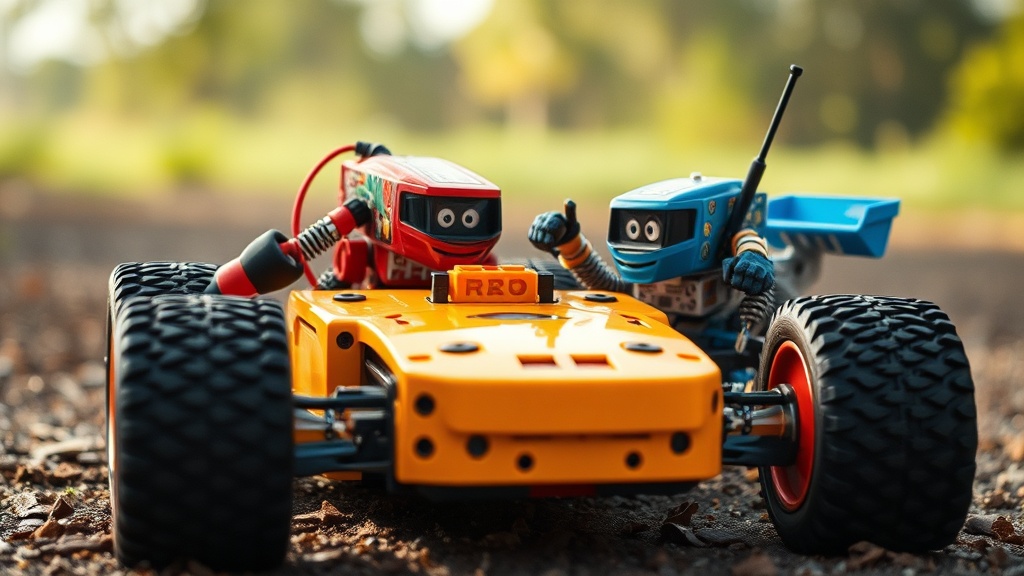
The premise was simple: six teams of toy engineers, each given a strict deadline and creative freedom, built custom RC cars from scratch. Those cars then competed across three brutal arenas — a dirt rally track, a soccer cage, and a king-of-the-hill platform. Only one car could win. The rest met a shredder called Mount Crunchmore. What sounds like entertainment is, beneath the surface, a remarkably honest portrait of how engineering decisions made under pressure play out in the real world.
The Six RC Car Designs and What They Tell Us About Engineering Philosophy
Each team's car was a physical argument about what matters most in a competition where the rules were deliberately vague. That ambiguity was not an oversight — it was the whole point. When you do not know exactly what you will face, you have to make a philosophical bet on which qualities will matter most.
Squirt the Lemon (Team Lemon) made a bet on psychological warfare. A fiberglass lemon shell concealing a lemon juice delivery system targeting opposing drivers, not opposing cars, was a genuinely lateral piece of thinking. It acknowledged that in human-controlled RC competition, the operator is as much a vulnerability as the machine. Sticky, stinging lemon juice in the eyes is not a technical attack — it is an environmental one. Clever, if eventually penalised.
Wedgie (Team Wedgie) went for mechanical function: an aluminium plasma-cut wedge scoop, spikes, and a front-mounted laser for reading terrain grade. This is the classic combat robotics playbook. Low profile, hard geometry, designed to get under opponents and flip them. It is the same logic that has dominated BattleBots for decades.
Metal Puppy (Team Metal Puppy) concealed its most dangerous feature behind deliberately cute aesthetics. The "friendly dog" framing masked a combat-robotics-grade motor capable of spinning a contact tip at 18 miles per hour. This is a well-understood strategy in product design too — disarming presentation that obscures serious capability. Metal Puppy ultimately won the tournament, which suggests the strategy paid off in more ways than one.
Yee-Haw brought a lasso mechanism capable of both grabbing and smashing opponents — a dual-mode weapon that prioritised versatility. The hidden back compartment hinted at further surprises, though the car was eliminated before all its cards were played.
Love Bug went in the opposite direction entirely: all steel, maximum weight, no apologies. The heaviest car in the field, it was built around one core insight — inertia wins king-of-the-hill. That bet proved correct. Love Bug dominated the final platform event through sheer mass, barely needing to manoeuvre to repel lighter opponents.
Park the Pig was the wildcard. Four soccer balls forming the chassis for maximum bounciness was an unconventional structural choice that gave it surprising resilience — it was the only car to cleanly clear a mud pit in the rally stage — but ultimately the design lacked the offensive capability to survive elimination rounds.
Rapid Prototyping Under Pressure: What a Few Days Really Reveals
One of the most honest things about this competition is the timeline. A few days to design, build, and test an RC car that will face unknown challenges is not a comfortable engineering window. It is, however, a brutally effective filter for identifying which ideas are robust and which ones depend on perfect conditions.
Rapid prototyping under hard deadlines forces engineers to make explicit trade-offs that longer timelines allow you to defer. You cannot over-engineer everything when time is short. You have to pick your hill — literally, in this case — and commit. Team Love Bug committed to weight and structural integrity. Team Metal Puppy committed to a devastating hidden weapon. Both of those singular commitments carried their cars deep into the competition.
The teams that struggled were those whose designs spread their bets too thin or relied on features that worked in isolation but not under competitive stress. This mirrors what product development teams discover repeatedly in industry: a product with one exceptional quality almost always outperforms a product that is merely good at everything.
The Role of Terrain and Unknown Variables in Design
Science Bob's three-arena dirt track was not a neutral testing ground. It was an active opponent. The mud pits, the BB floor scatter zone, the pneumatic launching doors that Mark Rober triggered remotely — all of these introduced variables that no team could have fully anticipated during their build phase.
This is intentional and important. Real-world engineering almost never operates in the conditions you designed for. RC cars, robots, consumer electronics, civil infrastructure — all of them eventually meet their own version of the mud pit. The question is not whether your design will face unexpected stress, but whether it has enough core resilience to survive it.
Metal Puppy's self-righting motor was arguably the single best design feature in the entire competition precisely because it addressed the unknown. The team did not know exactly what would knock their car over, but they knew something would. So they built in recovery. That kind of anticipatory design thinking — planning not for success but for the recovery from failure — is a mark of mature engineering.
Ghost Cars and Second-Order Effects: A Lesson in Systems Thinking
The introduction of ghost cars in the final round — driven by previously eliminated teams who had grudges to settle — was more than a dramatic twist. It introduced what engineers and game theorists call second-order effects: consequences that emerge not from direct action but from the interactions between multiple agents in a system.
Love Bug could dominate Metal Puppy one-on-one. But Love Bug plus ghost cars targeting Love Bug while Metal Puppy recovered was a different system entirely. The car that won was not necessarily the one best designed for a two-car duel — it was the one that could handle a chaotic multi-agent environment. Metal Puppy's self-righting capability and relatively compact footprint made it harder to pin down in the chaos.
This has a direct parallel in product and systems design. Designing for your primary use case is necessary but not sufficient. The systems your product lives inside — users, competitors, environment, time — will generate interactions you did not model. The most resilient designs have slack built in for exactly those moments.
Why Failure Is the Most Valuable Output of This Kind of Competition
Every car that got shredded produced something more valuable than the cars that won: a clear, unambiguous data point about what did not work. Park the Pig's soccer ball chassis was bouncy and charming but could not generate the directional force needed in the soccer event. Yee-haw's lasso mechanism was creative but the car lacked the chassis stability to deploy it reliably on rough terrain. Squirt's lemon juice weapon was genuinely innovative but cost the team momentum at critical moments.
None of these are reasons to dismiss those designs. They are reasons to iterate. The engineering design process is explicitly iterative — you build, test, observe failure, and redesign. The Dirt Box Derby compressed that cycle into a single public event, which meant the failure was visible and immediate rather than quiet and internal. That is actually a healthier relationship with failure than most professional environments allow.
Mark Rober has built an entire content and education brand around this principle: failure is not the opposite of success in engineering, it is a required step toward it. The shredder at Mount Crunchmore is dramatic, but the real message it carries is that every eliminated car represents a hypothesis that was tested and refined.
What RC Car Engineering Teaches Us About Creativity With Constraints
Free Weekly Newsletter
Enjoying this guide?
Get the best articles like this one delivered to your inbox every week. No spam.
The Dirt Box Derby is ultimately a study in constrained creativity — one of the most productive conditions for innovation that exists. Every team had the same basic resources, the same deadline, and the same rules. The differences in output were entirely a function of imagination, prioritisation, and execution.
Constraints force decisions. Decisions reveal values. The team that decided the most important thing was driver disruption built a lemon that squirts juice. The team that decided the most important thing was survival under chaos built a self-righting dog. Neither was wrong — they were just different bets on what the competition would reward.
This is why constrained creative challenges — hackathons, design sprints, competition builds, game jams — remain among the most effective tools for pushing creative and technical thinking forward. They do not give you time to find the perfect answer. They force you to commit to your best current answer and then learn from what happens next.
Building Smarter: Key Takeaways From the Dirt Box Derby
Whether you are a hobbyist RC enthusiast, an engineering student, or a product designer, the Dirt Box Derby offers a handful of principles worth keeping:
- One exceptional feature beats five average ones. Metal Puppy's self-righting motor and Love Bug's mass each won individual events by being the best at one thing.
- Design for recovery, not just performance. The ability to get back up is often more valuable than the ability to never fall.
- Unknown variables are guaranteed. Build in resilience for the scenarios you cannot predict, not just the ones you can.
- Your operator is part of your system. Squirt's lemon juice attack on drivers was unsportsmanlike but conceptually sound — humans are the weakest link in human-controlled systems.
- Failure is data. Treat every eliminated design as a answered question, not a wasted effort.
The cars are gone. Mount Crunchmore claimed most of them. But the engineering thinking that went into building them — and the visible, honest lessons from watching them compete — outlasts any single competition.
Frequently Asked Questions
What was the Dirt Box Derby and who organised it?
The Dirt Box Derby was an RC car competition organised by Mark Rober as part of his CrunchLabs platform. Six teams of toy engineers built custom RC cars from scratch in a matter of days, then competed across three distinct events: a dirt rally race, a soccer cage match, and a king-of-the-hill platform battle. The event was held in the CrunchLabs warehouse, which was transformed into a multi-arena dirt track by Science Bob.
Which RC car won the CrunchLabs Dirt Box Derby?
Metal Puppy, built by engineers Evan and Bam, won the overall competition. The car was designed to look like a friendly dog but concealed a combat-robotics-grade spinning motor capable of reaching 18 miles per hour at the contact tip. Crucially, it was also equipped with a self-righting mechanism that allowed it to recover from knockdowns — a feature that proved decisive throughout the tournament.
What engineering principles does RC car combat demonstrate?
RC car combat is a practical demonstration of several core engineering principles, including the trade-off between offensive and defensive capability, the value of rapid prototyping, the importance of designing for unknown variables, and the role of resilience over raw performance. Competitions like the Dirt Box Derby also illustrate how constrained creativity — limited time, limited resources, open-ended rules — often produces more innovative solutions than unconstrained design environments.
How does rapid prototyping under time pressure affect design quality?
Time pressure in prototyping forces engineers to make explicit prioritisation decisions rather than deferring trade-offs. This typically results in designs that are highly optimised for one or two key qualities rather than uniformly good across all dimensions. Research and practical experience in product development consistently show that focused, singular design bets often outperform hedged, do-everything designs — particularly in competitive or adversarial environments where your weaknesses will be actively exploited.
What is CrunchLabs and what kind of engineering content does it produce?
CrunchLabs is Mark Rober's science and engineering education company. It produces hands-on STEM subscription boxes for children and young adults, as well as original video content designed to make engineering accessible, entertaining, and genuinely educational. The platform is built around the idea that learning through building and experimentation — including learning through failure — is more effective than passive instruction.
Frequently Asked Questions
When Engineers Stop Theorising and Start Building
There is a version of engineering that lives in spreadsheets, peer-reviewed papers, and carefully controlled lab conditions. Then there is the version where you have a few days, a warehouse full of dirt, and six rival teams trying to destroy everything you just built. Mark Rober's CrunchLabs Dirt Box Derby leaned hard into the second version — and in doing so, accidentally produced one of the most instructive showcases of rapid prototyping, creative constraint, and competitive design thinking you will find outside of a university robotics programme.
The premise was simple: six teams of toy engineers, each given a strict deadline and creative freedom, built custom RC cars from scratch. Those cars then competed across three brutal arenas — a dirt rally track, a soccer cage, and a king-of-the-hill platform. Only one car could win. The rest met a shredder called Mount Crunchmore. What sounds like entertainment is, beneath the surface, a remarkably honest portrait of how engineering decisions made under pressure play out in the real world.
The Six RC Car Designs and What They Tell Us About Engineering Philosophy
Each team's car was a physical argument about what matters most in a competition where the rules were deliberately vague. That ambiguity was not an oversight — it was the whole point. When you do not know exactly what you will face, you have to make a philosophical bet on which qualities will matter most.
Squirt the Lemon (Team Lemon) made a bet on psychological warfare. A fiberglass lemon shell concealing a lemon juice delivery system targeting opposing drivers, not opposing cars, was a genuinely lateral piece of thinking. It acknowledged that in human-controlled RC competition, the operator is as much a vulnerability as the machine. Sticky, stinging lemon juice in the eyes is not a technical attack — it is an environmental one. Clever, if eventually penalised.
Wedgie (Team Wedgie) went for mechanical function: an aluminium plasma-cut wedge scoop, spikes, and a front-mounted laser for reading terrain grade. This is the classic combat robotics playbook. Low profile, hard geometry, designed to get under opponents and flip them. It is the same logic that has dominated BattleBots for decades.
Metal Puppy (Team Metal Puppy) concealed its most dangerous feature behind deliberately cute aesthetics. The "friendly dog" framing masked a combat-robotics-grade motor capable of spinning a contact tip at 18 miles per hour. This is a well-understood strategy in product design too — disarming presentation that obscures serious capability. Metal Puppy ultimately won the tournament, which suggests the strategy paid off in more ways than one.
Yee-Haw brought a lasso mechanism capable of both grabbing and smashing opponents — a dual-mode weapon that prioritised versatility. The hidden back compartment hinted at further surprises, though the car was eliminated before all its cards were played.
Love Bug went in the opposite direction entirely: all steel, maximum weight, no apologies. The heaviest car in the field, it was built around one core insight — inertia wins king-of-the-hill. That bet proved correct. Love Bug dominated the final platform event through sheer mass, barely needing to manoeuvre to repel lighter opponents.
Park the Pig was the wildcard. Four soccer balls forming the chassis for maximum bounciness was an unconventional structural choice that gave it surprising resilience — it was the only car to cleanly clear a mud pit in the rally stage — but ultimately the design lacked the offensive capability to survive elimination rounds.
Rapid Prototyping Under Pressure: What a Few Days Really Reveals
One of the most honest things about this competition is the timeline. A few days to design, build, and test an RC car that will face unknown challenges is not a comfortable engineering window. It is, however, a brutally effective filter for identifying which ideas are robust and which ones depend on perfect conditions.
Rapid prototyping under hard deadlines forces engineers to make explicit trade-offs that longer timelines allow you to defer. You cannot over-engineer everything when time is short. You have to pick your hill — literally, in this case — and commit. Team Love Bug committed to weight and structural integrity. Team Metal Puppy committed to a devastating hidden weapon. Both of those singular commitments carried their cars deep into the competition.
The teams that struggled were those whose designs spread their bets too thin or relied on features that worked in isolation but not under competitive stress. This mirrors what product development teams discover repeatedly in industry: a product with one exceptional quality almost always outperforms a product that is merely good at everything.
The Role of Terrain and Unknown Variables in Design
Science Bob's three-arena dirt track was not a neutral testing ground. It was an active opponent. The mud pits, the BB floor scatter zone, the pneumatic launching doors that Mark Rober triggered remotely — all of these introduced variables that no team could have fully anticipated during their build phase.
This is intentional and important. Real-world engineering almost never operates in the conditions you designed for. RC cars, robots, consumer electronics, civil infrastructure — all of them eventually meet their own version of the mud pit. The question is not whether your design will face unexpected stress, but whether it has enough core resilience to survive it.
Metal Puppy's self-righting motor was arguably the single best design feature in the entire competition precisely because it addressed the unknown. The team did not know exactly what would knock their car over, but they knew something would. So they built in recovery. That kind of anticipatory design thinking — planning not for success but for the recovery from failure — is a mark of mature engineering.
Ghost Cars and Second-Order Effects: A Lesson in Systems Thinking
The introduction of ghost cars in the final round — driven by previously eliminated teams who had grudges to settle — was more than a dramatic twist. It introduced what engineers and game theorists call second-order effects: consequences that emerge not from direct action but from the interactions between multiple agents in a system.
Love Bug could dominate Metal Puppy one-on-one. But Love Bug plus ghost cars targeting Love Bug while Metal Puppy recovered was a different system entirely. The car that won was not necessarily the one best designed for a two-car duel — it was the one that could handle a chaotic multi-agent environment. Metal Puppy's self-righting capability and relatively compact footprint made it harder to pin down in the chaos.
This has a direct parallel in product and systems design. Designing for your primary use case is necessary but not sufficient. The systems your product lives inside — users, competitors, environment, time — will generate interactions you did not model. The most resilient designs have slack built in for exactly those moments.
Why Failure Is the Most Valuable Output of This Kind of Competition
Every car that got shredded produced something more valuable than the cars that won: a clear, unambiguous data point about what did not work. Park the Pig's soccer ball chassis was bouncy and charming but could not generate the directional force needed in the soccer event. Yee-haw's lasso mechanism was creative but the car lacked the chassis stability to deploy it reliably on rough terrain. Squirt's lemon juice weapon was genuinely innovative but cost the team momentum at critical moments.
None of these are reasons to dismiss those designs. They are reasons to iterate. The engineering design process is explicitly iterative — you build, test, observe failure, and redesign. The Dirt Box Derby compressed that cycle into a single public event, which meant the failure was visible and immediate rather than quiet and internal. That is actually a healthier relationship with failure than most professional environments allow.
Mark Rober has built an entire content and education brand around this principle: failure is not the opposite of success in engineering, it is a required step toward it. The shredder at Mount Crunchmore is dramatic, but the real message it carries is that every eliminated car represents a hypothesis that was tested and refined.
What RC Car Engineering Teaches Us About Creativity With Constraints
The Dirt Box Derby is ultimately a study in constrained creativity — one of the most productive conditions for innovation that exists. Every team had the same basic resources, the same deadline, and the same rules. The differences in output were entirely a function of imagination, prioritisation, and execution.
Constraints force decisions. Decisions reveal values. The team that decided the most important thing was driver disruption built a lemon that squirts juice. The team that decided the most important thing was survival under chaos built a self-righting dog. Neither was wrong — they were just different bets on what the competition would reward.
This is why constrained creative challenges — hackathons, design sprints, competition builds, game jams — remain among the most effective tools for pushing creative and technical thinking forward. They do not give you time to find the perfect answer. They force you to commit to your best current answer and then learn from what happens next.
Building Smarter: Key Takeaways From the Dirt Box Derby
Whether you are a hobbyist RC enthusiast, an engineering student, or a product designer, the Dirt Box Derby offers a handful of principles worth keeping:
- One exceptional feature beats five average ones. Metal Puppy's self-righting motor and Love Bug's mass each won individual events by being the best at one thing.
- Design for recovery, not just performance. The ability to get back up is often more valuable than the ability to never fall.
- Unknown variables are guaranteed. Build in resilience for the scenarios you cannot predict, not just the ones you can.
- Your operator is part of your system. Squirt's lemon juice attack on drivers was unsportsmanlike but conceptually sound — humans are the weakest link in human-controlled systems.
- Failure is data. Treat every eliminated design as a answered question, not a wasted effort.
The cars are gone. Mount Crunchmore claimed most of them. But the engineering thinking that went into building them — and the visible, honest lessons from watching them compete — outlasts any single competition.
Frequently Asked Questions
What was the Dirt Box Derby and who organised it?
The Dirt Box Derby was an RC car competition organised by Mark Rober as part of his CrunchLabs platform. Six teams of toy engineers built custom RC cars from scratch in a matter of days, then competed across three distinct events: a dirt rally race, a soccer cage match, and a king-of-the-hill platform battle. The event was held in the CrunchLabs warehouse, which was transformed into a multi-arena dirt track by Science Bob.
Which RC car won the CrunchLabs Dirt Box Derby?
Metal Puppy, built by engineers Evan and Bam, won the overall competition. The car was designed to look like a friendly dog but concealed a combat-robotics-grade spinning motor capable of reaching 18 miles per hour at the contact tip. Crucially, it was also equipped with a self-righting mechanism that allowed it to recover from knockdowns — a feature that proved decisive throughout the tournament.
What engineering principles does RC car combat demonstrate?
RC car combat is a practical demonstration of several core engineering principles, including the trade-off between offensive and defensive capability, the value of rapid prototyping, the importance of designing for unknown variables, and the role of resilience over raw performance. Competitions like the Dirt Box Derby also illustrate how constrained creativity — limited time, limited resources, open-ended rules — often produces more innovative solutions than unconstrained design environments.
How does rapid prototyping under time pressure affect design quality?
Time pressure in prototyping forces engineers to make explicit prioritisation decisions rather than deferring trade-offs. This typically results in designs that are highly optimised for one or two key qualities rather than uniformly good across all dimensions. Research and practical experience in product development consistently show that focused, singular design bets often outperform hedged, do-everything designs — particularly in competitive or adversarial environments where your weaknesses will be actively exploited.
What is CrunchLabs and what kind of engineering content does it produce?
CrunchLabs is Mark Rober's science and engineering education company. It produces hands-on STEM subscription boxes for children and young adults, as well as original video content designed to make engineering accessible, entertaining, and genuinely educational. The platform is built around the idea that learning through building and experimentation — including learning through failure — is more effective than passive instruction.
About Zeebrain Editorial
Zeebrain publishes independent analysis of markets, investing, personal finance, and business. We disclose affiliate relationships, never accept payment for coverage, and fact-check all claims against primary sources. Read our editorial policy →
How this article was produced: Zeebrain articles are created with AI assistance from primary sources (including cited videos and market data) and reviewed under our editorial standards before publication. Spot an error? Tell us and we will correct it.
More from Science & Tech


Related Guides
Keep exploring this topic
Engineer the Perfect First Date: Science-Backed Dating Tips
Science & Tech · first date tips · dating science
ChatGPT Tips and Tricks: Mastering the Art of Conversational AI
Science & Tech
Microsoft Copilot Meets DeepSeek: The Multimodel AI Shift
Science & Tech
Is This The Future of Energy? (Fusion Explained)
Science & Tech
Explore More Categories
Keep browsing by topic and build depth around the subjects you care about most.