Henry VIII: The King Who Broke the World for Love
Quick Summary
Henry VIII wasn't born a tyrant. Discover how ambition, desire, and political chaos transformed England's golden prince into history's most infamous king.
In This Article
The Boy Who Was Never Meant to Be King
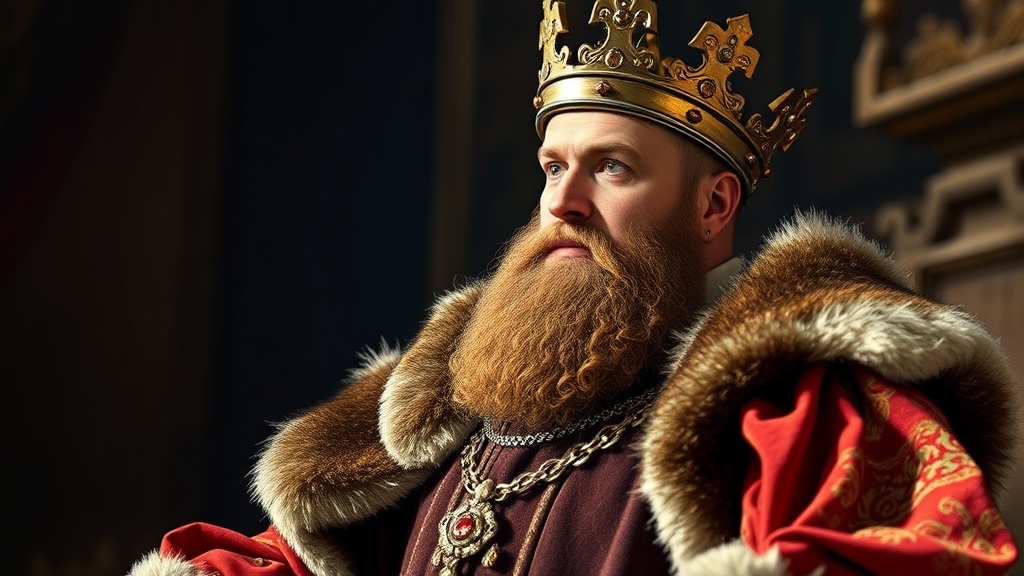
History has a way of building its monsters slowly. Henry VIII — the barrel-chested, wife-discarding, church-shattering colossus of Tudor England — did not arrive on the throne as the man we remember. He arrived as a teenager. Charming, educated, devastatingly handsome, and burning with the kind of idealism that only the very young and the very lucky ever get to carry. The tragedy of Henry VIII is not simply that he became a tyrant. It is that he so very nearly didn't.
To understand Henry VIII properly, you have to begin with what he was not supposed to be. He was the spare, not the heir. His older brother Arthur was the crown prince — groomed, betrothed, and polished for kingship from birth. Henry grew up in relative obscurity at Eltham Palace, educated by some of the finest minds in Europe, learning Latin, theology, music, and languages with a natural ease that astonished his tutors. The poet John Skelton, appointed as one of his instructors, wrote Henry a textbook of moral lessons that still survives today. Among its guidance: do not be mean, shun gluttony, and — one assumes this required emphasis — do not violate widows. Promising material for a future king. Less promising in retrospect.
But Arthur died in 1502, just months after his marriage to Catherine of Aragon. The alliance with Spain, so carefully constructed by their father Henry VII, suddenly dangled by a thread. And the spare — bookish, brilliant, overlooked Henry — stepped blinking into the light of succession.
A Golden King in a Gilded Cage
When Henry VIII was crowned in 1509 at eighteen years old, England exhaled. His father, Henry VII, had ruled with the cold paranoia of a man who had clawed his way to a throne through civil war and never quite forgot it. He levied ruinous fines against nobility, bishops, and barons alike with almost casual cruelty. When he died, the celebrations were not quiet.
His son seemed to be everything the old king was not. Young Henry was Renaissance England made flesh — athletic, intellectual, generous, and startlingly good-looking. Contemporary accounts describe a king who composed music, danced with abandon, jousted with reckless enthusiasm, and welcomed scholars and artists to his court with genuine warmth. He married Catherine of Aragon not because politics demanded it, though it did, but because he genuinely wanted to. Historians have noted that their early marriage was, by the standards of medieval monarchy, remarkably loving.
And yet even in these golden days, the shape of what was to come was already forming. Henry wanted war — specifically, he wanted glory in France, that ancient English obsession, the theatre where English kings had traditionally carved their reputations. His council, wise and cautious men inherited from his father, hemmed him in. They controlled the royal seals. They managed the money. They told him jousting was too dangerous.
It took a politically ambitious churchman named Thomas Wolsey to show Henry what ought to have been obvious from the start: he was the king. He could do whatever he wanted.
War, Glory, and the Limits of Ambition
Wolsey's rise is one of the more instructive subplots of Henry's reign. A butcher's son from Ipswich who became a Cardinal, Lord Chancellor, and the most powerful man in England after the king himself, Wolsey understood that his survival depended entirely on keeping Henry happy. He helped Henry circumvent his own council, encouraged him toward war with France, and largely managed the machinery of government while Henry hunted, feasted, and dreamed of conquest.
The wars themselves were a study in frustrated ambition. Henry won genuine victories — the Battle of the Spurs in 1513 was a real military triumph, and Catherine of Aragon, governing from home, led England to a crushing defeat of Scotland at Flodden that same year. For a moment, everything glittered.
But war is expensive, allies are unreliable, and Holy Roman Emperor Charles V — that extraordinary product of royal inbreeding, possessor of the most architecturally ambitious chin in European history — proved to be a deeply frustrating partner. Henry committed troops. Charles delayed. Henry committed again. Charles delayed again. When Charles finally destroyed the French at the Battle of Pavia in 1525 and captured the French king, he had no further use for Henry's ambitions and said so plainly. The dream of a French throne evaporated.
Henry was home, heavy with disappointment, and Catherine of Aragon had still not produced a male heir.
Anne Boleyn and the Machinery of Desire
It would be dishonest to pretend that Henry VIII's break with Rome was purely theological. It was, in significant part, hormonal. Anne Boleyn — one of Catherine's ladies-in-waiting, brilliant, sharp-tongued, and possessed of what contemporaries described as a magnetic, unconventional beauty — understood her leverage and used it with extraordinary precision.
Henry had taken mistresses before, including Anne's own sister. But Anne refused the role of royal side piece. She wanted the crown, and she was prepared to wait for it. Henry's letters to her, some of which survive, are extraordinary documents — raw with longing, almost adolescent in their desperation. In one, he writes of wanting to kiss her 'pretty duckies,' a phrase that has delighted historians for centuries and says rather more about the king's mental state than any political manifesto could.
With Anne whispering Protestant sympathies in one ear and wounded pride filling the other, Henry turned to Pope Clement VII for an annulment of his marriage to Catherine. His theological case was not without merit — he argued that the original papal dispensation allowing him to marry his brother's widow had been issued in error, citing Leviticus. It was, at the very least, a coherent argument.
But Pope Clement was not a free agent. Charles V, Catherine's nephew, had his soldiers camped around Rome. The papal legate sent to England to hear the case was an elderly cardinal named Campeggio, so afflicted by gout that the journey from Rome took six months and the trial itself dragged on for two years of theatrical delays and non-decisions. In the end, the Pope simply refused.
How Henry VIII Accidentally Invented Modern England
What followed is one of the most consequential acts of personal pique in the history of Western civilisation. Henry removed England from the jurisdiction of the Roman Catholic Church. He dissolved the monasteries, redistributed their wealth, appointed himself Supreme Head of the Church of England, and in doing so, fundamentally altered the religious, political, and cultural identity of a nation.
The arguments his theologians assembled were clever and, in their way, genuinely interesting. They claimed that papal authority over the English church was a historical usurpation — that the original English church had been self-governing, and Rome had simply expanded its influence over centuries of institutional creep. It was a nationalist argument dressed in ecclesiastical language, and it resonated. Some historians have drawn a straight, if winding, line from this moment to England's deep-seated suspicion of continental authority — a thread that runs, remarkably, all the way to Brexit.
Wolsey, who had failed to deliver the annulment, was stripped of his offices. He died before he could be tried for treason, which was probably a mercy. Anne Boleyn finally became queen in 1533. She gave Henry a daughter — Elizabeth, who would become one of England's greatest monarchs — but not the son he had demanded so relentlessly. Within three years, Anne herself would be executed on charges of adultery and treason, charges that most historians today regard as politically manufactured.
The machinery Henry had built to destroy one marriage would be used again and again.
The Weight of the Crown
The Henry VIII who died in 1547 was not the laughing, dancing prince who had taken the throne in 1509. He was obese, plagued by a leg wound that never healed, suspicious, and capable of breathtaking cruelty. Six wives. Two executed. One died in childbirth. Two divorced. One survived him. Thousands executed during the dissolution of the monasteries and the political purges that followed.
Free Weekly Newsletter
Enjoying this guide?
Get the best articles like this one delivered to your inbox every week. No spam.
And yet. The Church of England endures. The English Reformation, whatever its origins in a king's desire for an annulment, produced genuine religious and intellectual change. The daughter Anne Boleyn gave him — that unwanted, dangerous girl — ruled England for forty-five years and gave her name to a golden age.
History rarely gives us clean villains or simple heroes. Henry VIII was vain, brilliant, affectionate, monstrous, charming, and terrifying, sometimes in the same afternoon. He wanted glory, stumbled into revolution, and left a country permanently altered. Whether that makes him great is a question each generation answers differently. That it makes him endlessly fascinating is beyond dispute.
Frequently Asked Questions
Was Henry VIII really considered a Renaissance man?
Absolutely. In his youth, Henry VIII was genuinely celebrated across Europe as an intellectual and cultural polymath. He spoke multiple languages including Latin, French, and Spanish. He composed music — the song Pastime with Good Company is attributed to him — played several instruments, wrote poetry, and engaged seriously with theological debate. The disconnect between this image and his later reputation as a brutish tyrant is part of what makes his story so compelling to historians.
Why couldn't Henry VIII simply divorce Catherine of Aragon without papal permission?
In sixteenth-century Catholic Europe, marriage was a sacrament administered by the Church, which meant only the Church — and ultimately the Pope — had the authority to dissolve one. Henry needed an annulment, a declaration that the marriage had never been valid in the first place, rather than a divorce in the modern sense. The complicating factor was that Pope Clement VII was effectively a prisoner of Holy Roman Emperor Charles V, who was Catherine's nephew and had every political reason to block the annulment.
Did Henry VIII actually love any of his wives?
Most historians believe he genuinely loved at least two of them. His early relationship with Catherine of Aragon was, by contemporary accounts, unusually warm and affectionate for a royal marriage of the era. His passion for Anne Boleyn, whatever its ultimate fate, was intense and undeniable — his surviving letters to her are some of the most emotionally raw documents from his reign. He is also thought to have been genuinely devoted to Jane Seymour, his third wife, who died shortly after giving birth to his long-awaited son, Edward.
How did Henry VIII's break with Rome shape modern Britain?
The consequences were enormous and long-lasting. The English Reformation that followed Henry's split with Rome fundamentally reshaped religious life, redistributed vast wealth from the monasteries to the crown and nobility, and established the monarch as the head of a national church — a constitutional arrangement that persists to this day. More broadly, the arguments used to justify the break — that England was a sovereign nation whose governance should not be subject to foreign authority — seeded a strain of English political thought that has recurred in various forms ever since, including, some historians argue, in the philosophy underpinning the Brexit movement of the twenty-first century.
Frequently Asked Questions
The Boy Who Was Never Meant to Be King
History has a way of building its monsters slowly. Henry VIII — the barrel-chested, wife-discarding, church-shattering colossus of Tudor England — did not arrive on the throne as the man we remember. He arrived as a teenager. Charming, educated, devastatingly handsome, and burning with the kind of idealism that only the very young and the very lucky ever get to carry. The tragedy of Henry VIII is not simply that he became a tyrant. It is that he so very nearly didn't.
To understand Henry VIII properly, you have to begin with what he was not supposed to be. He was the spare, not the heir. His older brother Arthur was the crown prince — groomed, betrothed, and polished for kingship from birth. Henry grew up in relative obscurity at Eltham Palace, educated by some of the finest minds in Europe, learning Latin, theology, music, and languages with a natural ease that astonished his tutors. The poet John Skelton, appointed as one of his instructors, wrote Henry a textbook of moral lessons that still survives today. Among its guidance: do not be mean, shun gluttony, and — one assumes this required emphasis — do not violate widows. Promising material for a future king. Less promising in retrospect.
But Arthur died in 1502, just months after his marriage to Catherine of Aragon. The alliance with Spain, so carefully constructed by their father Henry VII, suddenly dangled by a thread. And the spare — bookish, brilliant, overlooked Henry — stepped blinking into the light of succession.
A Golden King in a Gilded Cage
When Henry VIII was crowned in 1509 at eighteen years old, England exhaled. His father, Henry VII, had ruled with the cold paranoia of a man who had clawed his way to a throne through civil war and never quite forgot it. He levied ruinous fines against nobility, bishops, and barons alike with almost casual cruelty. When he died, the celebrations were not quiet.
His son seemed to be everything the old king was not. Young Henry was Renaissance England made flesh — athletic, intellectual, generous, and startlingly good-looking. Contemporary accounts describe a king who composed music, danced with abandon, jousted with reckless enthusiasm, and welcomed scholars and artists to his court with genuine warmth. He married Catherine of Aragon not because politics demanded it, though it did, but because he genuinely wanted to. Historians have noted that their early marriage was, by the standards of medieval monarchy, remarkably loving.
And yet even in these golden days, the shape of what was to come was already forming. Henry wanted war — specifically, he wanted glory in France, that ancient English obsession, the theatre where English kings had traditionally carved their reputations. His council, wise and cautious men inherited from his father, hemmed him in. They controlled the royal seals. They managed the money. They told him jousting was too dangerous.
It took a politically ambitious churchman named Thomas Wolsey to show Henry what ought to have been obvious from the start: he was the king. He could do whatever he wanted.
War, Glory, and the Limits of Ambition
Wolsey's rise is one of the more instructive subplots of Henry's reign. A butcher's son from Ipswich who became a Cardinal, Lord Chancellor, and the most powerful man in England after the king himself, Wolsey understood that his survival depended entirely on keeping Henry happy. He helped Henry circumvent his own council, encouraged him toward war with France, and largely managed the machinery of government while Henry hunted, feasted, and dreamed of conquest.
The wars themselves were a study in frustrated ambition. Henry won genuine victories — the Battle of the Spurs in 1513 was a real military triumph, and Catherine of Aragon, governing from home, led England to a crushing defeat of Scotland at Flodden that same year. For a moment, everything glittered.
But war is expensive, allies are unreliable, and Holy Roman Emperor Charles V — that extraordinary product of royal inbreeding, possessor of the most architecturally ambitious chin in European history — proved to be a deeply frustrating partner. Henry committed troops. Charles delayed. Henry committed again. Charles delayed again. When Charles finally destroyed the French at the Battle of Pavia in 1525 and captured the French king, he had no further use for Henry's ambitions and said so plainly. The dream of a French throne evaporated.
Henry was home, heavy with disappointment, and Catherine of Aragon had still not produced a male heir.
Anne Boleyn and the Machinery of Desire
It would be dishonest to pretend that Henry VIII's break with Rome was purely theological. It was, in significant part, hormonal. Anne Boleyn — one of Catherine's ladies-in-waiting, brilliant, sharp-tongued, and possessed of what contemporaries described as a magnetic, unconventional beauty — understood her leverage and used it with extraordinary precision.
Henry had taken mistresses before, including Anne's own sister. But Anne refused the role of royal side piece. She wanted the crown, and she was prepared to wait for it. Henry's letters to her, some of which survive, are extraordinary documents — raw with longing, almost adolescent in their desperation. In one, he writes of wanting to kiss her 'pretty duckies,' a phrase that has delighted historians for centuries and says rather more about the king's mental state than any political manifesto could.
With Anne whispering Protestant sympathies in one ear and wounded pride filling the other, Henry turned to Pope Clement VII for an annulment of his marriage to Catherine. His theological case was not without merit — he argued that the original papal dispensation allowing him to marry his brother's widow had been issued in error, citing Leviticus. It was, at the very least, a coherent argument.
But Pope Clement was not a free agent. Charles V, Catherine's nephew, had his soldiers camped around Rome. The papal legate sent to England to hear the case was an elderly cardinal named Campeggio, so afflicted by gout that the journey from Rome took six months and the trial itself dragged on for two years of theatrical delays and non-decisions. In the end, the Pope simply refused.
How Henry VIII Accidentally Invented Modern England
What followed is one of the most consequential acts of personal pique in the history of Western civilisation. Henry removed England from the jurisdiction of the Roman Catholic Church. He dissolved the monasteries, redistributed their wealth, appointed himself Supreme Head of the Church of England, and in doing so, fundamentally altered the religious, political, and cultural identity of a nation.
The arguments his theologians assembled were clever and, in their way, genuinely interesting. They claimed that papal authority over the English church was a historical usurpation — that the original English church had been self-governing, and Rome had simply expanded its influence over centuries of institutional creep. It was a nationalist argument dressed in ecclesiastical language, and it resonated. Some historians have drawn a straight, if winding, line from this moment to England's deep-seated suspicion of continental authority — a thread that runs, remarkably, all the way to Brexit.
Wolsey, who had failed to deliver the annulment, was stripped of his offices. He died before he could be tried for treason, which was probably a mercy. Anne Boleyn finally became queen in 1533. She gave Henry a daughter — Elizabeth, who would become one of England's greatest monarchs — but not the son he had demanded so relentlessly. Within three years, Anne herself would be executed on charges of adultery and treason, charges that most historians today regard as politically manufactured.
The machinery Henry had built to destroy one marriage would be used again and again.
The Weight of the Crown
The Henry VIII who died in 1547 was not the laughing, dancing prince who had taken the throne in 1509. He was obese, plagued by a leg wound that never healed, suspicious, and capable of breathtaking cruelty. Six wives. Two executed. One died in childbirth. Two divorced. One survived him. Thousands executed during the dissolution of the monasteries and the political purges that followed.
And yet. The Church of England endures. The English Reformation, whatever its origins in a king's desire for an annulment, produced genuine religious and intellectual change. The daughter Anne Boleyn gave him — that unwanted, dangerous girl — ruled England for forty-five years and gave her name to a golden age.
History rarely gives us clean villains or simple heroes. Henry VIII was vain, brilliant, affectionate, monstrous, charming, and terrifying, sometimes in the same afternoon. He wanted glory, stumbled into revolution, and left a country permanently altered. Whether that makes him great is a question each generation answers differently. That it makes him endlessly fascinating is beyond dispute.
Frequently Asked Questions
Was Henry VIII really considered a Renaissance man?
Absolutely. In his youth, Henry VIII was genuinely celebrated across Europe as an intellectual and cultural polymath. He spoke multiple languages including Latin, French, and Spanish. He composed music — the song Pastime with Good Company is attributed to him — played several instruments, wrote poetry, and engaged seriously with theological debate. The disconnect between this image and his later reputation as a brutish tyrant is part of what makes his story so compelling to historians.
Why couldn't Henry VIII simply divorce Catherine of Aragon without papal permission?
In sixteenth-century Catholic Europe, marriage was a sacrament administered by the Church, which meant only the Church — and ultimately the Pope — had the authority to dissolve one. Henry needed an annulment, a declaration that the marriage had never been valid in the first place, rather than a divorce in the modern sense. The complicating factor was that Pope Clement VII was effectively a prisoner of Holy Roman Emperor Charles V, who was Catherine's nephew and had every political reason to block the annulment.
Did Henry VIII actually love any of his wives?
Most historians believe he genuinely loved at least two of them. His early relationship with Catherine of Aragon was, by contemporary accounts, unusually warm and affectionate for a royal marriage of the era. His passion for Anne Boleyn, whatever its ultimate fate, was intense and undeniable — his surviving letters to her are some of the most emotionally raw documents from his reign. He is also thought to have been genuinely devoted to Jane Seymour, his third wife, who died shortly after giving birth to his long-awaited son, Edward.
How did Henry VIII's break with Rome shape modern Britain?
The consequences were enormous and long-lasting. The English Reformation that followed Henry's split with Rome fundamentally reshaped religious life, redistributed vast wealth from the monasteries to the crown and nobility, and established the monarch as the head of a national church — a constitutional arrangement that persists to this day. More broadly, the arguments used to justify the break — that England was a sovereign nation whose governance should not be subject to foreign authority — seeded a strain of English political thought that has recurred in various forms ever since, including, some historians argue, in the philosophy underpinning the Brexit movement of the twenty-first century.
About Zeebrain Editorial
Zeebrain publishes independent analysis of markets, investing, personal finance, and business. We disclose affiliate relationships, never accept payment for coverage, and fact-check all claims against primary sources. Read our editorial policy →
How this article was produced: Zeebrain articles are created with AI assistance from primary sources (including cited videos and market data) and reviewed under our editorial standards before publication. Spot an error? Tell us and we will correct it.
More from History & Mysteries




Related Guides
Keep exploring this topic
Explore More Categories
Keep browsing by topic and build depth around the subjects you care about most.