Handheld Laser Guns: How Close Is the Science Really?
Quick Summary
From Star Wars blasters to real military lasers, we break down the physics, engineering challenges, and latest breakthroughs in handheld laser weapon technology.
In This Article
The Dream of the Laser Gun Is Older Than You Think
The idea of a handheld laser gun has captured the human imagination for well over a century. Long before George Lucas gave Han Solo his blaster, H.G. Wells was terrifying Victorian readers with Martian heat rays, and Flash Gordon was zapping villains with ray guns on the silver screen. Today, lasers are real, they are powerful, and in some cases they are genuinely dangerous. So why does the sci-fi blaster remain firmly in the realm of fiction? The answer involves thermodynamics, atmospheric physics, battery chemistry, and a surprisingly stubborn gap between what lasers can do in a laboratory and what they could ever do strapped to a soldier's hip.

This is not a story of a technology that simply needs more time and funding. It is a story of multiple interlocking engineering problems, each formidable on its own, that together make the handheld laser gun one of the most persistently elusive goals in applied physics.
How Lasers Actually Work — And Why It Matters for Weapons
Understanding the laser gun problem starts with understanding the laser itself. The theoretical foundation was laid by Albert Einstein in 1917, when he described a process called stimulated emission: under the right conditions, a photon of electromagnetic energy can interact with an excited electron in an atom, causing it to drop an energy level and release another photon of identical frequency. Chain enough of those interactions together, and you get a coherent, focused beam of light.
It took physicists until 1953 to turn that theory into hardware. Charles Townes, James Gordon, and Herbert Zeiger at Columbia University built the first maser — Microwave Amplification by Stimulated Emission of Radiation — by bombarding ammonia molecules with microwaves inside a resonant cavity. The leap to visible light came seven years later, when engineer Theodore Maiman at Hughes Research Laboratories wrapped a synthetic ruby rod in a xenon flash lamp, placed mirrors at either end, and in May 1960 produced the first true laser beam: a pulse of 694-nanometer red light.
By 1964, Kumar Patel at Bell Labs had developed the carbon dioxide laser, which could be built into the megawatt range — powerful enough to cut and weld steel. That milestone is precisely what makes the weapon application seem tantalizingly close. If a laser can slice through metal, surely it can be pointed at an adversary? The physics says yes. The engineering says: not so fast.
The Power Problem: Why Burning Flesh Is Harder Than It Sounds
Inflicting a meaningful second-degree burn on human skin requires depositing roughly 16 joules of energy per square centimeter. Delivered over one second, that demands a minimum laser output of 16 watts. Sounds modest — until you layer in the complications.
One second is far too slow for a combat weapon. A target can move, take cover, or raise a reflective surface. To be tactically useful, a laser weapon needs to deliver its energy in milliseconds, which immediately multiplies the peak power requirement by orders of magnitude. A centimetre-wide burn is also unlikely to incapacitate anyone; a wider, more damaging beam raises power demands further. And all of this assumes bare skin. Clothing, body armour, or even a thick jacket dramatically increases the energy needed to cause any meaningful injury.
Then comes the efficiency problem. Lasers are thermodynamically wasteful devices. Roughly 80% of the electrical energy fed into a typical high-power laser is converted not into the beam but into waste heat. That 16-watt laser therefore demands approximately 82 watts of electrical input. Scale up to the kilowatt range needed for genuine stopping power and you are looking at tens of kilowatts of input power — all of which must come from batteries a soldier can actually carry.
The most energy-dense lithium metal batteries currently available offer around 720 watt-hours per kilogram. Do the arithmetic and you quickly discover that a laser powerful enough to reliably incapacitate a target would either exhaust its power supply after only a handful of shots or require a battery pack so heavy it defeats the entire purpose of a handheld weapon.
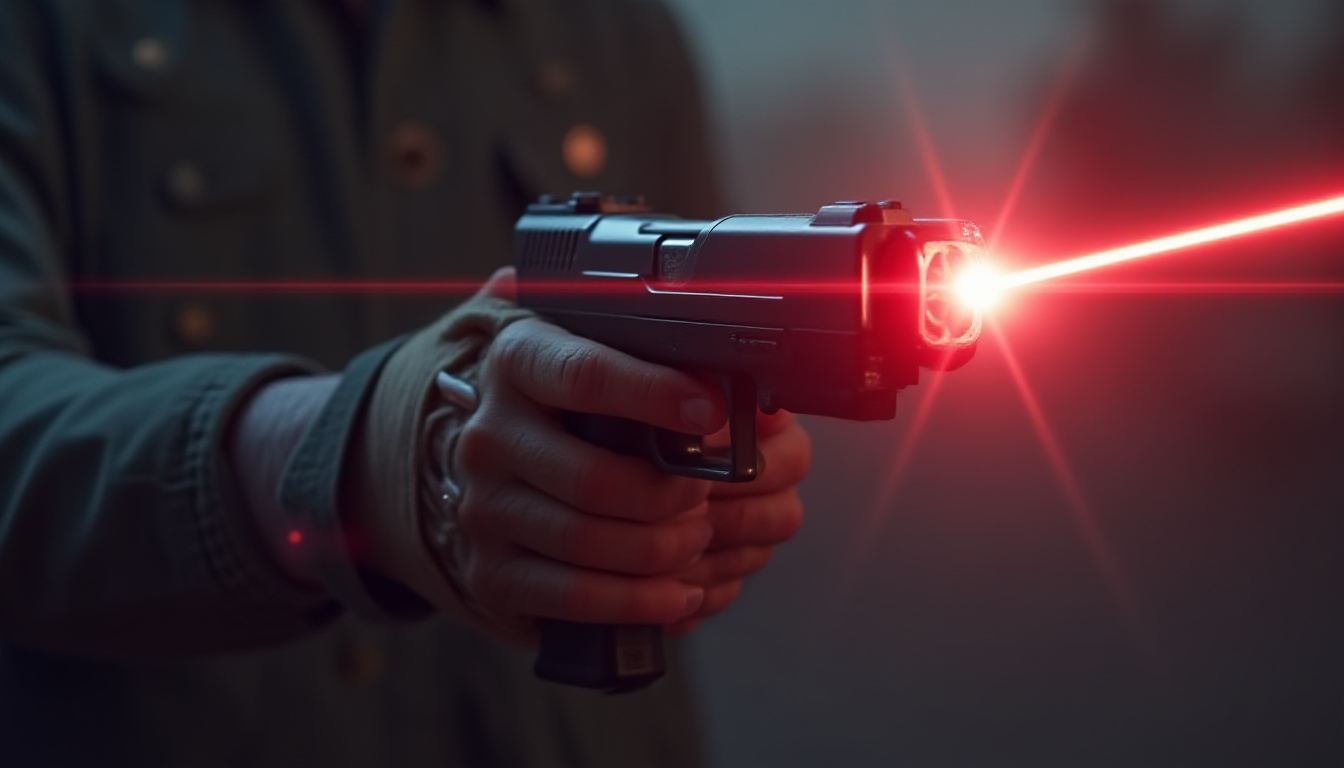
The most dramatic real-world demonstration of these limits came in 2025, when YouTuber Drake Anthony — known online as Styropyro — built a 250-watt handheld laser from an overclocked Chinese LED laser array mounted in a radar speed gun housing. The device is genuinely alarming: it ignites solid wood instantly, punches through drywall, and operates at 500 times the power level of the highest official laser safety classification. Just 0.2% of its output is enough to cause immediate, permanent blindness. And yet its practical range is only a few metres, its battery lasts minutes rather than shots, and it requires a bulky liquid cooling system to stop the waste heat from destroying its own electronics — which it did repeatedly during development.
Atmospheric Effects: The Invisible Wall No One Talks About
Even if engineers solved the battery and cooling problems overnight, a handheld laser gun would immediately run into a third category of obstacles: the atmosphere itself.
Dust, humidity, rain, and airborne particulates scatter laser light, reducing beam intensity over surprisingly short distances. More insidious is a phenomenon called thermal blooming, or thermal lensing. As a high-power beam travels through air, it heats the air molecules along its path. That heated air acts like a lens, distorting and spreading the beam — and crucially, the more powerful the laser, the worse the blooming becomes. Increasing output to compensate makes the problem worse, not better.
Engineers have proposed several countermeasures. Spreading the beam across a large curved mirror keeps local energy density low enough to avoid triggering blooming. Phased arrays of billions of tiny emitters can be steered adaptively to compensate for distortions in real time. Ultra-short pulses can reach a target before the surrounding air has time to heat up and scatter the beam. Phase-conjugate systems use a low-power guide laser to probe the optical path, then amplify returning reflections to find the least distorted route to the target.
All of these approaches work, to varying degrees, in controlled conditions. None of them are remotely compatible with a weapon you can hold in one hand and carry across a battlefield.
What Military Laser Programs Have Actually Achieved
Large-scale military laser programs have been running since the Cold War, and their history is instructive about what the technology genuinely can and cannot do.
The Soviet Union's Terra-3 and Omega programs tested ruby and carbon dioxide lasers in Kazakhstan from the 1960s onward, initially aiming to intercept the re-entry vehicles of incoming ballistic missiles. After the 1972 Anti-Ballistic Missile Treaty, the programs pivoted to anti-satellite roles, but the lasers lacked the range and accuracy to be operationally useful. In 1981, the Beriev design bureau converted a jet transport into a flying laboratory for a one-megawatt CO₂ laser. It could shoot down incoming warheads in testing, but not reliably enough or at sufficient range to constitute a credible defence system.
The United States' Strategic Defense Initiative — popularly dubbed Star Wars — pushed laser research hard through the 1980s before being cancelled in 1993. Since then, the most successful military laser weapons have been ship-mounted or vehicle-mounted systems: Lockheed Martin's HELIOS, Boeing's High Energy Laser Mobile Demonstrator, and the US Navy's Laser Weapon System have all demonstrated the ability to disable drones, small boats, and mortar rounds in field conditions. Raytheon's High Energy Laser system has been integrated onto the Army's Stryker armoured vehicle. These are real weapons, in active development and limited deployment. They are also the size of shipping containers or large vehicle turrets, and they draw power from dedicated generators.
The gap between a Stryker-mounted laser and a blaster you can holster is not a matter of incremental engineering. It represents a fundamental mismatch between the energy demands of useful laser weaponry and the physical constraints of anything a human being can carry.
Is a Handheld Laser Gun Actually Possible?
The honest answer is: not with current physics, and probably not with any physics we can foresee in the near term.
That does not mean the technology will never exist. Battery energy density is improving steadily, driven by the electric vehicle and consumer electronics industries. Laser efficiency is also improving, with some modern fibre lasers achieving wall-plug efficiencies approaching 50% — a significant improvement over the 20% typical of older designs. Room-temperature superconductors, if they ever become practical, could dramatically reduce the electrical losses in the drive systems. Advanced metamaterials might one day allow beam-shaping that mitigates thermal blooming without requiring bulky optics.
Free Weekly Newsletter
Enjoying this guide?
Get the best articles like this one delivered to your inbox every week. No spam.
But even an optimistic projection of these trends suggests that a genuinely combat-effective handheld laser weapon remains decades away, if it is achievable at all. The atmospheric effects problem in particular has no obvious near-term solution for a man-portable device. You can engineer around thermodynamics and improve battery chemistry, but you cannot engineer away the fact that air absorbs and scatters light in ways that scale badly with power.
What is far more likely in the shorter term is a generation of directed-energy weapons that occupy the middle ground: crew-served weapons light enough to be carried by a small team, vehicle-mounted systems compact enough to fit on standard military trucks, or drone-based platforms that sidestep the atmospheric problem by operating at close range or in near-vacuum at high altitude.
The Laser Gun as a Mirror for Our Technological Ambitions
There is something revealing about the persistence of the laser gun as a cultural and scientific goal. It sits at the intersection of our most optimistic assumptions about technology: that energy is infinitely manageable, that physics problems are engineering problems in disguise, and that science fiction is essentially a preview of science fact.
Sometimes that optimism is justified. The laser itself was once dismissed as a solution in search of a problem. Today it performs eye surgery, transmits internet data through fibre optic cables, measures the distance to the Moon, and guides precision munitions. The history of the laser is a history of a technology finding its applications gradually, not all at once.
The handheld blaster may follow the same trajectory — or it may remain the exception that proves the rule. Either way, understanding exactly why it is hard tells us something important not just about lasers, but about the nature of engineering ambition itself: the hardest problems are rarely the ones that look hardest from the outside.
Frequently Asked Questions
How powerful does a laser need to be to be used as a weapon?
To inflict a second-degree burn on bare skin, a laser needs to deliver approximately 16 joules per square centimetre. At a one-second exposure, that requires a minimum output of 16 watts. In practice, a combat-effective laser weapon would need to be in the kilowatt range to deposit energy fast enough to overcome evasion, clothing, and the need for a wider beam area — and would require tens of kilowatts of electrical input due to poor laser efficiency.
Why can't you just use an industrial laser as a weapon?
Industrial fibre lasers capable of cutting steel can exceed 40 kilowatts of output, but they weigh thousands of kilograms, require industrial power supplies and water-cooling systems, and are highly vulnerable to atmospheric conditions outdoors. Adapting one for handheld use would require solving battery density, thermal management, and beam propagation problems that current technology cannot address simultaneously.
What is thermal blooming and why does it matter for laser weapons?
Thermal blooming — also called thermal lensing — occurs when a high-power laser beam heats the air along its path. The warmer air has a different refractive index than the surrounding atmosphere, acting like a distorting lens that spreads and defocuses the beam. The critical problem for weapons use is that the effect worsens as laser power increases, meaning simply boosting output does not compensate for the loss in beam quality.
Are there any real handheld lasers that could injure someone today?
Yes. High-powered handheld lasers exist and are genuinely dangerous, primarily as blinding hazards. A 250-watt device built by content creator Styropyro can ignite wood and penetrate drywall, but its effective range is only a few metres and its battery life is measured in minutes. More critically, even Class 4 laser pointers available commercially can cause immediate and permanent eye damage. These devices are not weapons in any practical military sense, but they are serious safety hazards.
What is the most advanced military laser weapon currently deployed?
Several nations operate vehicle- and ship-mounted directed-energy laser systems. The US Navy's Laser Weapon System (LaWS) and Lockheed Martin's HELIOS programme represent the most mature Western deployments, capable of disabling drones, small boats, and optical sensors. These systems operate in the tens-of-kilowatts range and draw power from the ship's or vehicle's own generators. They are effective within their design parameters but bear no resemblance to a handheld weapon.
Frequently Asked Questions
The Dream of the Laser Gun Is Older Than You Think
The idea of a handheld laser gun has captured the human imagination for well over a century. Long before George Lucas gave Han Solo his blaster, H.G. Wells was terrifying Victorian readers with Martian heat rays, and Flash Gordon was zapping villains with ray guns on the silver screen. Today, lasers are real, they are powerful, and in some cases they are genuinely dangerous. So why does the sci-fi blaster remain firmly in the realm of fiction? The answer involves thermodynamics, atmospheric physics, battery chemistry, and a surprisingly stubborn gap between what lasers can do in a laboratory and what they could ever do strapped to a soldier's hip.
This is not a story of a technology that simply needs more time and funding. It is a story of multiple interlocking engineering problems, each formidable on its own, that together make the handheld laser gun one of the most persistently elusive goals in applied physics.
How Lasers Actually Work — And Why It Matters for Weapons
Understanding the laser gun problem starts with understanding the laser itself. The theoretical foundation was laid by Albert Einstein in 1917, when he described a process called stimulated emission: under the right conditions, a photon of electromagnetic energy can interact with an excited electron in an atom, causing it to drop an energy level and release another photon of identical frequency. Chain enough of those interactions together, and you get a coherent, focused beam of light.
It took physicists until 1953 to turn that theory into hardware. Charles Townes, James Gordon, and Herbert Zeiger at Columbia University built the first maser — Microwave Amplification by Stimulated Emission of Radiation — by bombarding ammonia molecules with microwaves inside a resonant cavity. The leap to visible light came seven years later, when engineer Theodore Maiman at Hughes Research Laboratories wrapped a synthetic ruby rod in a xenon flash lamp, placed mirrors at either end, and in May 1960 produced the first true laser beam: a pulse of 694-nanometer red light.
By 1964, Kumar Patel at Bell Labs had developed the carbon dioxide laser, which could be built into the megawatt range — powerful enough to cut and weld steel. That milestone is precisely what makes the weapon application seem tantalizingly close. If a laser can slice through metal, surely it can be pointed at an adversary? The physics says yes. The engineering says: not so fast.
The Power Problem: Why Burning Flesh Is Harder Than It Sounds
Inflicting a meaningful second-degree burn on human skin requires depositing roughly 16 joules of energy per square centimeter. Delivered over one second, that demands a minimum laser output of 16 watts. Sounds modest — until you layer in the complications.
One second is far too slow for a combat weapon. A target can move, take cover, or raise a reflective surface. To be tactically useful, a laser weapon needs to deliver its energy in milliseconds, which immediately multiplies the peak power requirement by orders of magnitude. A centimetre-wide burn is also unlikely to incapacitate anyone; a wider, more damaging beam raises power demands further. And all of this assumes bare skin. Clothing, body armour, or even a thick jacket dramatically increases the energy needed to cause any meaningful injury.
Then comes the efficiency problem. Lasers are thermodynamically wasteful devices. Roughly 80% of the electrical energy fed into a typical high-power laser is converted not into the beam but into waste heat. That 16-watt laser therefore demands approximately 82 watts of electrical input. Scale up to the kilowatt range needed for genuine stopping power and you are looking at tens of kilowatts of input power — all of which must come from batteries a soldier can actually carry.
The most energy-dense lithium metal batteries currently available offer around 720 watt-hours per kilogram. Do the arithmetic and you quickly discover that a laser powerful enough to reliably incapacitate a target would either exhaust its power supply after only a handful of shots or require a battery pack so heavy it defeats the entire purpose of a handheld weapon.
The most dramatic real-world demonstration of these limits came in 2025, when YouTuber Drake Anthony — known online as Styropyro — built a 250-watt handheld laser from an overclocked Chinese LED laser array mounted in a radar speed gun housing. The device is genuinely alarming: it ignites solid wood instantly, punches through drywall, and operates at 500 times the power level of the highest official laser safety classification. Just 0.2% of its output is enough to cause immediate, permanent blindness. And yet its practical range is only a few metres, its battery lasts minutes rather than shots, and it requires a bulky liquid cooling system to stop the waste heat from destroying its own electronics — which it did repeatedly during development.
Atmospheric Effects: The Invisible Wall No One Talks About
Even if engineers solved the battery and cooling problems overnight, a handheld laser gun would immediately run into a third category of obstacles: the atmosphere itself.
Dust, humidity, rain, and airborne particulates scatter laser light, reducing beam intensity over surprisingly short distances. More insidious is a phenomenon called thermal blooming, or thermal lensing. As a high-power beam travels through air, it heats the air molecules along its path. That heated air acts like a lens, distorting and spreading the beam — and crucially, the more powerful the laser, the worse the blooming becomes. Increasing output to compensate makes the problem worse, not better.
Engineers have proposed several countermeasures. Spreading the beam across a large curved mirror keeps local energy density low enough to avoid triggering blooming. Phased arrays of billions of tiny emitters can be steered adaptively to compensate for distortions in real time. Ultra-short pulses can reach a target before the surrounding air has time to heat up and scatter the beam. Phase-conjugate systems use a low-power guide laser to probe the optical path, then amplify returning reflections to find the least distorted route to the target.
All of these approaches work, to varying degrees, in controlled conditions. None of them are remotely compatible with a weapon you can hold in one hand and carry across a battlefield.
What Military Laser Programs Have Actually Achieved
Large-scale military laser programs have been running since the Cold War, and their history is instructive about what the technology genuinely can and cannot do.
The Soviet Union's Terra-3 and Omega programs tested ruby and carbon dioxide lasers in Kazakhstan from the 1960s onward, initially aiming to intercept the re-entry vehicles of incoming ballistic missiles. After the 1972 Anti-Ballistic Missile Treaty, the programs pivoted to anti-satellite roles, but the lasers lacked the range and accuracy to be operationally useful. In 1981, the Beriev design bureau converted a jet transport into a flying laboratory for a one-megawatt CO₂ laser. It could shoot down incoming warheads in testing, but not reliably enough or at sufficient range to constitute a credible defence system.
The United States' Strategic Defense Initiative — popularly dubbed Star Wars — pushed laser research hard through the 1980s before being cancelled in 1993. Since then, the most successful military laser weapons have been ship-mounted or vehicle-mounted systems: Lockheed Martin's HELIOS, Boeing's High Energy Laser Mobile Demonstrator, and the US Navy's Laser Weapon System have all demonstrated the ability to disable drones, small boats, and mortar rounds in field conditions. Raytheon's High Energy Laser system has been integrated onto the Army's Stryker armoured vehicle. These are real weapons, in active development and limited deployment. They are also the size of shipping containers or large vehicle turrets, and they draw power from dedicated generators.
The gap between a Stryker-mounted laser and a blaster you can holster is not a matter of incremental engineering. It represents a fundamental mismatch between the energy demands of useful laser weaponry and the physical constraints of anything a human being can carry.
Is a Handheld Laser Gun Actually Possible?
The honest answer is: not with current physics, and probably not with any physics we can foresee in the near term.
That does not mean the technology will never exist. Battery energy density is improving steadily, driven by the electric vehicle and consumer electronics industries. Laser efficiency is also improving, with some modern fibre lasers achieving wall-plug efficiencies approaching 50% — a significant improvement over the 20% typical of older designs. Room-temperature superconductors, if they ever become practical, could dramatically reduce the electrical losses in the drive systems. Advanced metamaterials might one day allow beam-shaping that mitigates thermal blooming without requiring bulky optics.
But even an optimistic projection of these trends suggests that a genuinely combat-effective handheld laser weapon remains decades away, if it is achievable at all. The atmospheric effects problem in particular has no obvious near-term solution for a man-portable device. You can engineer around thermodynamics and improve battery chemistry, but you cannot engineer away the fact that air absorbs and scatters light in ways that scale badly with power.
What is far more likely in the shorter term is a generation of directed-energy weapons that occupy the middle ground: crew-served weapons light enough to be carried by a small team, vehicle-mounted systems compact enough to fit on standard military trucks, or drone-based platforms that sidestep the atmospheric problem by operating at close range or in near-vacuum at high altitude.
The Laser Gun as a Mirror for Our Technological Ambitions
There is something revealing about the persistence of the laser gun as a cultural and scientific goal. It sits at the intersection of our most optimistic assumptions about technology: that energy is infinitely manageable, that physics problems are engineering problems in disguise, and that science fiction is essentially a preview of science fact.
Sometimes that optimism is justified. The laser itself was once dismissed as a solution in search of a problem. Today it performs eye surgery, transmits internet data through fibre optic cables, measures the distance to the Moon, and guides precision munitions. The history of the laser is a history of a technology finding its applications gradually, not all at once.
The handheld blaster may follow the same trajectory — or it may remain the exception that proves the rule. Either way, understanding exactly why it is hard tells us something important not just about lasers, but about the nature of engineering ambition itself: the hardest problems are rarely the ones that look hardest from the outside.
Frequently Asked Questions
How powerful does a laser need to be to be used as a weapon?
To inflict a second-degree burn on bare skin, a laser needs to deliver approximately 16 joules per square centimetre. At a one-second exposure, that requires a minimum output of 16 watts. In practice, a combat-effective laser weapon would need to be in the kilowatt range to deposit energy fast enough to overcome evasion, clothing, and the need for a wider beam area — and would require tens of kilowatts of electrical input due to poor laser efficiency.
Why can't you just use an industrial laser as a weapon?
Industrial fibre lasers capable of cutting steel can exceed 40 kilowatts of output, but they weigh thousands of kilograms, require industrial power supplies and water-cooling systems, and are highly vulnerable to atmospheric conditions outdoors. Adapting one for handheld use would require solving battery density, thermal management, and beam propagation problems that current technology cannot address simultaneously.
What is thermal blooming and why does it matter for laser weapons?
Thermal blooming — also called thermal lensing — occurs when a high-power laser beam heats the air along its path. The warmer air has a different refractive index than the surrounding atmosphere, acting like a distorting lens that spreads and defocuses the beam. The critical problem for weapons use is that the effect worsens as laser power increases, meaning simply boosting output does not compensate for the loss in beam quality.
Are there any real handheld lasers that could injure someone today?
Yes. High-powered handheld lasers exist and are genuinely dangerous, primarily as blinding hazards. A 250-watt device built by content creator Styropyro can ignite wood and penetrate drywall, but its effective range is only a few metres and its battery life is measured in minutes. More critically, even Class 4 laser pointers available commercially can cause immediate and permanent eye damage. These devices are not weapons in any practical military sense, but they are serious safety hazards.
What is the most advanced military laser weapon currently deployed?
Several nations operate vehicle- and ship-mounted directed-energy laser systems. The US Navy's Laser Weapon System (LaWS) and Lockheed Martin's HELIOS programme represent the most mature Western deployments, capable of disabling drones, small boats, and optical sensors. These systems operate in the tens-of-kilowatts range and draw power from the ship's or vehicle's own generators. They are effective within their design parameters but bear no resemblance to a handheld weapon.
About Zeebrain Editorial
Zeebrain publishes independent analysis of markets, investing, personal finance, and business. We disclose affiliate relationships, never accept payment for coverage, and fact-check all claims against primary sources. Read our editorial policy →
How this article was produced: Zeebrain articles are created with AI assistance from primary sources (including cited videos and market data) and reviewed under our editorial standards before publication. Spot an error? Tell us and we will correct it.
More from Curiosities




Related Guides
Keep exploring this topic
Explore More Categories
Keep browsing by topic and build depth around the subjects you care about most.