The Bahia Emerald: The Impossible Gem With a Restraining Order
Quick Summary
The Bahia Emerald weighs 340kg, shouldn't exist geologically, and has spent 25 years locked in an LA vault. Here's the full story of the world's strangest gemstone.
In This Article
The Rock That Broke the Rules of Geology — and the Law
Somewhere in a high-security vault in Los Angeles sits a 340-kilogram chunk of rock studded with the largest emerald crystals ever found. It has survived Hurricane Katrina, a fake kidnapping by 'Brazilian warlords', an attempted eBay auction, and a bid from Bernie Madoff. It has been claimed by at least fourteen different people and the government of Brazil. And at one point, a US federal court issued it a restraining order — not on any of the people fighting over it, but on the rock itself.

This is the Bahia Emerald. And before we even get to the legal chaos, the geology alone is enough to make your head spin. Because by every rule Earth is supposed to follow, this gem should not exist.
Why Emeralds Are Geologically Impossible
Emeralds are a variety of the mineral beryl — hexagonal, prismatic crystals coloured vivid green by the presence of chromium and vanadium. That sounds simple enough. But the problem lies in where those ingredients come from.
Beryllium, the metal ion essential to all beryl minerals, is found in the upper crust. It's a small, light ion that gets squeezed out of solidifying magma relatively early, concentrating near the surface as everything else crystallises below it. Chromium and vanadium, on the other hand, are heavy, highly charged ions that settle deep — locked into dense minerals formed early in magma cooling, sitting in the mantle or deep crust. The two groups of elements are often separated by tens or even hundreds of kilometres of solid rock.
Getting them to meet in a single crystal isn't just unlikely. According to standard geological logic, it essentially shouldn't happen.
And yet, in very specific conditions, it does. The ancient basement bedrock in Bahia, Brazil, is made from ultramafic rock — dark, iron-rich material from the deepest crust, rich in chromium. More than two billion years ago, this rock was intruded by a massive magma body containing large concentrations of beryllium. Normally, even then, the two elements would stay in their respective domains. But at the contact zone between the magma and the host rock — where intense heat triggered a process called contact metamorphism — superheated fluids flowed between the two rock types, carrying dissolved elements across the boundary. Beryllium migrated toward the chromium-rich rock. The two elements combined, crystallised, and produced emeralds of extraordinary size and quality.
That dark, black, unremarkable-looking mass surrounding the Bahia Emerald's crystals? That's the ancient ultramafic host rock. It's not just a container — it's the geological co-author of the gemstone itself. To a trained eye, it tells the entire story of how something impossible came to be.
How a 340-Kilogram Emerald Ended Up Under a Tarp in a Carport
In 2001, two American businessmen — Tony Thomas and Ken Conetto — flew to the Carnaíba mining district in Bahia on a financial Hail Mary. Their startup was failing. Their plan was to acquire $25 million in emeralds, use them as collateral for a $100 million loan, and leverage that into a high-return investment. Bold, if nothing else.
The shop they'd been promised turned out to be, by most accounts, a shambles. But the Brazilian dealers had something else to show them. Under a tarp, in a carport, sat the Bahia Emerald. The asking price was $60,000 — a figure that would later become a key data point in years of litigation, given that some would later claim the stone was worth $75 million or more.
A month after the visit, Thomas wired $60,000 to Brazil. What exactly that payment was for has been disputed ever since. He claimed it was for the Bahia Emerald. Court documents suggested it was for the original, smaller stones they'd gone there to buy. The emerald, Thomas then said, had gone missing in transit — a claim he never reported to authorities.
This was, as it turned out, false. The stone arrived in San Jose, California in 2005, shipped via FedEx with customs paperwork declaring its contents as either an ordinary rock or possibly a piece of concrete, with a listed value somewhere between $100 and zero.
A Quarter-Century of Legal Chaos
What followed is one of the stranger ownership sagas in the history of valuable objects. After arriving in California, the Bahia Emerald moved to a storage facility in New Orleans — arriving just in time for Hurricane Katrina, which submerged it for weeks. It then passed through the hands of a middleman named Larry Biegler, a Florida gem dealer who tried to use it as collateral in a diamond transaction, and eventually a Mormon investor from Idaho who put down $1.3 million for a stake in selling it.
At one point, the stone was listed on eBay with a minimum auction bid of $19 million and a buy-it-now price of $75 million. A buyer reportedly offered $127 million in a combination of cash, diamonds, and watches. That buyer was Bernie Madoff — who was, at the time, running the largest Ponzi scheme in history, so the deal unsurprisingly went nowhere.
Biegler eventually vanished, claiming to have been kidnapped by Brazilian warlords and demanding a ransom. The stone was subsequently reported stolen, recovered with the assistance of a SWAT team and helicopter by the LA County Sheriff's Department, and locked in a vault pending legal resolution.
Eight years of litigation produced a tentative ruling in favour of the Florida and Idaho claimants — only for the US Department of Justice to intervene on behalf of the Brazilian government, which argued that the original miners had no legal mining rights in the region and therefore had no right to sell the emerald in the first place. The DOJ filed a restraining order — not on any individual, but on the stone itself, invoking an obscure legal mechanism that allows the US government to freeze private property when a foreign government has laid an international claim to it.
What Is the Bahia Emerald Actually Worth?
This is a harder question than it sounds, and not just because of the unusual circumstances of the stone's history.
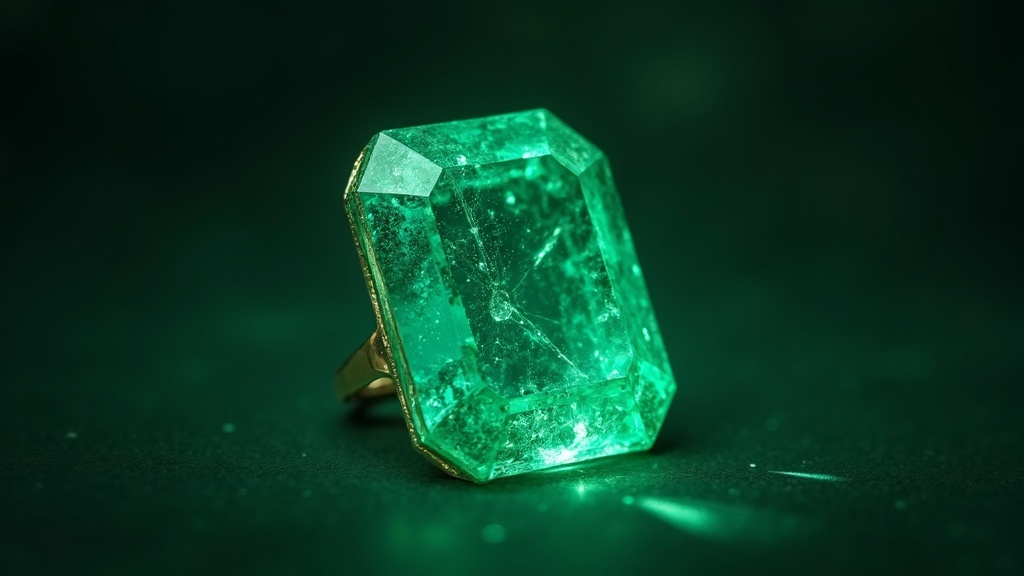
Emeralds are notoriously difficult to value. Unlike diamonds, where cut, clarity, carat weight, and colour produce relatively consistent pricing benchmarks, emeralds are almost never pure. The chaotic geological process that creates them also fills them with tiny fractures, gas bubbles, and mineral inclusions — collectively known in the trade as jardin, from the French word for garden. A stone's jardin is actually considered proof of authenticity; synthetic or treated stones rarely show the same organic complexity. But jardin also makes emeralds fragile. Heavily included stones are more likely to crack during cutting or setting, which significantly reduces their commercial value for jewellery.
The Bahia Emerald's value, then, is genuinely subjective. Its raw weight — approximately 1.7 million carats — is staggering. But carats alone don't determine price. The quality and cut potential of the individual crystals, the gem market conditions at any given moment, and crucially, whether a buyer can actually take legal possession of the thing, all factor in. Given that clear title to the stone has never been fully established until the 2024 court ruling in Brazil's favour, any valuation has been partly theoretical.
The Curse That Isn't — and the One That Kind Of Is
The Bahia Emerald has been described as cursed, and it's easy to see why the label stuck. Everyone who has held it has faced serious misfortune: bankruptcy, flood damage, legal ruin, and one apparently faked kidnapping. Thomas lost his documentation in a suspicious house fire. Conetto's business venture never recovered. Biegler disappeared under bizarre circumstances. Madoff, who allegedly wanted to buy it, ended up in prison.
Of course, there's a more rational explanation: the emerald attracted people who were already operating on the financial and legal margins, making bad decisions under pressure. The 'curse' may simply be what happens when an object of contested, enormous value passes through the hands of people who aren't equipped — legally, financially, or ethically — to handle it.
That said, the emerald has now sat in a vault for over a decade. A 2024 court ruling ordered it repatriated to Brazil for museum display. As of early 2026, that handover still hasn't happened. The most spectacular emerald ever found remains unseen by the public, its legal journey apparently not yet over even after 25 years.
What the Bahia Emerald Tells Us About Rarity and Value
Free Weekly Newsletter
Enjoying this guide?
Get the best articles like this one delivered to your inbox every week. No spam.
The Bahia Emerald is a useful lens through which to examine how humans assign value to natural objects. Its raw geological rarity is extraordinary — a freak confluence of deep-time events that produced something the planet's own chemistry said shouldn't be possible. That rarity is real, and it matters.
But the enormous dollar figures attached to it over the years — $19 million, $75 million, $127 million — reflect something else entirely: the human tendency to project almost unlimited value onto objects whose scarcity we find emotionally compelling. The stone's actual sellable value, if it could ever be cleanly sold, would depend on market conditions, buyer appetite, the cost of legal resolution, and the practical question of what you'd actually do with a 340-kilogram rock.
Emeralds have captivated humans for more than two millennia. They were treasured by ancient Egyptians, prized by Aztec and Muisca cultures in the Americas, and coveted by European royalty after Spanish conquistadors opened the Colombian mines in the sixteenth century. Throughout that history, their value has never been purely about material utility. It's been about meaning — about beauty, rarity, and the strange human instinct to want to possess the most extraordinary version of a thing.
The Bahia Emerald, sitting in its vault, may be the ultimate expression of that instinct colliding with reality. Everyone wanted to own it. No one quite managed to.
Conclusion
The Bahia Emerald is, depending on how you look at it, a geological miracle, a legal disaster, a cautionary tale about greed, or simply a very large rock with excellent PR. Probably all four. What it is undeniably is the largest emerald specimen ever found — a product of conditions so specific and improbable that they represent a genuine anomaly in Earth's geological history.
The 2024 ruling in favour of Brazil was presented as resolution. But as of writing, the stone hasn't moved. If and when it does reach a Brazilian museum, it will finally be seen by the public for the first time in its above-ground history — a gem that beat impossible odds twice over: once to form, and once to survive 25 years of human chaos more or less intact.
Frequently Asked Questions
What is the Bahia Emerald and why is it significant?
The Bahia Emerald is the largest emerald specimen ever discovered, found in the Carnaíba mining district of Bahia, Brazil, in 2001. It weighs approximately 340 kilograms and contains some of the largest individual emerald crystals on record. It is significant both for its extraordinary geological rarity — emeralds form under conditions that should, by normal geological logic, never occur — and for the prolonged legal battle over its ownership, which has involved at least fourteen claimants and two national governments.
Why are emeralds considered geologically impossible to form?
Emeralds require the combination of beryllium, which concentrates in the upper crust, and chromium and vanadium, which are deep-earth elements found in the mantle and lower crust. These elements are normally separated by tens to hundreds of kilometres of rock. Emeralds form only in very rare geological settings — such as the contact zone between a beryllium-rich magma intrusion and chromium-rich ultramafic host rock — where superheated fluids allow the elements to migrate and combine. This process is genuinely uncommon, which is why large, high-quality emeralds are extraordinarily rare.
Who owns the Bahia Emerald now?
In 2024, a US court ruled in favour of the Brazilian government, which had argued that the original miners had no legal mining rights and therefore no right to sell the stone. The ruling called for repatriation of the emerald to Brazil, where it is intended to be displayed in a museum. However, as of early 2026, the physical handover has not yet taken place and the stone is believed to remain in a high-security vault in Los Angeles.
What does jardin mean in the context of emeralds?
Jardin — French for 'garden' — is the term gemologists use for the networks of inclusions, fractures, and mineral traces found inside nearly all natural emeralds. These imperfections are a direct result of the chaotic geological conditions under which emeralds form. Paradoxically, a stone's jardin is considered evidence of authenticity, since synthetic or heavily treated stones rarely replicate the same organic internal complexity. However, jardin also makes emeralds more fragile than other gemstones, reducing their suitability for jewellery settings and complicating their commercial valuation.
Free Investing Tools
Frequently Asked Questions
The Rock That Broke the Rules of Geology — and the Law
Somewhere in a high-security vault in Los Angeles sits a 340-kilogram chunk of rock studded with the largest emerald crystals ever found. It has survived Hurricane Katrina, a fake kidnapping by 'Brazilian warlords', an attempted eBay auction, and a bid from Bernie Madoff. It has been claimed by at least fourteen different people and the government of Brazil. And at one point, a US federal court issued it a restraining order — not on any of the people fighting over it, but on the rock itself.
This is the Bahia Emerald. And before we even get to the legal chaos, the geology alone is enough to make your head spin. Because by every rule Earth is supposed to follow, this gem should not exist.
Why Emeralds Are Geologically Impossible
Emeralds are a variety of the mineral beryl — hexagonal, prismatic crystals coloured vivid green by the presence of chromium and vanadium. That sounds simple enough. But the problem lies in where those ingredients come from.
Beryllium, the metal ion essential to all beryl minerals, is found in the upper crust. It's a small, light ion that gets squeezed out of solidifying magma relatively early, concentrating near the surface as everything else crystallises below it. Chromium and vanadium, on the other hand, are heavy, highly charged ions that settle deep — locked into dense minerals formed early in magma cooling, sitting in the mantle or deep crust. The two groups of elements are often separated by tens or even hundreds of kilometres of solid rock.
Getting them to meet in a single crystal isn't just unlikely. According to standard geological logic, it essentially shouldn't happen.
And yet, in very specific conditions, it does. The ancient basement bedrock in Bahia, Brazil, is made from ultramafic rock — dark, iron-rich material from the deepest crust, rich in chromium. More than two billion years ago, this rock was intruded by a massive magma body containing large concentrations of beryllium. Normally, even then, the two elements would stay in their respective domains. But at the contact zone between the magma and the host rock — where intense heat triggered a process called contact metamorphism — superheated fluids flowed between the two rock types, carrying dissolved elements across the boundary. Beryllium migrated toward the chromium-rich rock. The two elements combined, crystallised, and produced emeralds of extraordinary size and quality.
That dark, black, unremarkable-looking mass surrounding the Bahia Emerald's crystals? That's the ancient ultramafic host rock. It's not just a container — it's the geological co-author of the gemstone itself. To a trained eye, it tells the entire story of how something impossible came to be.
How a 340-Kilogram Emerald Ended Up Under a Tarp in a Carport
In 2001, two American businessmen — Tony Thomas and Ken Conetto — flew to the Carnaíba mining district in Bahia on a financial Hail Mary. Their startup was failing. Their plan was to acquire $25 million in emeralds, use them as collateral for a $100 million loan, and leverage that into a high-return investment. Bold, if nothing else.
The shop they'd been promised turned out to be, by most accounts, a shambles. But the Brazilian dealers had something else to show them. Under a tarp, in a carport, sat the Bahia Emerald. The asking price was $60,000 — a figure that would later become a key data point in years of litigation, given that some would later claim the stone was worth $75 million or more.
A month after the visit, Thomas wired $60,000 to Brazil. What exactly that payment was for has been disputed ever since. He claimed it was for the Bahia Emerald. Court documents suggested it was for the original, smaller stones they'd gone there to buy. The emerald, Thomas then said, had gone missing in transit — a claim he never reported to authorities.
This was, as it turned out, false. The stone arrived in San Jose, California in 2005, shipped via FedEx with customs paperwork declaring its contents as either an ordinary rock or possibly a piece of concrete, with a listed value somewhere between $100 and zero.
A Quarter-Century of Legal Chaos
What followed is one of the stranger ownership sagas in the history of valuable objects. After arriving in California, the Bahia Emerald moved to a storage facility in New Orleans — arriving just in time for Hurricane Katrina, which submerged it for weeks. It then passed through the hands of a middleman named Larry Biegler, a Florida gem dealer who tried to use it as collateral in a diamond transaction, and eventually a Mormon investor from Idaho who put down $1.3 million for a stake in selling it.
At one point, the stone was listed on eBay with a minimum auction bid of $19 million and a buy-it-now price of $75 million. A buyer reportedly offered $127 million in a combination of cash, diamonds, and watches. That buyer was Bernie Madoff — who was, at the time, running the largest Ponzi scheme in history, so the deal unsurprisingly went nowhere.
Biegler eventually vanished, claiming to have been kidnapped by Brazilian warlords and demanding a ransom. The stone was subsequently reported stolen, recovered with the assistance of a SWAT team and helicopter by the LA County Sheriff's Department, and locked in a vault pending legal resolution.
Eight years of litigation produced a tentative ruling in favour of the Florida and Idaho claimants — only for the US Department of Justice to intervene on behalf of the Brazilian government, which argued that the original miners had no legal mining rights in the region and therefore had no right to sell the emerald in the first place. The DOJ filed a restraining order — not on any individual, but on the stone itself, invoking an obscure legal mechanism that allows the US government to freeze private property when a foreign government has laid an international claim to it.
What Is the Bahia Emerald Actually Worth?
This is a harder question than it sounds, and not just because of the unusual circumstances of the stone's history.
Emeralds are notoriously difficult to value. Unlike diamonds, where cut, clarity, carat weight, and colour produce relatively consistent pricing benchmarks, emeralds are almost never pure. The chaotic geological process that creates them also fills them with tiny fractures, gas bubbles, and mineral inclusions — collectively known in the trade as jardin, from the French word for garden. A stone's jardin is actually considered proof of authenticity; synthetic or treated stones rarely show the same organic complexity. But jardin also makes emeralds fragile. Heavily included stones are more likely to crack during cutting or setting, which significantly reduces their commercial value for jewellery.
The Bahia Emerald's value, then, is genuinely subjective. Its raw weight — approximately 1.7 million carats — is staggering. But carats alone don't determine price. The quality and cut potential of the individual crystals, the gem market conditions at any given moment, and crucially, whether a buyer can actually take legal possession of the thing, all factor in. Given that clear title to the stone has never been fully established until the 2024 court ruling in Brazil's favour, any valuation has been partly theoretical.
The Curse That Isn't — and the One That Kind Of Is
The Bahia Emerald has been described as cursed, and it's easy to see why the label stuck. Everyone who has held it has faced serious misfortune: bankruptcy, flood damage, legal ruin, and one apparently faked kidnapping. Thomas lost his documentation in a suspicious house fire. Conetto's business venture never recovered. Biegler disappeared under bizarre circumstances. Madoff, who allegedly wanted to buy it, ended up in prison.
Of course, there's a more rational explanation: the emerald attracted people who were already operating on the financial and legal margins, making bad decisions under pressure. The 'curse' may simply be what happens when an object of contested, enormous value passes through the hands of people who aren't equipped — legally, financially, or ethically — to handle it.
That said, the emerald has now sat in a vault for over a decade. A 2024 court ruling ordered it repatriated to Brazil for museum display. As of early 2026, that handover still hasn't happened. The most spectacular emerald ever found remains unseen by the public, its legal journey apparently not yet over even after 25 years.
What the Bahia Emerald Tells Us About Rarity and Value
The Bahia Emerald is a useful lens through which to examine how humans assign value to natural objects. Its raw geological rarity is extraordinary — a freak confluence of deep-time events that produced something the planet's own chemistry said shouldn't be possible. That rarity is real, and it matters.
But the enormous dollar figures attached to it over the years — $19 million, $75 million, $127 million — reflect something else entirely: the human tendency to project almost unlimited value onto objects whose scarcity we find emotionally compelling. The stone's actual sellable value, if it could ever be cleanly sold, would depend on market conditions, buyer appetite, the cost of legal resolution, and the practical question of what you'd actually do with a 340-kilogram rock.
Emeralds have captivated humans for more than two millennia. They were treasured by ancient Egyptians, prized by Aztec and Muisca cultures in the Americas, and coveted by European royalty after Spanish conquistadors opened the Colombian mines in the sixteenth century. Throughout that history, their value has never been purely about material utility. It's been about meaning — about beauty, rarity, and the strange human instinct to want to possess the most extraordinary version of a thing.
The Bahia Emerald, sitting in its vault, may be the ultimate expression of that instinct colliding with reality. Everyone wanted to own it. No one quite managed to.
Conclusion
The Bahia Emerald is, depending on how you look at it, a geological miracle, a legal disaster, a cautionary tale about greed, or simply a very large rock with excellent PR. Probably all four. What it is undeniably is the largest emerald specimen ever found — a product of conditions so specific and improbable that they represent a genuine anomaly in Earth's geological history.
The 2024 ruling in favour of Brazil was presented as resolution. But as of writing, the stone hasn't moved. If and when it does reach a Brazilian museum, it will finally be seen by the public for the first time in its above-ground history — a gem that beat impossible odds twice over: once to form, and once to survive 25 years of human chaos more or less intact.
Frequently Asked Questions
What is the Bahia Emerald and why is it significant?
The Bahia Emerald is the largest emerald specimen ever discovered, found in the Carnaíba mining district of Bahia, Brazil, in 2001. It weighs approximately 340 kilograms and contains some of the largest individual emerald crystals on record. It is significant both for its extraordinary geological rarity — emeralds form under conditions that should, by normal geological logic, never occur — and for the prolonged legal battle over its ownership, which has involved at least fourteen claimants and two national governments.
Why are emeralds considered geologically impossible to form?
Emeralds require the combination of beryllium, which concentrates in the upper crust, and chromium and vanadium, which are deep-earth elements found in the mantle and lower crust. These elements are normally separated by tens to hundreds of kilometres of rock. Emeralds form only in very rare geological settings — such as the contact zone between a beryllium-rich magma intrusion and chromium-rich ultramafic host rock — where superheated fluids allow the elements to migrate and combine. This process is genuinely uncommon, which is why large, high-quality emeralds are extraordinarily rare.
Who owns the Bahia Emerald now?
In 2024, a US court ruled in favour of the Brazilian government, which had argued that the original miners had no legal mining rights and therefore no right to sell the stone. The ruling called for repatriation of the emerald to Brazil, where it is intended to be displayed in a museum. However, as of early 2026, the physical handover has not yet taken place and the stone is believed to remain in a high-security vault in Los Angeles.
What does jardin mean in the context of emeralds?
Jardin — French for 'garden' — is the term gemologists use for the networks of inclusions, fractures, and mineral traces found inside nearly all natural emeralds. These imperfections are a direct result of the chaotic geological conditions under which emeralds form. Paradoxically, a stone's jardin is considered evidence of authenticity, since synthetic or heavily treated stones rarely replicate the same organic internal complexity. However, jardin also makes emeralds more fragile than other gemstones, reducing their suitability for jewellery settings and complicating their commercial valuation.
About Zeebrain Editorial
Zeebrain publishes independent analysis of markets, investing, personal finance, and business. We disclose affiliate relationships, never accept payment for coverage, and fact-check all claims against primary sources. Read our editorial policy →
How this article was produced: Zeebrain articles are created with AI assistance from primary sources (including cited videos and market data) and reviewed under our editorial standards before publication. Spot an error? Tell us and we will correct it.
More from Curiosities




Related Guides
Keep exploring this topic
Explore More Categories
Keep browsing by topic and build depth around the subjects you care about most.